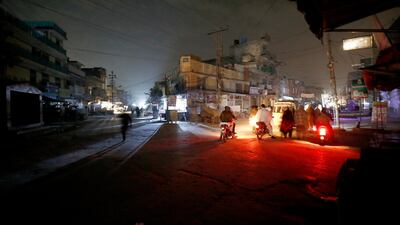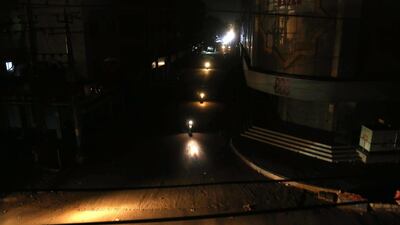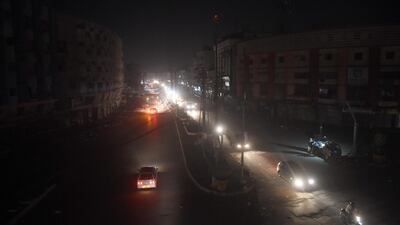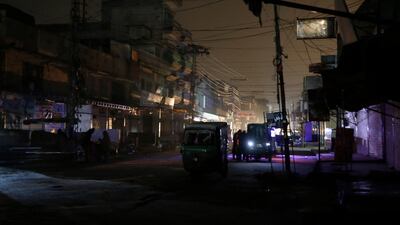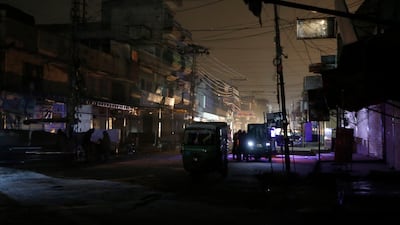
A dark street in Rawalpindi during a widespread power cut in Pakistan early on January 10, 2021. AP Photo

Pakistan hit by nationwide power cut


  • English
  • Arabic


Pakistan's worst power outage in several years plunged the country into darkness and led internet connectivity in the country to collapse.
An engineering fault in southern Pakistan shortly before midnight on Saturday tripped the country's grid and caused power plants to shut down across the country.

All of the country's major cities, including Karachi, Lahore, Peshawar and Islamabad, reported blackouts as the nation of more than 220 million was left largely without electricity.

  • People are silhouetted on vehicle headlights on a dark street during widespread power outages in Rawalpindi, Pakistan. Pakistan's national power grid experienced a major breakdown late night on Saturday, leaving millions of people in darkness, local media reported. AP Photo
    People are silhouetted on vehicle headlights on a dark street during widespread power outages in Rawalpindi, Pakistan. Pakistan's national power grid experienced a major breakdown late night on Saturday, leaving millions of people in darkness, local media reported. AP Photo
  • Motorists drive through a residential area during a power blackout in Pakistan's port city of Karachi. AFP
    Motorists drive through a residential area during a power blackout in Pakistan's port city of Karachi. AFP
  • The blackout after a fault developed in power transmission lines in Karachi, Pakistan. Pakistan was hit by a nationwide blackout when power failures were reported in all major cities. EPA
    The blackout after a fault developed in power transmission lines in Karachi, Pakistan. Pakistan was hit by a nationwide blackout when power failures were reported in all major cities. EPA
  • Motorists drive through a residential area during a power blackout in Pakistan's port city of Karachi. AFP
    Motorists drive through a residential area during a power blackout in Pakistan's port city of Karachi. AFP
  • Motorists drive through a residential area during a power blackout in Pakistan's port city of Karachi. AFP
    Motorists drive through a residential area during a power blackout in Pakistan's port city of Karachi. AFP
  • A motorcyclist rides through a residential area during a power blackout in Pakistan's port city of Karachi early. AFP
    A motorcyclist rides through a residential area during a power blackout in Pakistan's port city of Karachi early. AFP
  • A general view of the blackout after fault developed in power transmission lines in Karachi, Pakistan. Pakistan was hit by a nationwide blackout, when power failures were reported in all major cities. EPA
    A general view of the blackout after fault developed in power transmission lines in Karachi, Pakistan. Pakistan was hit by a nationwide blackout, when power failures were reported in all major cities. EPA
  • People and auto-rickshaws are silhouetted on vehicles headlights on a dark street during widespread power outages in Rawalpindi, Pakistan. AP Photo
    People and auto-rickshaws are silhouetted on vehicles headlights on a dark street during widespread power outages in Rawalpindi, Pakistan. AP Photo

Ghulam Mustafa, a labourer in Islamabad, said his entire neighbourhood had been plunged into darkness.

"I have spoken to family in Lahore and Multan, it is everywhere," he told The National. "We were used to this, but the power has been better. I pray for those who are in hospitals."

Engineers spent Sunday working on a phased restoration, as they brought power plants back online. Power in the capital, Islamabad, was quickly resumed and by the middle of the day, the government said supply had been partially restored in most areas of Punjab, as well as the economic hub Karachi in the south.
Netblockers, which monitors internet access, said the outage led connectivity to drop by nearly half as telecoms networks were affected.
"While not a total blackout, the disruption is consistent with a nation-scale power grid failure and is among the most severe such outages to strike the country in the observatory's records," the watchdog said.
There were no immediate reports of disruption at hospitals, which run back-up generators, and the overnight timing spared many businesses and factories.
The outage was caused by "an engineering fault" at 11.41pm on Saturday at the Guddu power plant in southern Sindh province, power minister Omar Ayub Khan told a press conference in Islamabad.

The fault triggered the shutdown of other power plants in seconds.

Mr Khan said the exact cause was still being investigated and he urged people to be patient as engineers fired up the main Tarbela power plant in the north-west, which would lead to a restoration of power in the rest of the country in phases.
Pakistan's once frequent power cuts and scheduled outages have become much less common in the past decade as Chinese investment has poured into the energy sector. Yet the country still comes in at 115 in a World Bank ranking of reliable electricity supplies, well below neighbouring India at 80 and Bangladesh at 101.
A delicate and interlinked grid system can see a problem in one part of the country cascade into breakdowns elsewhere.
The last major outage, in May 2018, saw the power supply partially disrupted for more than nine hours. Three years earlier, an apparent rebel attack on a key power line plunged about 80 per cent of Pakistan into darkness. That blackout was one of the worst in Pakistan's history and caused electricity to be cut in major cities nationwide.

Promises to fix Pakistan's electricity woes were a major part of the winning election platform of the Pakistan Muslim League (Nawaz) party in 2013. Power plants have been one of the cornerstones of Chinese investment in Pakistan under Beijing's Belt and Road initiative and several new coal-fired plants quickly added to Pakistan's generating capacity.

Yet the power grid still remains dilapidated. The World Bank estimates some 71 per cent of Pakistanis have access to electricity, compared with 95 per cent in India and 85 per cent in Bangladesh.


Bridgerton%20season%20three%20-%20part%20one
%3Cp%3E%3Cstrong%3EDirectors%3A%20%3C%2Fstrong%3EVarious%3C%2Fp%3E%0A%3Cp%3E%3Cstrong%3EStarring%3A%3C%2Fstrong%3E%20Nicola%20Coughlan%2C%20Luke%20Newton%2C%20Jonathan%20Bailey%3C%2Fp%3E%0A%3Cp%3E%3Cstrong%3ERating%3A%20%3C%2Fstrong%3E3%2F5%3C%2Fp%3E%0A
Our family matters legal consultant

Name: Hassan Mohsen Elhais

Position: legal consultant with Al Rowaad Advocates and Legal Consultants.

The%20specs
%3Cp%3E%3Cstrong%3EEngine%3A%3C%2Fstrong%3E%201.8-litre%204-cyl%20turbo%0D%3Cbr%3E%3Cstrong%3EPower%3A%20%3C%2Fstrong%3E190hp%20at%205%2C200rpm%0D%3Cbr%3E%3Cstrong%3ETorque%3A%3C%2Fstrong%3E%20320Nm%20from%201%2C800-5%2C000rpm%0D%3Cbr%3E%3Cstrong%3ETransmission%3A%20%3C%2Fstrong%3ESeven-speed%20dual-clutch%20auto%0D%3Cbr%3E%3Cstrong%3EFuel%20consumption%3A%3C%2Fstrong%3E%206.7L%2F100km%0D%3Cbr%3E%3Cstrong%3EPrice%3A%3C%2Fstrong%3E%20From%20Dh111%2C195%0D%3Cbr%3E%3Cstrong%3EOn%20sale%3A%20%3C%2Fstrong%3ENow%3C%2Fp%3E%0A
First-round leaderbaord

-5 C Conners (Can)

-3 B Koepka (US), K Bradley (US), V Hovland (Nor), A Wise (US), S Horsfield (Eng), C Davis (Aus);

-2 C Morikawa (US), M Laird (Sco), C Tringale (US)

Selected others: -1 P Casey (Eng), R Fowler (US), T Hatton (Eng)

Level B DeChambeau (US), J Rose (Eng) 

1 L Westwood (Eng), J Spieth (US)

3 R McIlroy (NI)

4 D Johnson (US)

Key recommendations
  • Fewer criminals put behind bars and more to serve sentences in the community, with short sentences scrapped and many inmates released earlier.
  • Greater use of curfews and exclusion zones to deliver tougher supervision than ever on criminals.
  • Explore wider powers for judges to punish offenders by blocking them from attending football matches, banning them from driving or travelling abroad through an expansion of ‘ancillary orders’.
  • More Intensive Supervision Courts to tackle the root causes of crime such as alcohol and drug abuse – forcing repeat offenders to take part in tough treatment programmes or face prison.
Japan 30-10 Russia

Tries: Matsushima (3), Labuschange | Golosnitsky

Conversions: Tamura, Matsuda | Kushnarev

Penalties: Tamura (2) | Kushnarev

Tips for newlyweds to better manage finances

All couples are unique and have to create a financial blueprint that is most suitable for their relationship, says Vijay Valecha, chief investment officer at Century Financial. He offers his top five tips for couples to better manage their finances.

Discuss your assets and debts: When married, it’s important to understand each other’s personal financial situation. It’s necessary to know upfront what each party brings to the table, as debts and assets affect spending habits and joint loan qualifications. Discussing all aspects of their finances as a couple prevents anyone from being blindsided later.

Decide on the financial/saving goals: Spouses should independently list their top goals and share their lists with one another to shape a joint plan. Writing down clear goals will help them determine how much to save each month, how much to put aside for short-term goals, and how they will reach their long-term financial goals.

Set a budget: A budget can keep the couple be mindful of their income and expenses. With a monthly budget, couples will know exactly how much they can spend in a category each month, how much they have to work with and what spending areas need to be evaluated.

Decide who manages what: When it comes to handling finances, it’s a good idea to decide who manages what. For example, one person might take on the day-to-day bills, while the other tackles long-term investments and retirement plans.

Money date nights: Talking about money should be a healthy, ongoing conversation and couples should not wait for something to go wrong. They should set time aside every month to talk about future financial decisions and see the progress they’ve made together towards accomplishing their goals.