


Two states in southern India became the latest to declare coronavirus lockdowns as the experts warned that conditions were ripe for a repeat of the tragic scenes seen in other parts of the country, where a surge in cases left hospitals unable to cope with the demand for beds, medicines and oxygen.
Bengaluru, the capital of Karnataka state, has the highest active caseload of any Indian city with more than 300,000 and is already buckling under oxygen shortages, overrun hospitals and crowded crematoriums.
Karnataka and neighbouring Tamil Nadu state both declared lockdowns from May 10 to 24 on Friday. In Tamil Nadu, the lockdown announcement followed a daily record of more than 26,000 cases.
Infections have swelled in India since February in a disastrous turn blamed on more contagious variants as well as government decisions to allow massive crowds to gather for religious festivals and political rallies.
On Saturday, India reported 401,078 confirmed cases, including a record high of 4,187 deaths. Overall, India has more than 21.8 million confirmed infections and nearly 240,000 deaths. Experts say even those dramatic tolls are undercounts.
-
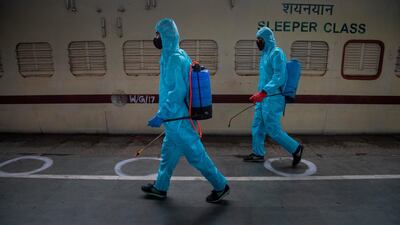
Health workers disinfect a train converted to a Covid-19 care centre after a surge in the number of positive coronavirus cases in Guwahati, India. AP -
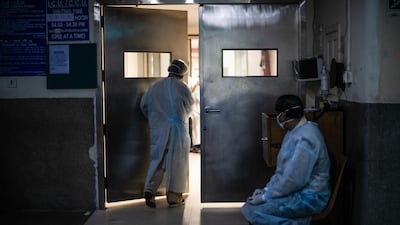
A worker caring for Covid-19 patients takes a break in the ICU ward at the Holy Family hospital in New Delhi, India. Getty -
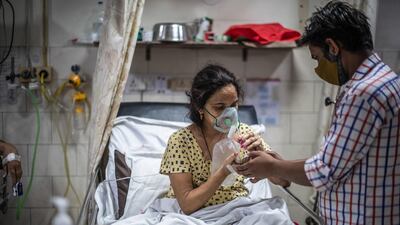
A worker attends to a patient in the emergency ward at the Holy Family hospital. Getty -
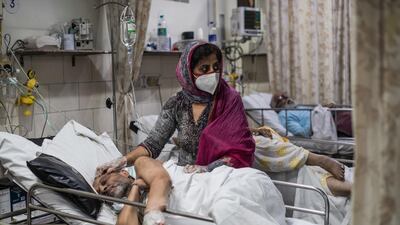
Covid-19 patients in the emergency ward at the Holy Family hospital. Getty -
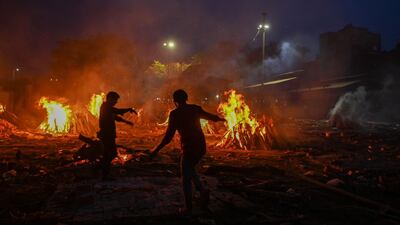
Volunteers help with the funeral pyres at a cremation ground in New Delhi. The capital's crematoriums and burial grounds have been overwhelmed during the second wave of the pandemic. AFP -
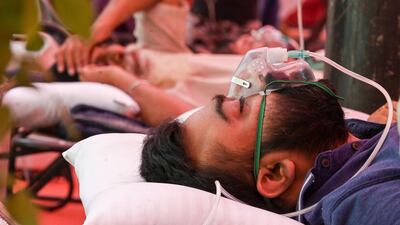
A Covid-19 patient breathes with the help of oxygen provided by a gurdwara, a place of worship for Sikhs. The tent along the roadside in Ghaziabad is helping people who need oxygen support. AFP -
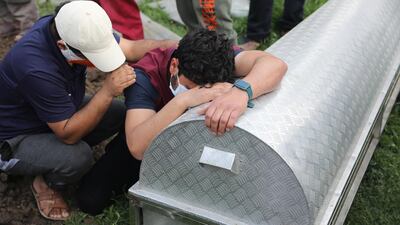
Kashmiris mourn over the coffin of a relative who died of Covid-19 at a graveyard on the outskirts of Srinagar. EPA -

Urns containing ashes of dead people, including those who died of Covid-19. The urns are kept at a crematorium in New Delhi and will be immersed after the lockdown. Reuters -
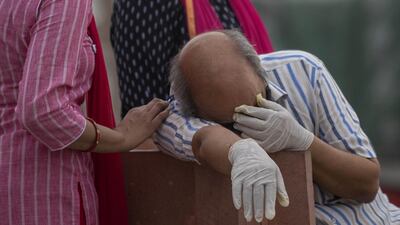
A distraught relative of a coronavirus victim at a cremation ground on the banks of the River Ganges at Garhmukteshwar in the northern state of Uttar Pradesh. Reuters -
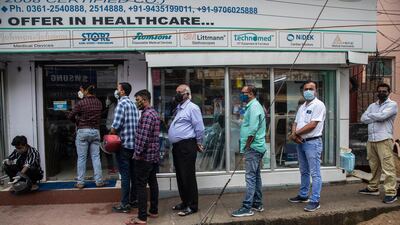
Masked customers line up outside a pharmacy to buy medicines in Guwahati. AP -
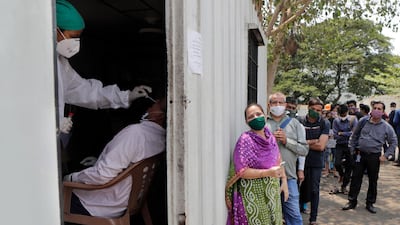
A health worker takes a nasal swab sample to test for Covid-19 as others wait their turn outside a field hospital in Mumbai. AP -
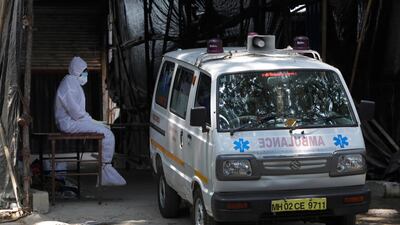
A health worker takes a break outside a field hospital in Mumbai, India. AP
One doctor in Bengaluru said he had to reject patients “left, right and center” as his hospital struggled to find more oxygen.
“The problem is the demand is so high that we need constant oxygen,” said Sanjay Gururaj, the medical director at Shanti Hospital and Research Centre. The hospital is sending a truck twice a day to oxygen plants on the outskirts of the city to bring back 12 jumbo oxygen cylinders. “In normal times, this would have lasted over two weeks — now, it lasts just over a day.”
Murad Banaji, mathematician
The state’s oxygen shortages prompted the high court on Wednesday to order the federal government to increase the daily liquid medical oxygen supplied to Karnataka. The ruling came after 24 virus patients died in a government hospital on Monday. It was not clear how many of them died due to the lack of oxygen, but an investigation is ongoing.
India's Prime Minister Narendra Modi has so far left the responsibility for fighting the virus in this current surge to poorly equipped state governments, and faced accusations of doing too little. His government has yet to impose a national lockdown as it did during its first wave last year, but around half of all Indian states have imposed a total shutdown. The rest are under a partial shutdown.
The government says it is doing everything it can amid a “once-in-a-century crisis”. Meanwhile, many medical experts, opposition leaders and even Supreme Court judges are calling for national restrictions, arguing that a patchwork of state rules is insufficient to quell the rise in infections.
Experts caution that the surge in Bengaluru is fast eclipsing other hard-hit cities like the capital, New Delhi, and Mumbai. Cases have increased 100-fold since February, said Murad Banaji, a mathematician modelling Covid-19 growth in India, citing official data. Test positivity has jumped to more 30 per cent, which indicates the infection is much more widespread than confirmed figures, he said.
“Disaster was looming by early March, when cases started to shoot up,” he said. “Bangalore is more than a ticking time bomb right now — it is in the middle of an explosion.” Bengaluru was previously known as Bangalore.
Much of the focus in recent weeks has been on northern India, led by New Delhi, where television stations have broadcast images of patients lying on stretchers outside hospitals and of mass funeral pyres that burn throughout the night.
The situation unfurling in Karnataka has thrown attention to other southern states also battling a rise in cases. Daily cases have breached the 20,000 mark for the past three days in Andhra Pradesh state, leading to new restrictions there.
Kerala, which emerged as a blueprint for tackling the pandemic last year, began a lockdown on Saturday. With daily cases crossing 40,000, the state is aggressively boosting resources, including converting hundreds of industrial oxygen cylinders into medical oxygen, said Amar Fetle, the state’s officer for Covid-19.
“The magnitude of cases from last year to now is vastly different,” Dr Fetle said.
Increasing numbers have meant more hospitalisations and more strain on health care systems, with hospitals running nearly full. “It’s become a race between occupancy and how fast we can add beds. We’re trying to stay ahead of the virus as best as we can,” he said.
It is clear infections are rapidly rising across the southern region, but there has been “less visible outcry” than in the north because of relatively better health infrastructure and government initiatives that address problems at the community level, said Jacob John, professor of community medicine at Christian Medical College, Vellore.
But while the virus has ripped through large cities in waves, smaller towns and villages where health care is less accessible are now exposed.
“These places are quickly getting affected, which means we may not have sustained the worst yet in south India,” he said.

