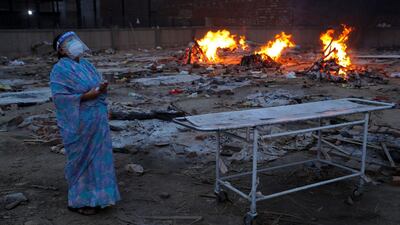
Crematoriums in India are using cow-dung cakes and crop residue to perform the last rites for thousands of Covid-19 victims as the scale of the rising death toll causes a severe shortage of firewood.
More than 60,000 people have died since late March in the Hindu-majority nation of 1.3 billion, as a surge of coronavirus infections overwhelmed hospitals and crematoriums.
"The situation is so dire in the city that the [number of] cremations that would take place in a week are occurring on a single day now," Nirmal Jain, mayor of East Delhi, told The National.
India is reporting record-breaking numbers of infections and fatalities, with daily confirmed cases hitting more than 412,000 – a global record – and deaths nearing 4,000 on Thursday alone. A total of 230,000 Covid-related deaths have been registered by the government since the pandemic began.
Health experts and crematorium managers, however, say the actual cases and fatalities could be 10 times those of official figures, given the limited access to testing.
Many crematoriums are operating round the clock and some were extended into car parks, public parks and on to pavements when they ran out of space.
This includes those in the capital, New Delhi, one of the regions worst hit by the surge.
The situation was equally grim at Muslim graveyards. Delhi’s largest Muslim cemetery closed this week after running out of space.
New Delhi alone officially reported more than 5,000 deaths in April.
The surge in fatalities caused a shortage of firewood, forcing authorities to look for alternative fuels to help families perform the last rites for pandemic victims.
Two civic bodies in the city of 20 million said on Tuesday they were installing machines at government cowsheds to produce dung and crop-stubble cakes for use as fuel.
“To not put pressure on wood, we have suggested the use of cow-dung cakes and some crematoriums are using cow-dung cakes for the funerals,” Mr Jain said.
Nearly 80 per cent of India’s population are Hindu, and most of them perform cremations as last rites, as do several of India’s religious minorities including Sikhs, Buddhists and Jains.
As per Hindu tradition, each cremation requires 1,500 kilograms of firewood and other essentials, usually provided by the crematoriums.
The shortage of wood is fuelling a black market and price increases as families search for hours to collect enough logs.
Some families were forced to shell out 10 times the usual cost of firewood as demand increased.
Cities including Surat in western Gujarat state turned to mass pyres to cremate dozens of bodies at a time to deal with the shortage of wood and space. Authorities there are now using sugarcane bagasse to fuel funeral pyres. The dried sugar cane pulp is stuffed between the logs before they are set alight.
Surat hit the international news after the metal parts of crematorium furnaces melted in the heat of constant fires and the city was forced to reopen several defunct crematoriums to handle demand.
In the Hindu holy city of Varanasi, known for endless cremation spots on the banks of the River Ganges, the price of pyre wood soared from 400 rupees ($5.43) for about 100kg to 4,000 rupees ($54.30).
In Garhmukteshwar in Uttar Pradesh, another major site for Hindu cremations on the banks of the Ganges, the firewood demand made distributors double their prices, but sellers say they are reluctant to pass that on to grieving customers.
“Earlier we bought wood for 400 rupees per quintal [100kg]. Now we are buying it for 650 rupees from the suppliers but we can’t sell it for a higher price to the families. We don’t want to trouble them at a time like this,” Mahesh Kumar said.

Islamophobia definition
A widely accepted definition was made by the All Party Parliamentary Group on British Muslims in 2019: “Islamophobia is rooted in racism and is a type of racism that targets expressions of Muslimness or perceived Muslimness.” It further defines it as “inciting hatred or violence against Muslims”.
JERSEY INFO
Red Jersey
General Classification: worn daily, starting from Stage 2, by the leader of the General Classification by time.
Green Jersey
Points Classification: worn daily, starting from Stage 2, by the fastest sprinter, who has obtained the best positions in each stage and intermediate sprints.
White Jersey
Young Rider Classification: worn daily, starting from Stage 2, by the best young rider born after January 1, 1995 in the overall classification by time (U25).
Black Jersey
Intermediate Sprint Classification: worn daily, starting from Stage 2, by the rider who has gained the most Intermediate Sprint Points.
Mercer, the investment consulting arm of US services company Marsh & McLennan, expects its wealth division to at least double its assets under management (AUM) in the Middle East as wealth in the region continues to grow despite economic headwinds, a company official said.
Mercer Wealth, which globally has $160 billion in AUM, plans to boost its AUM in the region to $2-$3bn in the next 2-3 years from the present $1bn, said Yasir AbuShaban, a Dubai-based principal with Mercer Wealth.
“Within the next two to three years, we are looking at reaching $2 to $3 billion as a conservative estimate and we do see an opportunity to do so,” said Mr AbuShaban.
Mercer does not directly make investments, but allocates clients’ money they have discretion to, to professional asset managers. They also provide advice to clients.
“We have buying power. We can negotiate on their (client’s) behalf with asset managers to provide them lower fees than they otherwise would have to get on their own,” he added.
Mercer Wealth’s clients include sovereign wealth funds, family offices, and insurance companies among others.
From its office in Dubai, Mercer also looks after Africa, India and Turkey, where they also see opportunity for growth.
Wealth creation in Middle East and Africa (MEA) grew 8.5 per cent to $8.1 trillion last year from $7.5tn in 2015, higher than last year’s global average of 6 per cent and the second-highest growth in a region after Asia-Pacific which grew 9.9 per cent, according to consultancy Boston Consulting Group (BCG). In the region, where wealth grew just 1.9 per cent in 2015 compared with 2014, a pickup in oil prices has helped in wealth generation.
BCG is forecasting MEA wealth will rise to $12tn by 2021, growing at an annual average of 8 per cent.
Drivers of wealth generation in the region will be split evenly between new wealth creation and growth of performance of existing assets, according to BCG.
Another general trend in the region is clients’ looking for a comprehensive approach to investing, according to Mr AbuShaban.
“Institutional investors or some of the families are seeing a slowdown in the available capital they have to invest and in that sense they are looking at optimizing the way they manage their portfolios and making sure they are not investing haphazardly and different parts of their investment are working together,” said Mr AbuShaban.
Some clients also have a higher appetite for risk, given the low interest-rate environment that does not provide enough yield for some institutional investors. These clients are keen to invest in illiquid assets, such as private equity and infrastructure.
“What we have seen is a desire for higher returns in what has been a low-return environment specifically in various fixed income or bonds,” he said.
“In this environment, we have seen a de facto increase in the risk that clients are taking in things like illiquid investments, private equity investments, infrastructure and private debt, those kind of investments were higher illiquidity results in incrementally higher returns.”
The Abu Dhabi Investment Authority, one of the largest sovereign wealth funds, said in its 2016 report that has gradually increased its exposure in direct private equity and private credit transactions, mainly in Asian markets and especially in China and India. The authority’s private equity department focused on structured equities owing to “their defensive characteristics.”
KILLING OF QASSEM SULEIMANI
COMPANY PROFILE
Name: Lamsa
Founder: Badr Ward
Launched: 2014
Employees: 60
Based: Abu Dhabi
Sector: EdTech
Funding to date: $15 million
UPI facts
More than 2.2 million Indian tourists arrived in UAE in 2023
More than 3.5 million Indians reside in UAE
Indian tourists can make purchases in UAE using rupee accounts in India through QR-code-based UPI real-time payment systems
Indian residents in UAE can use their non-resident NRO and NRE accounts held in Indian banks linked to a UAE mobile number for UPI transactions
The specs: Lamborghini Aventador SVJ
Price, base: Dh1,731,672
Engine: 6.5-litre V12
Gearbox: Seven-speed automatic
Power: 770hp @ 8,500rpm
Torque: 720Nm @ 6,750rpm
Fuel economy: 19.6L / 100km
