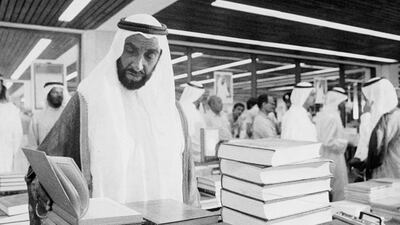
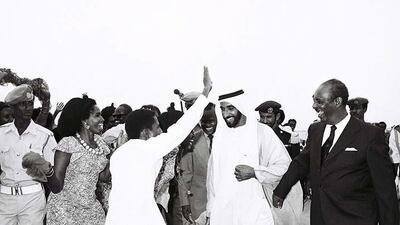
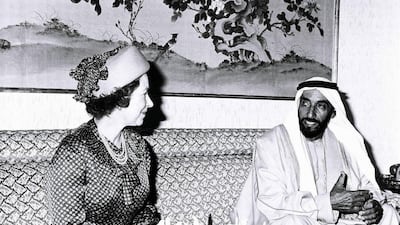
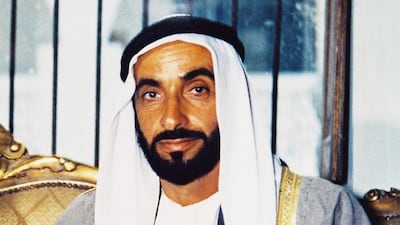
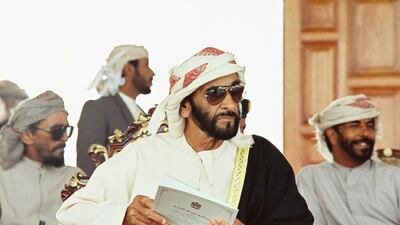
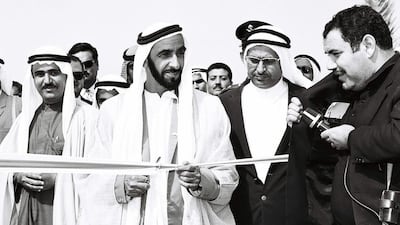
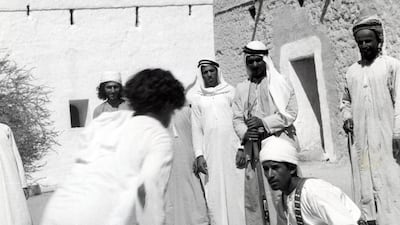
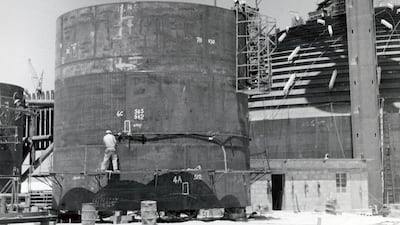
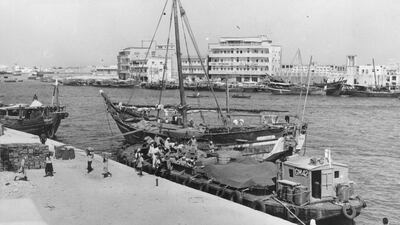
When Sheikh Zayed sought to build the UAE in 1971, the scale of the task was immense. And one of his biggest challenges was to unite the Bedouin.
It took a man such as Sheikh Zayed to convince tribes to abandon decades of nomadic living, commit to belonging to one place and believe in the dream of the UAE.
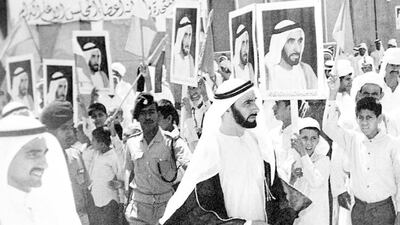
Although most had barely spoken to him, the first President of the UAE was such a formidable force that his ideas were enough to bring together camel herders, pearl divers and so many more from all corners of the emirates.
He built houses for them, schools to educate their children and hospitals to treat their sick.
Although few could read and write and many were set in their ways, they believed in him.
He was younger than most of them but his strength of leadership made him known as Baba Zayed.
To mark the UAE's 49th National Day, and as the country enters its 50th year, The National interviewed six people who lived through those days of change.
When the union was founded, Rashid Al Mazrouei, 62, was about 12 years old.
A report crackled over the radio saying there was a big meeting between the sheikhs.
Although Mr Al Mazrouei did not realise it at the time, that meeting in a tent would reshape his life and his country.
“I remember it but we were not as aware as today," he says. "We had a radio and I would hear the speeches of [Egyptian president] Anwar Al Sadat so we knew the events, but we were young and didn’t really pay much attention."
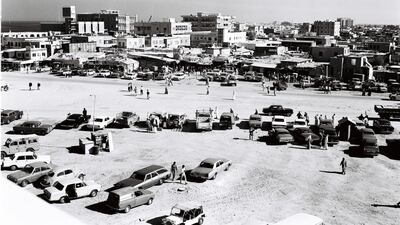
We lived in tents and we would bring water on donkeys from wells to the house. We studied by lantern or under the moonlight because there was no electricity
Born in the desert in the Northern Emirates, Mr Al Mazrouei was raised in the Sharjah oasis. Houses were primitive before union, and there was no electricity or running water when he was a child. It seemed as if things would never change.
“We use to live in houses made of palm fronds. We would go to wells to get water," he says.
“We lived in tents and we would bring water on donkeys from wells to the house. We had our palm trees, our dates and water. Our oasis was considered a city and people came to us.”
Such were the times of his father and ancestors.
“I remember when I was in primary school, we would study by lantern or under the moonlight because there was no electricity. We would walk to school six kilometres away.
“It was difficult but it was beautiful. At the time, this was as good as they thought it would get.”
But unification was going to change all this.
"We had roads and the number of schools increased. We had hospitals and clinics.
"Since then, we felt that we were invincible and would reach to the highest places. Sheikh Zayed built the foundations and we are not surprised by the developments, whether it is going to Mars or reaching first place in everything."
He was one of the first Emiratis who studied abroad in the 1980s.
“After I returned, I worked in the Ministry of Education as the head of the educational sector. Then I joined the Ministry of Foreign Affairs and spent eight years abroad before joining the Emirates Heritage Club where I remained until I retired in 2017."
In later years, he moved from Sharjah to Abu Dhabi and, reflecting on 1971, he says unification brought everyone together.
"We have one currency and one flag. Now if you go to any region in the UAE you will see developments and villas. Before they used to live in tents.”
Mr Al Mazrouei once met Sheikh Zayed when they shook hands at an event.
“It was the closing festival of school activities. All the heads of education zones we lined up and shook his hand.”
Mr Al Mazrouei misses the old times, and while he welcomes progress, there are some aspects of life that he hoped would never change.
“I do miss the peaceful life. We were alone and when we went anywhere. The cities were simple. People welcomed you.
“My message to all on National Day is that we should love our country. Many of our youth don’t know our traditional proverbs, and I've asked for it to be included in national curriculums. The most important is to learn and continue our education and hold on to our identity, which is based on our traditions and our heritage."
______________
Sheikh Zayed and the story of a nation
Abu Dhabi traffic facts
Drivers in Abu Dhabi spend 10 per cent longer in congested conditions than they would on a free-flowing road
The highest volume of traffic on the roads is found between 7am and 8am on a Sunday.
Travelling before 7am on a Sunday could save up to four hours per year on a 30-minute commute.
The day was the least congestion in Abu Dhabi in 2019 was Tuesday, August 13.
The highest levels of traffic were found on Sunday, November 10.
Drivers in Abu Dhabi lost 41 hours spent in traffic jams in rush hour during 2019
Mercer, the investment consulting arm of US services company Marsh & McLennan, expects its wealth division to at least double its assets under management (AUM) in the Middle East as wealth in the region continues to grow despite economic headwinds, a company official said.
Mercer Wealth, which globally has $160 billion in AUM, plans to boost its AUM in the region to $2-$3bn in the next 2-3 years from the present $1bn, said Yasir AbuShaban, a Dubai-based principal with Mercer Wealth.
“Within the next two to three years, we are looking at reaching $2 to $3 billion as a conservative estimate and we do see an opportunity to do so,” said Mr AbuShaban.
Mercer does not directly make investments, but allocates clients’ money they have discretion to, to professional asset managers. They also provide advice to clients.
“We have buying power. We can negotiate on their (client’s) behalf with asset managers to provide them lower fees than they otherwise would have to get on their own,” he added.
Mercer Wealth’s clients include sovereign wealth funds, family offices, and insurance companies among others.
From its office in Dubai, Mercer also looks after Africa, India and Turkey, where they also see opportunity for growth.
Wealth creation in Middle East and Africa (MEA) grew 8.5 per cent to $8.1 trillion last year from $7.5tn in 2015, higher than last year’s global average of 6 per cent and the second-highest growth in a region after Asia-Pacific which grew 9.9 per cent, according to consultancy Boston Consulting Group (BCG). In the region, where wealth grew just 1.9 per cent in 2015 compared with 2014, a pickup in oil prices has helped in wealth generation.
BCG is forecasting MEA wealth will rise to $12tn by 2021, growing at an annual average of 8 per cent.
Drivers of wealth generation in the region will be split evenly between new wealth creation and growth of performance of existing assets, according to BCG.
Another general trend in the region is clients’ looking for a comprehensive approach to investing, according to Mr AbuShaban.
“Institutional investors or some of the families are seeing a slowdown in the available capital they have to invest and in that sense they are looking at optimizing the way they manage their portfolios and making sure they are not investing haphazardly and different parts of their investment are working together,” said Mr AbuShaban.
Some clients also have a higher appetite for risk, given the low interest-rate environment that does not provide enough yield for some institutional investors. These clients are keen to invest in illiquid assets, such as private equity and infrastructure.
“What we have seen is a desire for higher returns in what has been a low-return environment specifically in various fixed income or bonds,” he said.
“In this environment, we have seen a de facto increase in the risk that clients are taking in things like illiquid investments, private equity investments, infrastructure and private debt, those kind of investments were higher illiquidity results in incrementally higher returns.”
The Abu Dhabi Investment Authority, one of the largest sovereign wealth funds, said in its 2016 report that has gradually increased its exposure in direct private equity and private credit transactions, mainly in Asian markets and especially in China and India. The authority’s private equity department focused on structured equities owing to “their defensive characteristics.”
Friday's schedule in Madrid
Men's quarter-finals
Novak Djokivic (1) v Marin Cilic (9) from 2pm UAE time
Roger Federer (4) v Dominic Thiem (5) from 7pm
Stefanos Tsitsipas (8) v Alexander Zverev (3) from 9.30pm
Stan Wawrinka v Rafael Nadal (2) from 11.30pm
Women's semi-finals
Belinda Bencic v Simona Halep (3) from 4.30pm
Sloane Stephens (8) v Kiki Bertens (7) from 10pm
How to get exposure to gold
Although you can buy gold easily on the Dubai markets, the problem with buying physical bars, coins or jewellery is that you then have storage, security and insurance issues.
A far easier option is to invest in a low-cost exchange traded fund (ETF) that invests in the precious metal instead, for example, ETFS Physical Gold (PHAU) and iShares Physical Gold (SGLN) both track physical gold. The VanEck Vectors Gold Miners ETF invests directly in mining companies.
Alternatively, BlackRock Gold & General seeks to achieve long-term capital growth primarily through an actively managed portfolio of gold mining, commodity and precious-metal related shares. Its largest portfolio holdings include gold miners Newcrest Mining, Barrick Gold Corp, Agnico Eagle Mines and the NewMont Goldcorp.
Brave investors could take on the added risk of buying individual gold mining stocks, many of which have performed wonderfully well lately.
London-listed Centamin is up more than 70 per cent in just three months, although in a sign of its volatility, it is down 5 per cent on two years ago. Trans-Siberian Gold, listed on London's alternative investment market (AIM) for small stocks, has seen its share price almost quadruple from 34p to 124p over the same period, but do not assume this kind of runaway growth can continue for long
However, buying individual equities like these is highly risky, as their share prices can crash just as quickly, which isn't what what you want from a supposedly safe haven.
Bullet%20Train
%3Cp%3E%3Cstrong%3EDirector%3A%3C%2Fstrong%3E%20David%20Leitch%3Cbr%3E%3Cstrong%3EStars%3A%3C%2Fstrong%3E%20Brad%20Pitt%2C%20Aaron%20Taylor-Johnson%2C%20Brian%20Tyree%20Henry%2C%20Sandra%20Bullock%3Cbr%3E%3Cstrong%3ERating%3A%3C%2Fstrong%3E%203%2F5%3C%2Fp%3E%0A
Our family matters legal consultant
Name: Hassan Mohsen Elhais
Position: legal consultant with Al Rowaad Advocates and Legal Consultants.
Tori Amos
Native Invader
Decca
Small Victories: The True Story of Faith No More by Adrian Harte
Jawbone Press
Take Me Apart
Kelela
(Warp)
The%20new%20Turing%20Test
%3Cp%3EThe%20Coffee%20Test%3C%2Fp%3E%0A%3Cp%3E%3Cem%3EA%20machine%20is%20required%20to%20enter%20an%20average%20American%20home%20and%20figure%20out%20how%20to%20make%20coffee%3A%20find%20the%20coffee%20machine%2C%20find%20the%20coffee%2C%20add%20water%2C%20find%20a%20mug%20and%20brew%20the%20coffee%20by%20pushing%20the%20proper%20buttons.%3C%2Fem%3E%3C%2Fp%3E%0A%3Cp%3EProposed%20by%20Steve%20Wozniak%2C%20Apple%20co-founder%3C%2Fp%3E%0A
From Zero
Artist: Linkin Park
Label: Warner Records
Number of tracks: 11
Rating: 4/5
UAE currency: the story behind the money in your pockets
The National's picks
4.35pm: Tilal Al Khalediah
5.10pm: Continous
5.45pm: Raging Torrent
6.20pm: West Acre
7pm: Flood Zone
7.40pm: Straight No Chaser
8.15pm: Romantic Warrior
8.50pm: Calandogan
9.30pm: Forever Young
The biog
Favourite films: Casablanca and Lawrence of Arabia
Favourite books: Start with Why by Simon Sinek and Good to be Great by Jim Collins
Favourite dish: Grilled fish
Inspiration: Sheikh Zayed's visionary leadership taught me to embrace new challenges.
Dubai Bling season three
Cast: Loujain Adada, Zeina Khoury, Farhana Bodi, Ebraheem Al Samadi, Mona Kattan, and couples Safa & Fahad Siddiqui and DJ Bliss & Danya Mohammed
Rating: 1/5
Israel Palestine on Swedish TV 1958-1989
Director: Goran Hugo Olsson
Rating: 5/5
Key facilities
- Olympic-size swimming pool with a split bulkhead for multi-use configurations, including water polo and 50m/25m training lanes
- Premier League-standard football pitch
- 400m Olympic running track
- NBA-spec basketball court with auditorium
- 600-seat auditorium
- Spaces for historical and cultural exploration
- An elevated football field that doubles as a helipad
- Specialist robotics and science laboratories
- AR and VR-enabled learning centres
- Disruption Lab and Research Centre for developing entrepreneurial skills
Favourite things
Luxury: Enjoys window shopping for high-end bags and jewellery
Discount: She works in luxury retail, but is careful about spending, waits for sales, festivals and only buys on discount
University: The only person in her family to go to college, Jiang secured a bachelor’s degree in business management in China
Masters: Studying part-time for a master’s degree in international business marketing in Dubai
Vacation: Heads back home to see family in China
Community work: Member of the Chinese Business Women’s Association of the UAE to encourage other women entrepreneurs