


When Sheikh Zayed, the Founding Father, sought to unite the emirates in 1971, the scale of the task was immense.
One of his biggest challenges was to unite the Bedouins and it took a man such as Sheikh Zayed to convince the tribes to abandon decades of nomadic living, commit to belonging to one place and believe in the dream of the UAE.
Although most had barely spoken to him, the first President of the UAE was such a formidable force that his ideas were enough to bring together camel herders, pearl divers and so many more from all corners of the emirates.
He built houses for them, schools to educate their children and hospitals to treat their sick.
Although many could barely read or write and were so set in their ways, they believed in a man they barely knew.
He was younger than most of them but his strength of leadership made him instantly known as "Baba Zayed". To mark the UAE's 49th National Day, and as the country enters its 50th year, The National interviewed six people who lived through these days of change.
Mohamed Al Mazrouei, 47, witnessed these rapid developments, having been born a few years after the union.
Mr Al Mazrouei, whose father, Buti Al Mazrouei, once worked as a pearl diver, heard first-hand about the difficult times before the union.
But then came change, led by Sheikh Zayed, that brought roads, hospitals and schools.
“We lived in the beginning of the union and saw the change from National Day to present times," Mohamed Al Mazrouei says.
"Maybe we struggled to learn in the beginning but now I am studying for a master's and a PhD.
"I was born in the seventies. I saw my brothers ahead of me and saw the development."
Mr Al Mazrouei recalls that life in the past was a circle based on trade and mutual benefit. Everyone helped each other.
"It was a circle between people who lived on the coast and those in the desert. Each complemented the other and depended on the other," he says.
"The divers rarely found enough [people] so they used to ask for assistance from the people of the desert. The Bedouins would come to them and offer their services.
"The divers went out to sea for four months in the summer. Those who were left behind would take their families and stay at the oases in Liwa and Al Ain.
“After that they would all move back to the desert to live off the dates they collected while at the oasis. The winter was spent in the desert with the sheep and camels.”
Bedouins moved around according to the season. Hotter months were spent near the oasis where there was water, shade and less humidity than on the coast.
“During this period they needed hay to feed their cattle so they would buy it at the city, which is what they called the Al Ain oasis," he says.
"They would exchange whatever they had for rice, flour, sugar and other food they needed.
“It was a circulation. The people of the sea didn’t have wood so they would buy it from the Bedouins. There were markets on the coast and on the oasis.
"The traders would get their things from India. So basically those who returned from sea would sell their pearls to the traders who would go on to resell the pearls to a bigger trader.

“When they sell it in India, it wasn’t the Indians who bought these pearls, it was sold to the British colonisers in India."
The discovery of Japanese pearls and the coming of oil changed these old ways.
“We went from a level of prosperity to another level until it reached where we are today at the forefront of countries around the world. This goes back to first God and Zayed and his children and their wise leadership," he says.
Mr Al Mazrouei says bringing the tribes together and establishing schools is Sheikh Zayed's legacy.
“Sheikh Zayed was social and loved the Bedouins; he would sit among them and joke with them. There was a brotherhood between them and he wanted to gather the tribes from the desert," he says.
"He knew it was a struggle to educate the elderly so he opened schools for the young. He believed that a country would not develop without schools and proper health care.
"In video and archive photos you will see pictures of parents studying alongside their children. He would give salaries to students and clothes."
_________________
Sheikh Zayed and the story of a nation
-
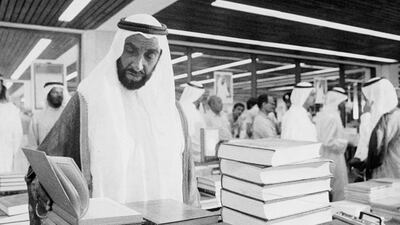
Sheikh Zayed, seen here attending an early book fair in Abu Dhabi. Courtesy: Al Ittihad -
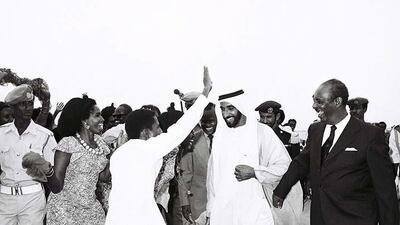
The true genius of a culture and a society lay, Sheikh Zayed believed, in their capacity to adopt and thrive in a changing world. Courtesy: Al Ittihad -

Sheikh Zayed raising the flag at Union House in Dubai. December 2, 1971. Courtesy: Al Ittihad -

Sheikh Zayed attending the first UAE National Day celebrations on December 2, 1972. Courtesy: Al Ittihad -

Sheikh Zayed attending the first session of the National Consultative Council in Abu Dhabi in October 1971. Courtesy: Al Ittihad -
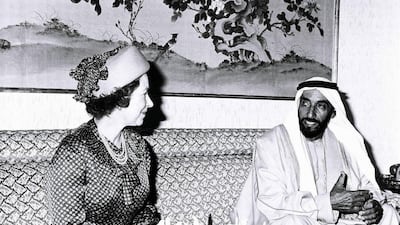
Sheikh Zayed meets Queen Elizabeth II during a state visit 40 years ago. Courtesy: Al Ittihad -
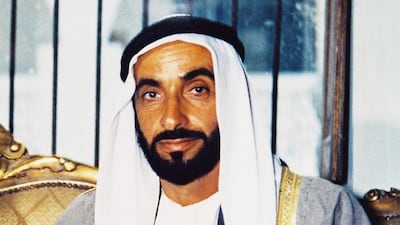
Sheikh Zayed, the founding father of the UAE. Courtesy: Al Ittihad -
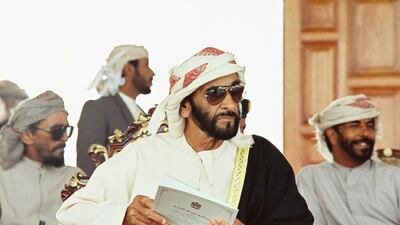
Sheikh Zayed was a man of the people. Courtesy: Al Ittihad -
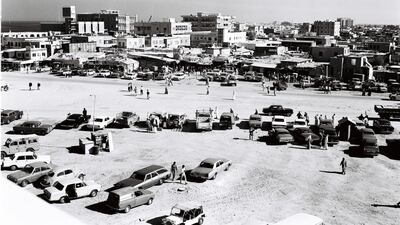
The old souq in Abu Dhabi shot at some point in the 1970s. Courtesy Al Ittihad -
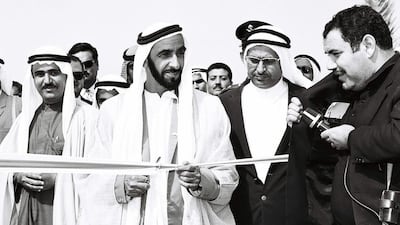
Sheikh Zayed's leadership is not just remembered for all that he built, but for all he did for others. Courtesy: Al Ittihad -
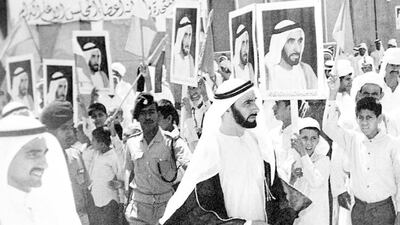
Sheikh Zayed walking past supporters Fujairah during his in January 1972. Wam -
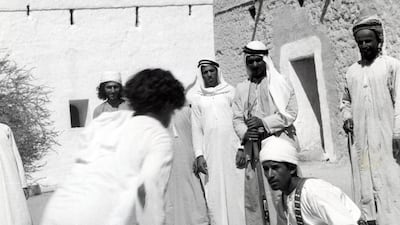
Men dance while holding khanjars in Al Ain, 1959. Getty Images -
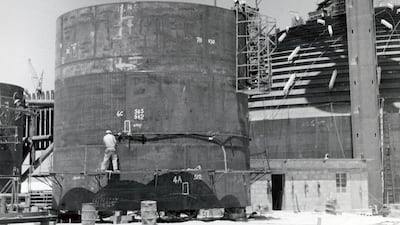
Oil sustained the development of the UAE. And this, a petroleum tank being built in Dubai Creek in 1970, was a familiar sight. Getty Images -
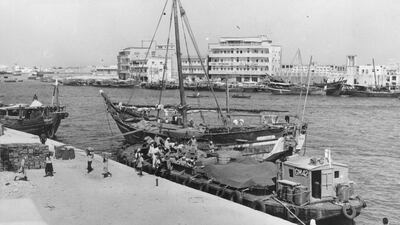
Ships unloading their goods on the creek for the Customs Department in Dubai in 1967. Getty Images



