Children under the age of five could suffer developmental problems owing to long periods of social confinement during the pandemic.
Paediatricians and speech therapists reported an increase in the number of young children requiring sessions after spending much of last year learning from home.
Some children and infants failed to meet their developmental milestones because of social distancing, restrictions on play dates and nurseries and minimal contact with extended families, experts said.
Although Covid-19 has not had much of a direct impact on children, it has delayed their development in many cases
Face masks have also slowed the development of some infants, who rely on facial expressions to communicate.
Mayssoun Jaber is a speech and language therapist and clinical manager at KidsFirst Medical Centre in Khalifa City, Abu Dhabi, a centre for children with learning difficulties. She said there was a notable difference between the levels of work therapists were doing before the pandemic and now.
"It was difficult for us to complete assessments of children who may need help, due to restrictions during the worst months of the pandemic," she said.
“If a child had issues, there was no opportunity to step in to make a diagnosis and begin any corrective therapy, especially for early years children, as they were not attending school or had limited social interaction when these issues would typically be picked up.
“They had limited exposure to other children, even within their own families.
“This contributed to delays in language development in some children and also delayed any face-to-face assessment.”
A UK report by the Education Endowment Foundation found protective measures implemented to reduce Covid-19 infection rates deprived younger children of social contact required for healthy development.
In 58 primary schools assessed in the UK, 76 per cent of pupils starting school in September 2020 needed more support with communication than in previous years.
Ninety-six per cent of schools were concerned about pupils' speech and language development.
It also found more children aged between four and five needed help with language and vocabulary.
Doctors said poor language development could have long-lasting effects in adolescence and adulthood.
“Although Covid-19 has not had much of a direct impact on children, it has delayed their development in many cases,” said Dr Anuradha Ajesh, a paediatrician at Bareen International Hospital in MBZ City, Abu Dhabi.
“It has mainly impacted [children’s] personal, social and language development because of protective confinement and the resulting social isolation.
"We have seen many children with speech delays in our clinics.
"Babies use facial expressions to communicate and wearing face masks has hampered this.
“Older children have been denied the opportunities to play with others.”
The first five years of life are critical to healthy growth in four main areas of development: physical; language and communication; cognitive; and social or emotional development.
Children unable to express themselves or interact with others are more likely to experience problems with reading or socialising and may suffer mental health issues.
“When younger children cannot go outside to play with their friends, they become stressed so that has also created problems,” Dr Ajesh said.
“Because of this we have seen some children stop talking or communicating altogether.
“It can be rectified at home, with parents finding time to speak with their children or arrange video calls with other family or friends who they may relate to.
“Video chats have been a good way to maintain relationships during the pandemic.
“Serious speech impediments or developmental delays can be rectified with counselling and therapy.”
Beverly Payne, from Ireland, was concerned when her youngest daughter, Aiya, showed signs of delayed development.
“My eight-year-old had sensory issues, but we were not aware that was anything to worry about,” said Ms Payne, who lives in Dubai.
“A week before Covid-19 hit, she brought home a book from school she had been reading for a year.
"When we began online learning, we realised she had other issues, like dyslexia, as she could not read the computer screen."
She could have had help with these issues if she were attending school in person, but it was much harder while at home, said Ms Payne.
“Aiya missed out on so much during the pandemic as she could not do the work on her computer.”
Therapists at the Wilson Centre in Dubai found Aiya responded to daily sessions and that improved her learning and development.
“One morning, we sat down for breakfast and Aiya said she could taste food for the first time,” Ms Payne said.
“We had no idea that one of the sensory issues she had was a lack of taste."
All of a sudden, she started to read again, recognise colours and improve her social interaction that had been dormant during the pandemic, Ms Payne said.
“Something just clicked in her brain, and as a parent that is a huge relief," she said.
"Parents in this situation can feel lost, but there is hope."
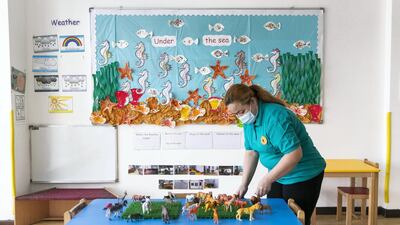
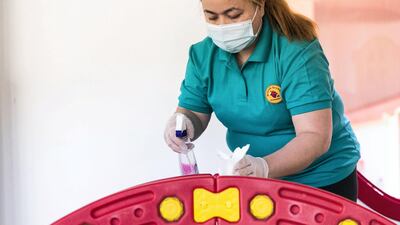
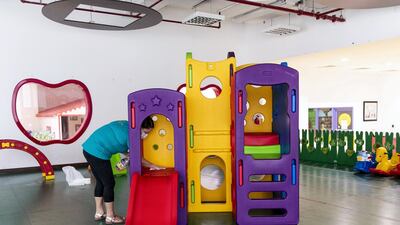
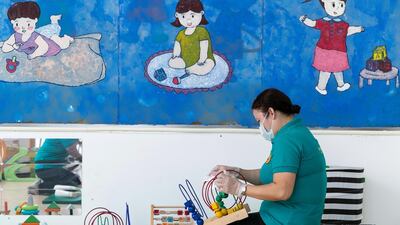
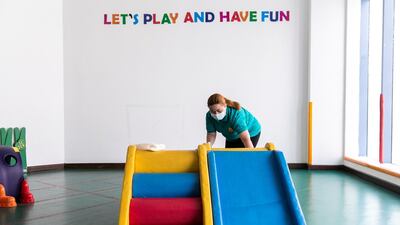
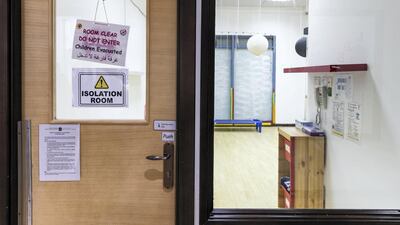
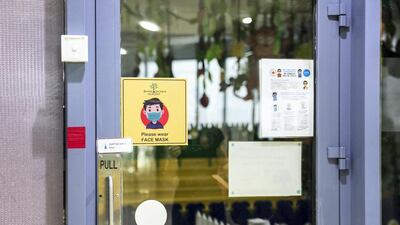
Disinfection work at a UAE nursery – in pictures
Jigra
Starring: Alia Bhatt, Vedang Raina, Manoj Pahwa, Harsh Singh
The years Ramadan fell in May
The specs
Engine: 2.0-litre 4-cyl turbo
Power: 247hp at 6,500rpm
Torque: 370Nm from 1,500-3,500rpm
Transmission: 10-speed auto
Fuel consumption: 7.8L/100km
Price: from Dh94,900
On sale: now
Tamkeen's offering
- Option 1: 70% in year 1, 50% in year 2, 30% in year 3
- Option 2: 50% across three years
- Option 3: 30% across five years
Dr Amal Khalid Alias revealed a recent case of a woman with daughters, who specifically wanted a boy.
A semen analysis of the father showed abnormal sperm so the couple required IVF.
Out of 21 eggs collected, six were unused leaving 15 suitable for IVF.
A specific procedure was used, called intracytoplasmic sperm injection where a single sperm cell is inserted into the egg.
On day three of the process, 14 embryos were biopsied for gender selection.
The next day, a pre-implantation genetic report revealed four normal male embryos, three female and seven abnormal samples.
Day five of the treatment saw two male embryos transferred to the patient.
The woman recorded a positive pregnancy test two weeks later.
THE BIO
Mr Al Qassimi is 37 and lives in Dubai
He is a keen drummer and loves gardening
His favourite way to unwind is spending time with his two children and cooking
Key facilities
- Olympic-size swimming pool with a split bulkhead for multi-use configurations, including water polo and 50m/25m training lanes
- Premier League-standard football pitch
- 400m Olympic running track
- NBA-spec basketball court with auditorium
- 600-seat auditorium
- Spaces for historical and cultural exploration
- An elevated football field that doubles as a helipad
- Specialist robotics and science laboratories
- AR and VR-enabled learning centres
- Disruption Lab and Research Centre for developing entrepreneurial skills
Company%20profile
%3Cp%3EName%3A%20Tabby%3Cbr%3EFounded%3A%20August%202019%3B%20platform%20went%20live%20in%20February%202020%3Cbr%3EFounder%2FCEO%3A%20Hosam%20Arab%2C%20co-founder%3A%20Daniil%20Barkalov%3Cbr%3EBased%3A%20Dubai%2C%20UAE%3Cbr%3ESector%3A%20Payments%3Cbr%3ESize%3A%2040-50%20employees%3Cbr%3EStage%3A%20Series%20A%3Cbr%3EInvestors%3A%20Arbor%20Ventures%2C%20Mubadala%20Capital%2C%20Wamda%20Capital%2C%20STV%2C%20Raed%20Ventures%2C%20Global%20Founders%20Capital%2C%20JIMCO%2C%20Global%20Ventures%2C%20Venture%20Souq%2C%20Outliers%20VC%2C%20MSA%20Capital%2C%20HOF%20and%20AB%20Accelerator.%3Cbr%3E%3C%2Fp%3E%0A
Ten tax points to be aware of in 2026
1. Domestic VAT refund amendments: request your refund within five years
If a business does not apply for the refund on time, they lose their credit.
2. E-invoicing in the UAE
Businesses should continue preparing for the implementation of e-invoicing in the UAE, with 2026 a preparation and transition period ahead of phased mandatory adoption.
3. More tax audits
Tax authorities are increasingly using data already available across multiple filings to identify audit risks.
4. More beneficial VAT and excise tax penalty regime
Tax disputes are expected to become more frequent and more structured, with clearer administrative objection and appeal processes. The UAE has adopted a new penalty regime for VAT and excise disputes, which now mirrors the penalty regime for corporate tax.
5. Greater emphasis on statutory audit
There is a greater need for the accuracy of financial statements. The International Financial Reporting Standards standards need to be strictly adhered to and, as a result, the quality of the audits will need to increase.
6. Further transfer pricing enforcement
Transfer pricing enforcement, which refers to the practice of establishing prices for internal transactions between related entities, is expected to broaden in scope. The UAE will shortly open the possibility to negotiate advance pricing agreements, or essentially rulings for transfer pricing purposes.
7. Limited time periods for audits
Recent amendments also introduce a default five-year limitation period for tax audits and assessments, subject to specific statutory exceptions. While the standard audit and assessment period is five years, this may be extended to up to 15 years in cases involving fraud or tax evasion.
8. Pillar 2 implementation
Many multinational groups will begin to feel the practical effect of the Domestic Minimum Top-Up Tax (DMTT), the UAE's implementation of the OECD’s global minimum tax under Pillar 2. While the rules apply for financial years starting on or after January 1, 2025, it is 2026 that marks the transition to an operational phase.
9. Reduced compliance obligations for imported goods and services
Businesses that apply the reverse-charge mechanism for VAT purposes in the UAE may benefit from reduced compliance obligations.
10. Substance and CbC reporting focus
Tax authorities are expected to continue strengthening the enforcement of economic substance and Country-by-Country (CbC) reporting frameworks. In the UAE, these regimes are increasingly being used as risk-assessment tools, providing tax authorities with a comprehensive view of multinational groups’ global footprints and enabling them to assess whether profits are aligned with real economic activity.
Contributed by Thomas Vanhee and Hend Rashwan, Aurifer
MATCH INFO
Juventus 1 (Dybala 45')
Lazio 3 (Alberto 16', Lulic 73', Cataldi 90 4')
Red card: Rodrigo Bentancur (Juventus)
Mercer, the investment consulting arm of US services company Marsh & McLennan, expects its wealth division to at least double its assets under management (AUM) in the Middle East as wealth in the region continues to grow despite economic headwinds, a company official said.
Mercer Wealth, which globally has $160 billion in AUM, plans to boost its AUM in the region to $2-$3bn in the next 2-3 years from the present $1bn, said Yasir AbuShaban, a Dubai-based principal with Mercer Wealth.
“Within the next two to three years, we are looking at reaching $2 to $3 billion as a conservative estimate and we do see an opportunity to do so,” said Mr AbuShaban.
Mercer does not directly make investments, but allocates clients’ money they have discretion to, to professional asset managers. They also provide advice to clients.
“We have buying power. We can negotiate on their (client’s) behalf with asset managers to provide them lower fees than they otherwise would have to get on their own,” he added.
Mercer Wealth’s clients include sovereign wealth funds, family offices, and insurance companies among others.
From its office in Dubai, Mercer also looks after Africa, India and Turkey, where they also see opportunity for growth.
Wealth creation in Middle East and Africa (MEA) grew 8.5 per cent to $8.1 trillion last year from $7.5tn in 2015, higher than last year’s global average of 6 per cent and the second-highest growth in a region after Asia-Pacific which grew 9.9 per cent, according to consultancy Boston Consulting Group (BCG). In the region, where wealth grew just 1.9 per cent in 2015 compared with 2014, a pickup in oil prices has helped in wealth generation.
BCG is forecasting MEA wealth will rise to $12tn by 2021, growing at an annual average of 8 per cent.
Drivers of wealth generation in the region will be split evenly between new wealth creation and growth of performance of existing assets, according to BCG.
Another general trend in the region is clients’ looking for a comprehensive approach to investing, according to Mr AbuShaban.
“Institutional investors or some of the families are seeing a slowdown in the available capital they have to invest and in that sense they are looking at optimizing the way they manage their portfolios and making sure they are not investing haphazardly and different parts of their investment are working together,” said Mr AbuShaban.
Some clients also have a higher appetite for risk, given the low interest-rate environment that does not provide enough yield for some institutional investors. These clients are keen to invest in illiquid assets, such as private equity and infrastructure.
“What we have seen is a desire for higher returns in what has been a low-return environment specifically in various fixed income or bonds,” he said.
“In this environment, we have seen a de facto increase in the risk that clients are taking in things like illiquid investments, private equity investments, infrastructure and private debt, those kind of investments were higher illiquidity results in incrementally higher returns.”
The Abu Dhabi Investment Authority, one of the largest sovereign wealth funds, said in its 2016 report that has gradually increased its exposure in direct private equity and private credit transactions, mainly in Asian markets and especially in China and India. The authority’s private equity department focused on structured equities owing to “their defensive characteristics.”
'My Son'
Director: Christian Carion
Starring: James McAvoy, Claire Foy, Tom Cullen, Gary Lewis
Rating: 2/5