


Coronavirus vaccinations are likely to begin in the US this year and could reach the entire population by the end of 2021, a senior official at the US Centres for Disease Control and Prevention said.
But Dr Nancy Messonnier, the CDC’S immunisation director, said that myths and misinformation could discourage some people from taking the vaccine.
Dr Messonnier told the Covid-19: The Road to Recovery online seminar organised by emergency alert company Everbridge that early immunisation programmes would focus on healthcare workers because vaccine supplies would be limited.
“We expect the first doses of the vaccine to be available this calendar year but the quantity this year will be somewhat limited, which means vaccines will be targeted,” she said.
But with manufacturing already started in anticipation of approval, the introduction of vaccinations is forecast to accelerate rapidly in 2021, with “a pretty short window” before larger quantities became available.
“We could rapidly have enough vaccine available next year to vaccinate the entire [US] population,” Dr Messonnier said.
The first results from some of the 10 coronavirus vaccines in Phase 3 clinical trials could be weeks away.
-
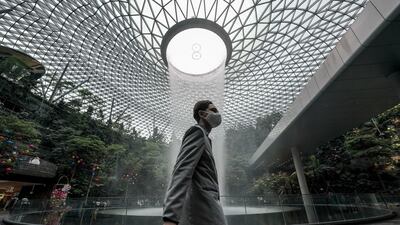
A member of customer service staff walks past the Rain Vortex waterfall inside the Jewel Changi Airport mall in Singapore. The airport reported a 36 per cent downturn in profits due to travel restrictions. EPA -
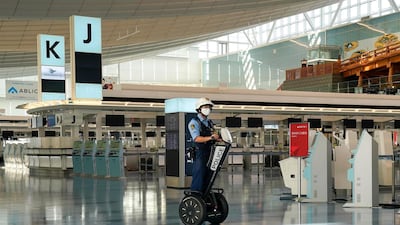
A policeman on a Segway patrols on the departure floor at Tokyo International Airport after Japan started easing entry restrictions to visitors from around the world. EPA -

A traveler arriving on the first international commercial flight to land in South Africa since lockdown is welcomed at Cape Town International Airport, South Africa. EPA -

A health worker sprays sanitizer on a passenger at Damascus International Airport on its re-opening day for regular international commercial traffic. Reuters -
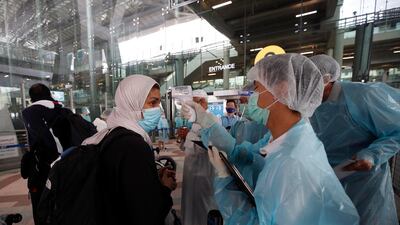
Thai health officials check the body temperature of an arriving foreigner prior to heading to a 14-day quarantine period, at the Suvarnabhumi International Airport. EPA -
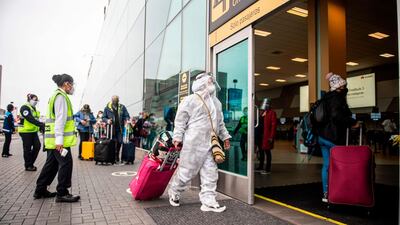
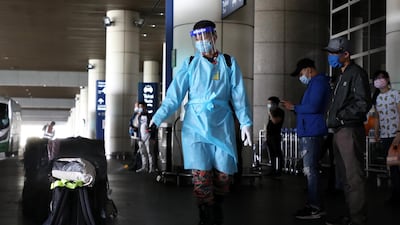
A passenger wearing a protective suit and face mask enters the Jorge Chavez International Airport, Peru, as international flights resume after a break of more than six months. AFP -
A firefighter sprays disinfectant on luggage at the entrance of Kuala Lumpur International Airport in Malaysia. Reuters -
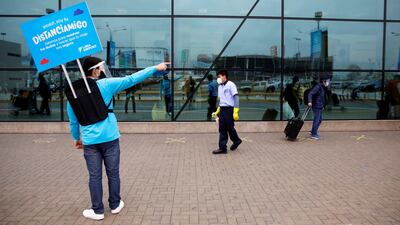
A worker wears a sign that says "Distance friend" outside of the Jorge Chavez International Airport in Lima, Peru. Reuters -
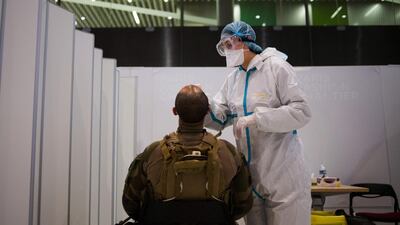
A health worker administers a Covid-19 swab test on a French soldier at Charles de Gaulle airport, France. Bloomberg -
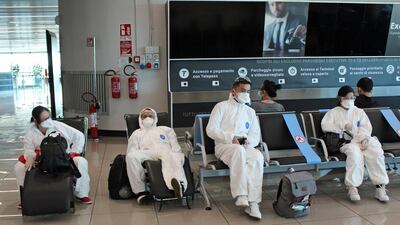
Passengers at 'Leonardo da Vinci' airport, near Rome, Italy. The health authorities of the Lazio Region have decided to build in an additional rapid Covid-19 test center. EPA


Dr Messonnier said there would probably be several vaccines available, allowing people with medical or other conditions a choice of more suitable treatments.
With the prominence of an anti-vax movement and the spread of disinformation online, she said a lack of willingness among some people to be vaccinated was a concern.
“I’m worried," Dr Messonnier said. “We’ve got to get the correct information out there. We need to fight myths and misinformation.”
The conference also heard that vaccines would not provide an immediate return to normal life.
Dr Sanjay Gupta, associate professor of neurosurgery at Emory University Hospital and chief medical correspondent for CNN, told the conference that vaccination would not mean the end of wearing masks or social distancing.
“It’s not going to monumentally flip a switch and return things to normal,” Dr Gupta said.
He said vaccines were not likely to be 100 per cent effective but they would improve as second-generation vaccines become available next year.
“We’re about to embark on the largest-scale adult vaccine programme in our lifetime,” Dr Gupta said.
“We’re talking 4 billion to 5 billion vaccinations, and what if you have to do that every year?
“We’re talking about a completely new sector of society to protect us from this novel coronavirus.”
Tate Reeves, the Republican Governor of Mississippi, said that his state anticipated an economic dividend from people moving there from larger cities in the north of the US where coronavirus infection numbers were high.
“Where you have a large number of people living in very confined spaces, you’re more susceptible to the spread of the virus,” Mr Reeves said.
“Those of us in the South who are more rural have an opportunity to attract more people into the state.
"We’re really poised as a state for tremendous economic growth.”
He said Mississippi had not shut down sectors of the economy, including construction, that he thought were unlikely to cause significant disease transmission.
“If you shut down your economy for weeks and weeks or months on end, there are consequences – there are major consequences,” Mr Reeves said.
“We focused on not only protecting lives but protecting livelihoods. We feel it’s worked out as well as could be expected.”
The conference addressed unique challenges presented by the pandemic to businesses, including how to deal with much larger numbers of people working from home.
Jim Whitehurst, president of IBM, said this encouraged companies to digitise operations and increase automation.
Mr Whitehurst said companies were now at the difficult stage of looking for ways to get operations back to near normal despite the pandemic.
“We’re in what I would call the most difficult phase,” he said. “It’s hard because it’s nebulous.
"What is safe? We want people to feel safe, we need to bring people back in a way that we get that balance."
Mr Whitehurst said it was important that employees were given choice over whether they went back to work, and only did so if they were comfortable with it.
He said technology could help when increasing numbers of people returned to work, such as through the use of systems that monitored how many people were in a room, to prevent overcrowding.
Former Ford chief executive and president Jim Hackett, now a special adviser to the car maker, said companies could maintain operations if they kept a close eye on potential coronavirus outbreaks.
“We’ve never had to shut down a factory for an hour since we went back in May,” Mr Hackett said.
“We’ve had positive tests but as we’ve had positive tests, we’re able to quarantine and secure.
“The lessons learnt from all that are in a binder that will for ever sit on the shelf.”

