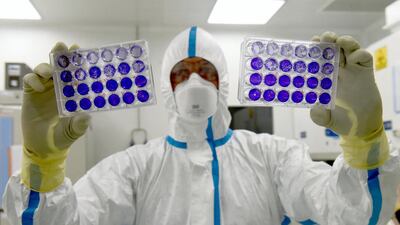

In late November, scientists in the UK detected a troubling new Covid-19 variant.
Growth of the strain, which had been circulating at “very low levels” until two weeks previously, was on the turn.
And it was about to explode across the south-east of the country.
The variant first came to light when experts were investigating why infection rates in Kent were not falling, despite severe restrictions being in place.
Genetic sequencing of SARS-CoV-2 samples in the area revealed a cluster of the B117 strain, which came to be known as the Kent variant, spreading rapidly into London and beyond.
Tests showed the variant first emerged in late September.
At the end of October the strain accounted for only 3 per cent of cases in England.
But by the start of February the share had soared to 96 per cent.
The UK discovered the strain due to prolific genomic sequencing of the coronavirus.
It is eighth in a list of the world’s top sequencers, led by countries with much smaller caseloads.
The UK has analysed 7.4 per cent of its two million-plus cases –157,439 cases – according to the Covid-19 Genomics UK Consortium.
Experts have said other countries need to catch up.
The National explains why.

What is the benefit of sequencing the genome of coronavirus cases?
There are several.
All viruses change and by tracing mutations over time scientists can work out their impact.
Sequencing traces these changes, mapping the lineage, transmission and the rate of evolution of the virus, stated a report by McKinsey & Company.
“In the case of New York City’s initial outbreak in March 2020, once epidemiologists identified the probable date of introduction and the strain, public health leaders were able to estimate how many people in the area were infected.
“Such information is vital to support effective response,” it said.
In the UK, research has since confirmed what scientists already suspected – the B117 strain discovered in the UK is significantly more transmissible.
But by discovering the presence of the new variant, the government was able to quickly contain it by imposing another strict lockdown, which eventually brought the growth in new cases under control.

How many strains are there of SARS-CoV-2?
There are several known strains, and they will continue to emerge over time.
The virus acquires about two mutations per month. Most of them are useless to SARS-CoV-2, but they sometimes assist the virus by enabling it to spread more easily, for example.
A few of the strains emerging include the same mutations, which is a sign they benefit the virus in some way.
For example, a number now share the E484K mutation in the spike protein, dubbed “eek” by some scientists.
The mutation is known to reduce the protection offered by vaccines and previous infection by “substantially” increasing the amount of serum antibody needed to prevent the infection of cells, according to research by the University of Cambridge.
It was first identified in a variant that appeared in South Africa.
But it has since been detected in the P1 Brazilian strain, which is responsible for a second massive surge in the rainforest city of Manaus, along with some Kent variant samples.
Last week, it was revealed 70 per cent of Covid-19 patients tested at a hospital in Tokyo also carried the E484K mutation.
How many countries sequence cases?
More don’t than do.
Australia is the world’s top sequencer. It tests more than half of samples, according to the GISAID Initiative, which provides a global database of coronavirus genomes. But the country has recorded a relatively small number in total, because it has not had many Covid-19 cases.
The UK is by far the biggest sequencer, testing about 8 per cent of samples from its considerable caseload. That represents 45 per cent of the world’s sequences, according to McKinsey & Company.
Some countries, such as the US, sequence less than half a per cent of cases. And many have no sequencing capacity at all.

Does the UAE sequence samples?
Yes. The country has not revealed what percentage of samples it sequences, but Dr Farida Al Hosani, a federal health spokeswoman, said the mutations circulating in the Emirates are monitored.
“Since the beginning of the global announcement of new strains, the UAE has been following up on changes and developments in the virus, and a national team was formed to study the tracking of mutated strains in co-operation with all health authorities,” she said.
“The team analyses the situation periodically and reviews recommendations in this regard.”
G42 Healthcare, a subsidiary of Abu Dhabi-based Group 42, said it has conducted a SARS-CoV-2 genome sequencing study that identified the genomic source of the pandemic.
The viral genome sequencing was performed on 1,067 nasopharyngeal swab samples collected in Abu Dhabi between May and June 2020.
The analysis revealed unique genetic variations specific to the UAE virus strains, and the patterns of the virus’s introduction, the company said.
Coronavirus: latest pictures from around the world
-

A woman walks down a street in Sao Paulo, Brazil after the city ended 10 days of lockdown. EPA -
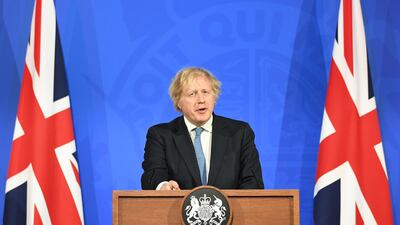
UK Prime Minister Boris Johnson holds a news conference on the pandemic in London. Reuters -

Medical personnel vaccinate older adults in the city of Leon, Guanajuato state, Mexico. EPA -
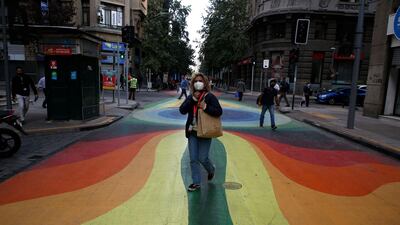
A person wearing a mask walks during quarantine in Santiago, Chile. The country will close its international borders and cancel flights during April after passing one million reported cases of Covid-19. Getty -

Commuters wearing protective masks make their way in Tokyo, Japan. Reuters -
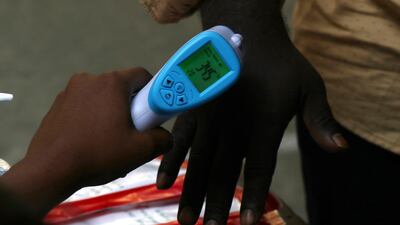
An official checks the temperature of a voter as part of precautions against the coronavirus as he arrives to cast his vote in the Tamil Nadu state assembly elections in Chennai, India. AP Photo -
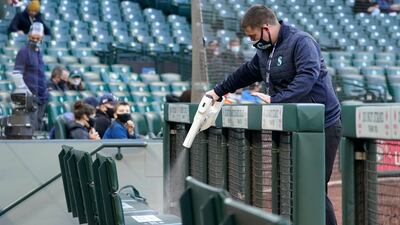
A worker sprays seats in the Seattle Mariners' dugout as a precaution against Covid-19 before a baseball game against the Chicago White Sox in the US. AP Photo -
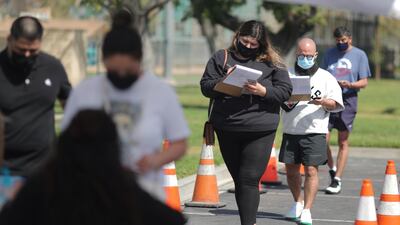
People queue for vaccinations in Artesia, California. Reuters -

A Covid-19 sign hangs in the concourse of Globe Life Field before the Texas Rangers' home opener baseball game against the Toronto Blue Jays, in Arlington, Texas. AP -
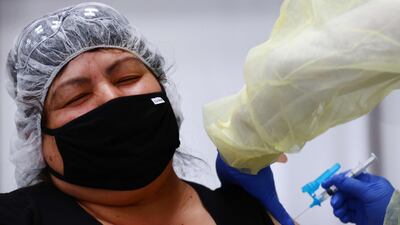
A woman receives a one-shot dose of the Johnson & Johnson Covid-19 vaccine at a clinic in Riverside, California. AFP



