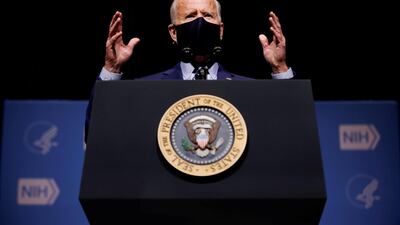

This weekend marks US President Joe Biden’s first month in the Oval Office, which means it is still early days for any concrete foreign policy decisions to have been taken. Thus far, Mr Biden has limited himself to feel-good postures on complex global issues. On February 19, he will deliver a virtual address at the Munich Security Conference on the “importance of our transatlantic ties and the need for the United States and Europe to take on global challenges”. For the moment, such posturing does the job of soothing frayed nerves.
All too soon though, a harder metric will be employed. Mr Biden's performance will be measured against his promises, not least the bold pledge that America has returned to the world stage as a values-driven leader. But will the world and Europe, in particular, buy it?
Is the world even willing to follow America’s marching orders?
Much will depend on what sort of leadership Mr Biden proposes. The usual term for American presidents is "leader of the free world". But that is a relic of the Cold War era and a categorisation ripe for retirement. Which phrase, if any, could Mr Biden replace it with?
Not too long ago, former US President Barack Obama, an evocative writer, suggested that America reinvent its engagement with the world because “what was lost during the Trump presidency” was the US administration’s ability to “set the agenda” at summits and so on. Now, in this multipolar world, said Mr Obama, the US can’t walk into a room and demand everyone fall into line. Instead, it has to understand the interests of the key players, lead by example, and play the roles of “convener … persuader”.

But even to serve as convener of the free world, Mr Biden would have to keep in mind three cold, hard facts.
First, while Europe is relieved to have a more dependable partner in the White House, the experience of the Trump years has shifted strategic thinking towards a new vision of "European sovereignty".
Second, the so-called “Washington Consensus” – the international institutions and alliances that helped shape global politics for much of the 20th century – needs to be reimagined.
Third, part of the reinvention must include the retooling of the global economy. Much will depend on the outcome of ongoing efforts to agree on the efficient taxation of multinational companies, digital services taxes (DST) and international trade rules that return to their original purpose of raising living standards across the board. This is where Mr Biden could play a crucial role. American involvement in shaping viable proposals would reassure the hesitant and nudge the recalcitrant. Its support for a global consensus would help set the tone for collaboration rather than conflict. As Mr Obama noted in his pitch for America to take up the role of world-convener: “if we didn’t set the agenda, nobody else had the combination of technical skill, bandwidth, diplomatic experience, relationships, trust and power to be able to stitch together various interests to arrive at something like a Paris accord.”
One month into the Biden administration, is there any sign it will take up the somewhat humbler task of convener – not leader – of the world? Will Mr Biden’s America lead, as he has promised, “not by the example of our power, but by the power of our example”?
There are some encouraging developments. Days ago, Mr Biden's administration reversed Mr Trump's block on the appointment of Nigerian-born US national Ngozi Okonjo-Iweala as director-general of the World Trade Organisation (WTO). The seven-month leadership void at the 164-country global trade body was finally filled on February 15.
There are welcome indications too that the US and the EU want to collaborate on getting the WTO’s dispute settlement system back in business, particularly on the issue of state subsidies. In December 2019, the Trump administration crippled the WTO with a two-year effort to block judicial appointments to its trades-disputes court. Meanwhile, Brussels, Washington and Tokyo are said to be open to working on a joint proposal to tighten subsidy rules.
The US has also signalled interest in negotiating taxation of multinational companies with Mr Biden’s treasury secretary Janet Yellen telling the US Senate at her January 19 confirmation hearing that it is better to “avoid a race to the bottom in corporate taxation”. She also indicated a willingness to consult on digital taxes. The Biden treasury department also recently appointed three scholars of international tax policy, which suggests a new seriousness about dealing with US tax rules for multinational corporations and negotiating international tax policy changes at the Organisation for Economic Co-operation and Development (OECD). That said, it’s thought the complexity and controversial nature of the DST issue means it is unlikely to be resolved by multilateral consensus by mid-2021, the point at which several OECD countries are set to enforce the charges.
Finally, there is a welcome sense of realism in official briefings about Mr Biden's hopes and plans. For instance, before his first phone call as president with his Chinese counterpart Xi Jinping, an unnamed American official confessed that Mr Biden's strategy would be driven by awareness that "the lion's share of the history of the 21st century is going to be written in the Asia-Pacific".
Despite it all, there are occasional flashes of scepticism bordering on cynicism overseas about Mr Biden’s intentions. In The Netherlands, some are calling Mr Biden “Trump with manners” simply because he toughened “Buy American” procurement rules and seems to be overwhelmingly focused on the domestic crises that beset the US right now.
But this is a precipitate judgment. It’s just too soon to tell.
Rashmee Roshan Lall is a columnist for The National

