
As negotiations on a Brexit deal between the UK and EU go to the wire, Britain’s Conservative government has talked a lot about one of the possible outcomes being an “Australia-style deal”.
Earlier in the year, the focus was on a “Canada-style deal”, which is a genuine trade agreement that indeed removes plenty of tariffs and eases quotas, and contains mutual recognition of standards and qualifications. This appealed to many, including those in the "Remain" camp who had reluctantly concluded that Brexit was, by then, unstoppable. For firstly, Canada and Europe's Comprehensive Economic and Trade Agreement is an accord of substance. And secondly, who doesn’t like liberal, tolerant Canada, with its good record on safety and ethics, and historically strong welfare programmes?
After a while, however, it became clear that such a deal could not be hammered out between Brussels and London. It was then that Australia became the favoured model. Many have pointed out that as Canberra does not in fact have a free trade agreement with the EU – just a few specific arrangements – “Australia-style deal” is pretty much a euphemism for “no deal” and World Trade Organisation status. The UK’s Boris Johnson, tweeted the former Swedish prime minister Carl Bildt, “probably thinks it sounds better like that".
-

Pro Brexit supporters gather for the Brexit Day celebration party hosted by Leave Means Leave at Parliament Square on Friday. Getty Images -
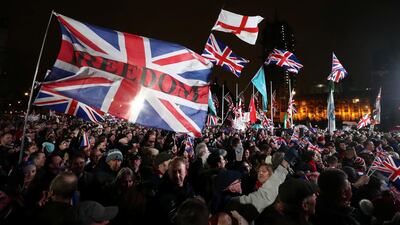
Thousands gathered in Parliament Square to mark Britain's departure from the EU. Reuters -

Some Brexit supporters dressed up for the celebrations. Getty Images -
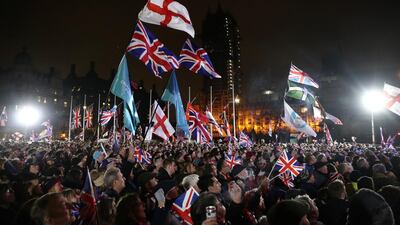
Crowds counted down the hours and then the minutes until the Brexit hour at 11pm local time. Reuters -

Britain officially left the EU after a debilitating political period that has bitterly divided the nation since the 2016 referendum. AP -
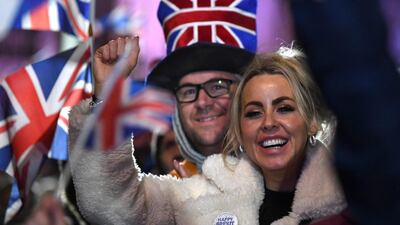
Britain ended 47 years of EU membership on Friday. AFP -

Brexit Party leader Nigel Farage speaks to the media before addressing crowds in Parliament Square. Reuters


This may be true. Critics such Alastair Campbell, who was once a strategist for former UK prime minister Tony Blair, have seized on this and said that “an ‘Australia-style’ exit might as well be Namibia or Zimbabwe. It’s just that Australia sounds better because we tend to like Aussies".
Supporters of Mr Johnson could counter that it is perfectly reasonable to frame the possible terms of Britain’s new relationship with the EU in a way that is easily understandable: by comparing them to those enjoyed by a successful, developed nation with which the UK is familiar, and with which it has strong historical, defence, cultural and familial ties.
If Mr Campbell concedes that this comparison indeed resonates, it should be pointed out that it does so particularly strongly in Britain’s Conservative party. Mr Johnson himself spent a year as a teaching assistant in Australia in 1983. When he won the London mayoral contest in 2008, much credit was given to his Australian strategist, Lynton Crosby, who also masterminded David Cameron’s victory in the 2015 general election. A Crosby protege, Isaac Levido, ran the 2019 election campaign that saw the Conservatives returned to power again, this time with an 80-seat majority. Both Mr Crosby, known as “the lizard of Oz”, and Mr Levido had previously helped Conservative premiers to electoral victories in Australia.


Their toughness and discipline on messaging is matched by the unabashedly right-wing and uncompromising rhetoric often to be evinced by Australian politicians, which is music to the ears of many in the UK Conservative party. The former prime minister Tony Abbott – now an adviser to Britain's Board of Trade – has been forthright about his traditionalist Catholic beliefs. His current successor, Scott Morrison, has forcefully stood up to China. Australia has long had a policy of detaining refugees and asylum-seekers offshore; some have criticised the policy as inhumane and possibly illegal, but the general message sent on immigration appeals to many British Tory right wingers.
It is worth noting that the UK brands its post-EU immigration rules as an "Australia-style", points-based system. Canada, too, uses a similar, points-based system for non-refugee migrants, and requires applicants to score two points higher than in Australia. Mysteriously, one never hears of Britain wanting appeal to hardliners by adopting Canadian-style immigration.
Anglo-Australian appreciation goes both ways. Australia's Mr Morrison and the UK's Mr Johnson had what was referred to as a "Zoom love-in" over a post-Brexit alliance last month. One Australian historian even wrote that his country may be experiencing a revival of "the old, Menziean allegiance to the UK" – a reference to the very strong ties developed under former Australian prime minister Robert Menzies up until 1973, when the UK joined the European Economic Community. The development ended the system of "imperial preferences" and forced Australia urgently to seek new markets.
Many at the time saw that, with some justification, as Britain abandoning the Commonwealth. But here a note of caution should be sounded. The "Global Britain" that Mr Johnson wants to see emerging post-Brexit cannot rely, nor be seen to rely, on an Anglosphere of white-majority former colonies such as Canada and Australia. The same goes for greater engagement with the Commonwealth – it must be with the wider group of 54 states, not just those with populations mostly descended from Britons.
For that would risk playing into the narrative of "imperial nostalgia" that "Leavers" need to guard against, regardless of the fact that it is nearly always Remainers, not Brexiteers, who talk about it. Such notions may – secretly – please nationalistic elements in the UK, but they will not be welcomed in the global south nor in the Indo-Pacific region that many close to the Johnson administration see as a productive future for Britain to explore. Memories of colonisation have not faded. They have no wish for new "white saviours" from the Anglosphere.
-
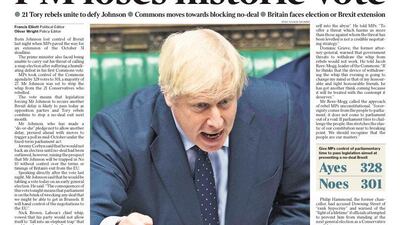
The London Times: PM loses historic vote. -
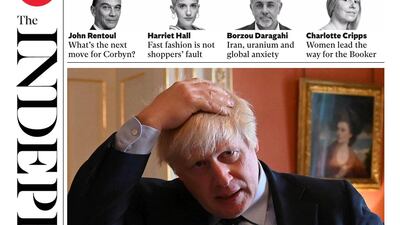
The Independent: Johnson loses control -
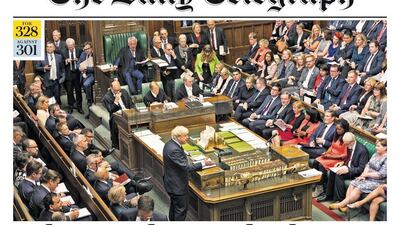
The Telegraph: Johnson demands election -
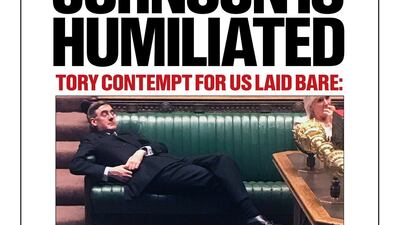
The Scottish National: Johnson is humilitated -
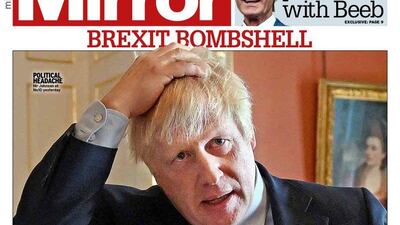
The Mirror: Boris loses control -

The Daily Mail: Now you decide Britain -
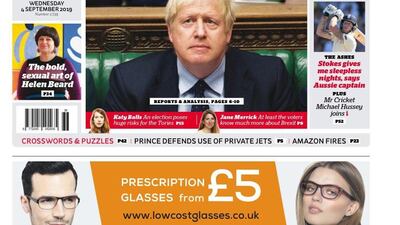
The i: Johnson loses control -
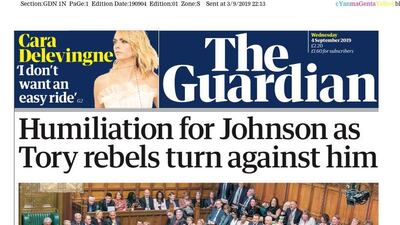
The Guardian: Humiltiation for Johnson as Tory rebels turn against him -
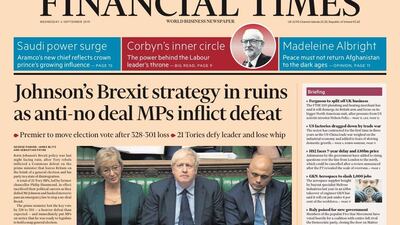
The Financial Times: Johnson's Brexit strategy in ruins as anti-no deal MPs inflict defeat -
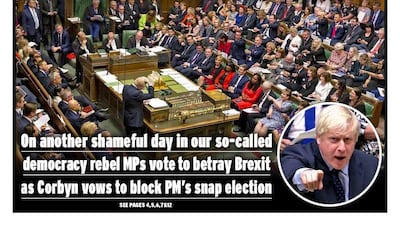
The Daily Express: Parliament surrenders to the EU -
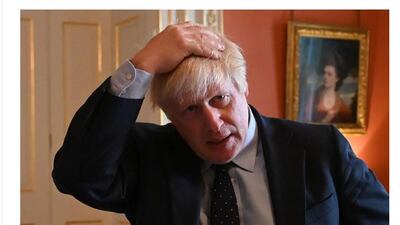
Politico: British lawmakers take control -
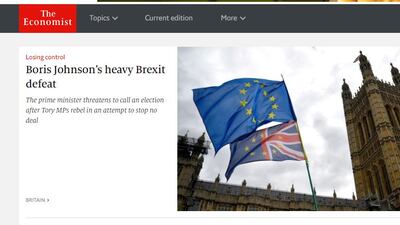
The Economist: Boris Johnson's heavy Brexit defeat -
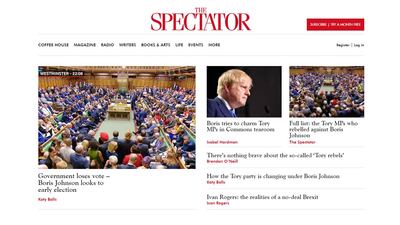
The Spectator homepage -
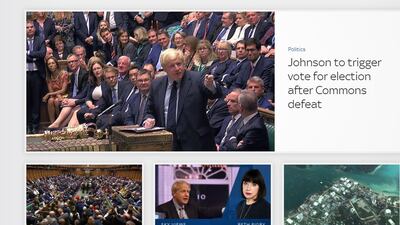
Skynews.com homepage -
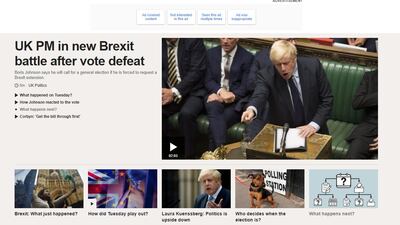
BBC news homepage -
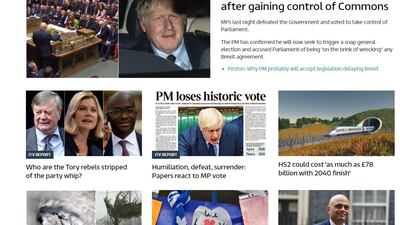
ITV news homepage


This is a difficult needle for Mr Johnson to thread. He knows that some of the most enthusiastic supporters of Brexit, including in his own party, are not fully signed up to the more diverse, enlightened Britain hoped for during the reform period when Mr Cameron was Tory leader. He cannot lose their votes. At the same time, the liberal, internationalist Boris Johnson that I encountered when he was an MP, magazine editor and London mayor is exactly what will be needed as he tries to reunite his country around the world to his "Global Britain" banner.
Australia may be a good friend to Britain. If the UK wants to attract new compadres, however, it should not make it sound too much like a bromance. Once the deal is done (or not), I would suggest the comparison with Canberra be retired quickly. Britain is going to find out for itself, and soon enough, what life beyond the EU is going to be.
Sholto Byrnes is an East Asian affairs columnist for The National

