



Dubai Airport is carrying out random PCR tests on arrival for some flights as part of efforts to limit the spread of Covid-19.
Screening on arrival is already mandatory on Emirates flights from more than 50 countries, including Brazil, India, Pakistan and Russia.
But authorities have confirmed additional testing is being carried out on flights not included on this list.
"PCR tests are mandatory for the flights mentioned on Emirates' website,” said a Dubai Media Office statement.
“However, as part of the extra precautionary measures, Dubai Airport may conduct random tests upon arrival for certain flights."
Residents returning to Dubai in recent days posted on social media about how they had been asked to complete PCR tests on arrival at Dubai International from the UK, which is not on the list of countries from which a swab on arrival is compulsory.
Positive tests require passengers to isolate at home for 10 days from the first day a PCR test is taken, even without showing symptoms of Covid-19.
Those testing positive must also download the Covid-19 DXB app, or face a potential Dh10,000 ($2,722) fine.
A second PCR test is not necessary after the isolation period is complete.
According to the latest information from Emirates and Etihad, passengers travelling to Dubai and Abu Dhabi from all countries (GCC included) must have a negative Covid‑19 RT‑PCR test certificate for a test taken no more than 72 hours before departure.
Travellers must bring an official printed or digital certificate in English or Arabic to check-in because the airline will not accept SMS certificates.
Covid‑19 PCR certificates in other languages are acceptable if they can be validated at the originating testing station.
Dubai steps up safety measures
-
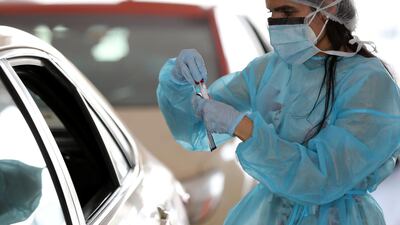
People get tested for coronavirus at the Mina Rashid screening centre in Dubai. Chris Whiteoak / The National -
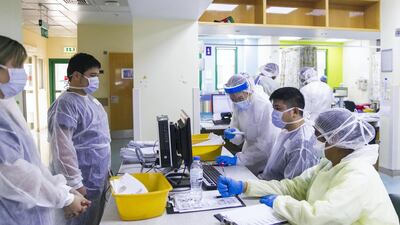
Since the beginning of the coronavirus pandemic, health authorities have called upon citizens and residents to join with the efforts of health care professionals. Health workers, such as these Sheikh Khalifa Medical City, have led the way. Reem Mohammed / The National -
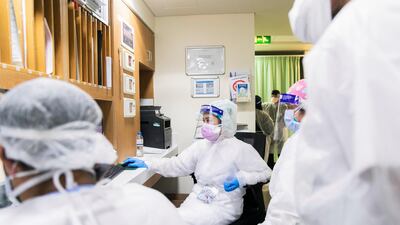
Healthcare workers at the emergency ward in Sheikh Khalifa Medical City. The President, Sheikh Khalifa, has paid tribute to the frontline workers who helped to curb Covid-19. Reem Mohammed / The National -
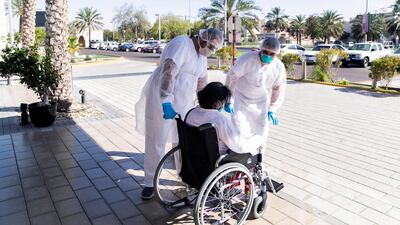
Healthcare workers at Sheikh Khalifa Medical City receive a patient outside the emergency department. Reem Mohammed / The National -
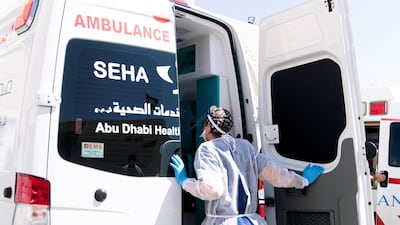
A consultant physician at the emergency department in Sheikh Khalifa Medical City, receives a Covid-19 patient. Reem Mohammed / The National -
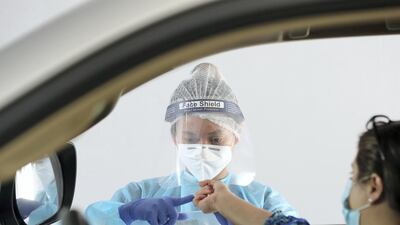
People get the laser blood test tests at the Mina Rashid screening centre in Dubai. Chris Whiteoak / The National -
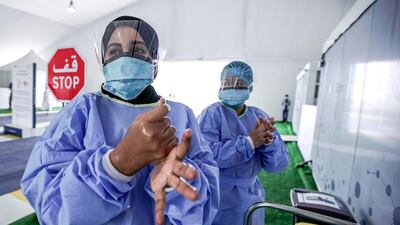
A nurse sanitises her hands after conducting a swab test at one of the UAE's screening drive-through centres in Mina Rashid, Dubai. Victor Besa / The National -
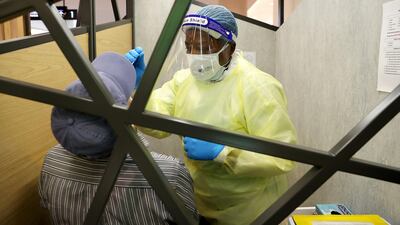
A health worker taking the Covid-19 nasal swab test at a testing station in thet Mall of the Emirates in Dubai. Pawan Singh / The National -
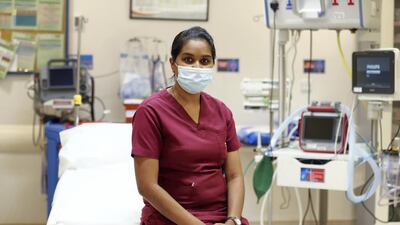
Nurse Renu Venugopal, who contracted Covid-19, recovered and continued to treat patients at Al Zahra Hospital, Sharjah. Chris Whiteoak / The National -
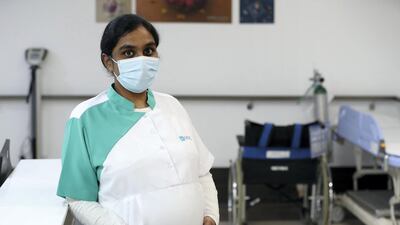
Ruth Deva Kiruba says being pregnant during a pandemic was surreal and sometimes lonely. Chris Whiteoak / The National -
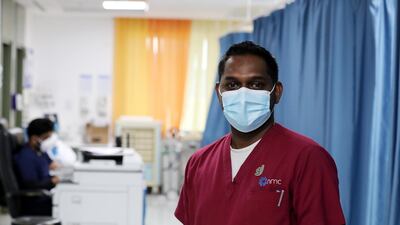
EMT nurse Jephy Antony, who contracted Covid-19, recovered and continued to treat patients at the NMC Royal Hospital, DIP, Dubai. Chris Whiteoak / The National -
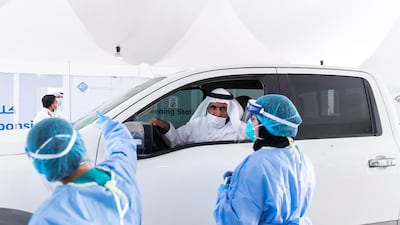
A visitor gets tested at the Ras Al Khaimah Covid-19 drive-through testing centre. Reem Mohammed / The National -
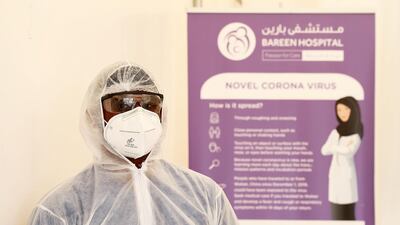
Nurse Nikhil Rajendran inside the fever clinic at the Bareen International Hospital in Mohamed Bin Zayed City in Abu Dhabi. Pawan Singh / The National -
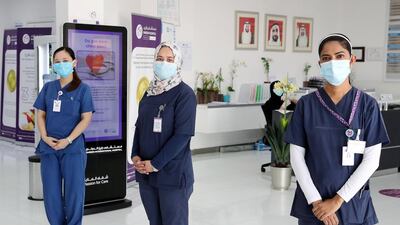
Shane Simeon Galang from Philippines, Mervat Aslan Mhgoub Mohamed from Egypt and Sowmya Kotian from India, who are nurses at the Bareen International Hospital in Mohamed bin Zayed City in Abu Dhabi. Pawan Singh / The National


Authorities are taking robust steps to contain the virus, particularly in light of the emergence of the highly contagious Omicron variant.
Daily case numbers have steadily increased in recent weeks – rising from below 50 in early December to 1,846 on Tuesday.
Screening rates are being stepped up to help break the chain of transmission, with a record 431,482 tests conducted in the latest 24-hour reporting period.
Travel from several African nations into the UAE is still prohibited because of high case numbers of the Omicron strain of Covid-19.
Passengers travelling to Dubai who have been in or transited through Ethiopia, Kenya, Nigeria or Tanzania in the past 14 days are not permitted to enter the emirate.
The restrictions are waived for diplomats, UAE citizens and their first-degree relatives and staff and those with a Golden Visa.
There are also specific requirements for passengers travelling from Bangladesh, Ethiopia, Egypt, Ghana, India, Indonesia, Kenya, Lebanon, Nigeria, Pakistan, Sri Lanka, South Africa, Sudan, Tanzania, Uganda, Vietnam and Zambia.
Dubai set out precautionary measures for New Year's Eve celebrations on Tuesday, with the public reminded to wear masks and follow social distancing rules.
Sheikh Mansoor bin Mohammed, Chairman of Dubai’s Supreme Committee of Crisis and Disaster Management, said strong preventive measures had helped to keep people safe.
“Every member of the community should stringently observe the preventive guidelines in place, including wearing face masks and observing social distancing, to protect their families and others,” he said.

