


As authorities in Australia face the unhappy task of disposing of the bodies of hundreds of dead whales beached on Tasmania, a key question is what caused this week’s mass stranding.
As widely reported, nearly 400 long-finned pilot whales died after becoming beached at Macquarie Heads on Tasmania’s west coast.
It is the largest mass stranding recorded in Australia, although by no means the largest involving pilot whales: for example, a century ago, about 1,000 were beached in New Zealand.
Going back further, the fossil record indicates that mass strandings – which mostly affect dolphins, porpoises and toothed whales – have been happening for millions of years.
While they can be natural events, experts say human-induced chemical and noise pollution may also play a role today.
-
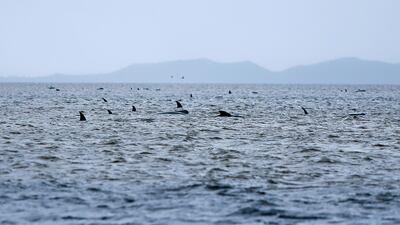
Stranded whales are seen along the coastline near the remote west coast town of Strahan on the island state of Tasmania, Australia. Reuters -
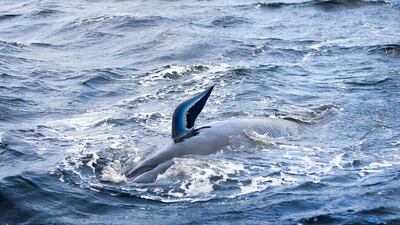
A stranded whale is seen along the coastline near the remote west coast town of Strahan. Reuters -
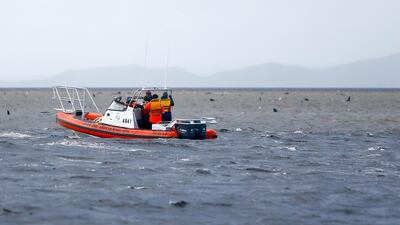
A Parks and Wildlife boat assesses the situation at Strahan. Reuters -
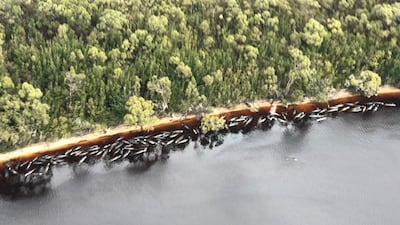
Numerous stranded whales are seen along the coastline near the remote west coast town of Strahan. Reuters -
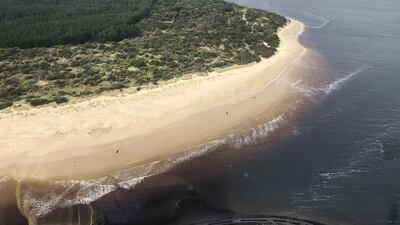
An aerial view shows pilot whales beached along the coastline near the remote west coast town of Strahan. EPA -
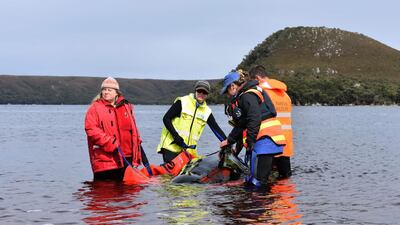
Rescuers work to save a whale stranded on a sandbar in Macquarie Harbour on the rugged west coast of Tasmania. AFP -
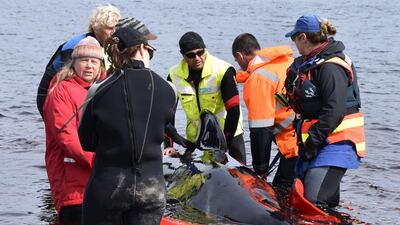
Rescuers work to save a whale stranded on a sandbar in Macquarie Harbour on the rugged west coast of Tasmania. AFP -

Rescue teams work to save a Pilot Whale at Macquarie Harbour in Strahan. Getty Images -
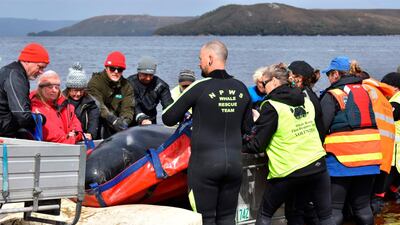
Rescuers load a whale onto a trailer in Macquarie Harbour on Tasmania's west coast. AFP -
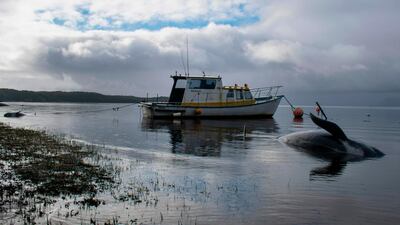
Pilot whales, some of at least 380 stranded that have died, are seen washed up in Macquarie Harbour on Tasmania's west coast. AFP


Globally, around 2,000 stranding events take place annually. Similar events are seen even in the UAE, with a dead killer whale or orca having been found off Ras Al Khaimah in 2008 after the animal died probably after getting lost.
Following the "sick leader" prompts mass deaths
According to Dr Andrew Brownlow, a veterinary surgeon who has been conducting post-mortems on stranded whales and other cetaceans for more than a decade, the “sick leader hypothesis” is one possible explanation for this week’s events in Tasmania, which have seen about 380 individuals die and several dozen helped into deeper waters by rescuers.
Pilot whales live in large matrilineal pods of adult females and their family members, and a leading animal may have approached the shore after becoming disoriented because it was in unwell or distressed.
“If you have a leader who, for whatever reason – disease or trauma or noise – if that animal decides to go in a particular direction, the others will follow,” said Dr Brownlow, who heads the Scottish Marine Animal Stranding Scheme in the UK and advises the International Whaling Commission on strandings.
“That’s where you have the horrific situation where you can get 400 to 500 animals on a beach. If you looked at these animals, you would find that 95 percent were healthy at the point at which they reached the beach.”
Noise of industry a threat to marine life
Local geography also often plays a part, with the creatures’ sonar navigation system struggling to identify a gently sloping shoreline.
“It’s very difficult for them to navigate near soft sand,” said Dr Brownlow. “It’s like us trying to navigate in a forest in the fog.”
Other factors, said Dr Brownlow, were noise from naval sonar and oil and gas exploration, which can disturb cetaceans and make them flee safer deep water to more hazardous shallow waters. Pollution can also cause animals to become ill and disoriented, while rough seas may also play a role.
“[Mass strandings] have been going on for as long as there’ve been animals like these in the sea, it would seem,” said Dr Brownlow.
“We don’t actually have to assume it’s because of something we’ve done, although it would be highly disingenuous of us to discount the possibility we’re somehow partly responsible for these type of events.”
Strandings could put some species in grave danger
Indeed, artificial causes could be causing an increase in strandings in some parts of the world. In the UK, for example, 4,896 whales, dolphins and porpoises died on beaches between 2011 and 2017, up 15 percent on the previous seven-year period.
“Reasons may include an increase in underwater noise sources, entanglement in fishing gear and plastic ingestion,” said Danny Groves, a spokesperson for the international charity Whale and Dolphin Conservation.
With the worldwide population of long-finned pilot whales numbering around one million, a mass stranding does not threaten the species, although many other cetaceans are much less abundant.
Andrew Baillie, cetacean strandings officer at the Natural History Museum in London, said it was important for people who had seen beached animals anywhere in the world to report them to the national strandings body.
“Pilot whales are not threatened; even a mass stranding is not going to be a conservation threat, but for rarer species, it’s worth us monitoring the strandings, and if we can get to it, we can take samples and try to find out why it’s stranded,” he said.

