


Now that the James Webb Space Telescope has reached its final orbit, engineers will spend the next five months preparing the observatory for its mission to study the universe.
The world’s most powerful telescope on Monday successfully completed a journey of 1.5 million kilometres, arriving at a place in space known as Lagrange Point 2.
The location helps the $10 billion spacecraft to orbit the Sun while “hiding behind” the Earth to protect itself from the solar heat and allowing it to see greater distances than any other telescope in history.
Bill Ochs, Webb’s project manager, said the telescope has been successful since its launch from a spaceport in South America on December 25.
“During the past month, the James Webb Space Telescope has achieved amazing success and is a tribute to all the folks who spent many years and even decades to ensure mission success,” he said.
“We are now on the verge of aligning the mirrors, instrument activation and commissioning, and the start of wondrous and astonishing discoveries.”
The telescope was in development for more than 20 years and faced several delays.
Once operations begin, the observatory should be able to see more than 13.5 billion light years away and capture data concerning the birth of the universe.
However, there are still several months to go before the science phase commences. The first science images are expected by summer.
In a webcast on Tuesday, Nasa engineers explained the next steps.
Cooling down the telescope
First, the telescope needs to cool down more.
Its enormous mirror, made up of 18 smaller hexagonal mirrors, has to be kept at a temperature of minus 233°C to work properly.
The temperature of its instruments also has to be reduced so it can take images successfully.
A five-layer sunshield, the size of a tennis court, helps to weaken the heat from the Sun by more than a million times.

“Now, we just continue to cool down in order for our instruments and fine steering mirror to function at optimal capacity. They need to reach a set temperature range,” said Dr Amber Straughn, deputy project scientist for Webb’s science communications.
“Sometimes it's easy for us to assume that because it's space, it can get really cold. Why wouldn't we just instantly freeze up, especially with this humongous sunshield?
“But we have to remember that the space environment is not like it is here on Earth. We have heat transfer processes here on Earth, like convection and conduction. In space, we're limited to radiation, therefore the heat dissipation takes a lot longer.”
Aligning the mirrors
By next week, engineers will start aligning the 18 mirrors so they all point in one direction.
Small motors placed behind every mirror would help engineers move each one of them by 10 nanometres – less than the thickness of a single strand of hair.
These tiny movements would help with precision.
“That's how much control we have with these motors. They provide six degrees of freedom. We're going to move each mirror very carefully,” Dr Straughn said.
“And we're going to determine which images are reflecting from which mirrors, and then through the wavefront sensing and control process we'll be able to achieve full alignment and fully align our iconic gold mirror and finally focus the telescope.”
Testing the instruments
Once the alignment is complete, engineers will calibrate its four main instruments.
These include cameras, spectrographs and imagers that will detect light from distant stars and galaxies, and planets orbiting other stars.
They will test the instruments several times to make sure the telescope is ready for its science operation by the summer.
Wonders of space - in pictures
-
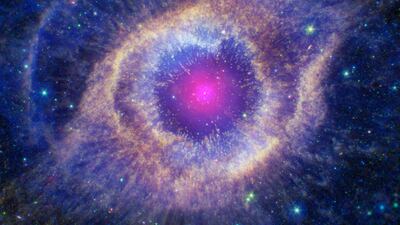
Helix Nebula is a phase when a star like the Sun runs out of fuel, it expands and its outer layers puff off, and then the core of the star shrinks. All photos: Nasa -
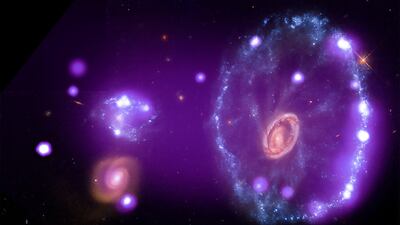
This Cartwheel Galaxy resembles a bull's eye, which is appropriate because its appearance is partly due to a smaller galaxy that passed through the middle of this object. -
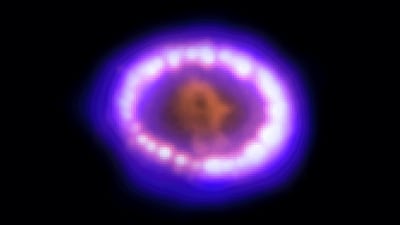
On February 24, 1987, observers in the southern hemisphere saw a new object in a nearby galaxy called the Large Magellanic Cloud. This was one of the brightest supernova explosions in centuries and soon became known as Supernova 1987A. -
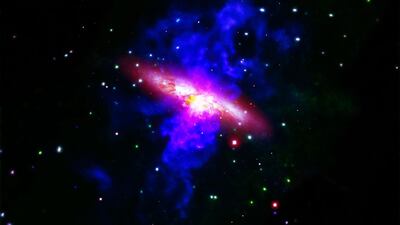
Messier 82, or M82, is a galaxy that is oriented edge-on to Earth. This gives astronomers an interesting view of what happens as this galaxy undergoes bursts of star formations. -

Galaxy clusters are the largest objects in the universe held together by gravity. They contain enormous amounts of superheated gas, with temperatures of tens of millions of degrees, which glow brightly in X-rays and can be observed across millions of light years between galaxies. -

What will be the next star in our Milky Way galaxy to explode as a supernova? Astronomers aren't certain, but one candidate is in Eta Carinae, a volatile system containing two massive stars that closely orbit each other.



