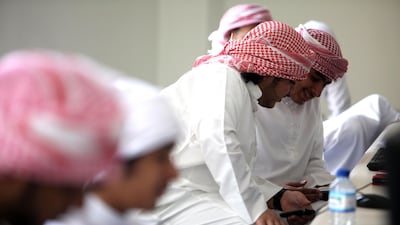
• The UAE changed its working week in January 2022. Federal and local government staff now work from 7.30am to 3.30pm, from Monday to Thursday, and from 7.30am to midday on Friday. Sarah Dea / The National
    The UAE changed its working week in January 2022. Federal and local government staff now work from 7.30am to 3.30pm, from Monday to Thursday, and from 7.30am to midday on Friday. Sarah Dea / The National
  • Friday sermons and prayers are held at 1.15pm after the working week changes. Chris Whiteoak / The National
    Friday sermons and prayers are held at 1.15pm after the working week changes. Chris Whiteoak / The National
  • Schools in the UAE scheduled lessons in line with major changes to the working week. Chris Whiteoak / The National
    Schools in the UAE scheduled lessons in line with major changes to the working week. Chris Whiteoak / The National
  • No specific instructions or guidance was made relating to the private sector, but companies do not require the government’s permission to set their working week. Victor Besa / The National.
    No specific instructions or guidance was made relating to the private sector, but companies do not require the government’s permission to set their working week. Victor Besa / The National.
  • The new long weekend would ‘boost productivity and improve work-life balance’, the UAE Government Media Office said in a tweet in January when the changes were introduced. Paulo Vecina / The National
    The new long weekend would ‘boost productivity and improve work-life balance’, the UAE Government Media Office said in a tweet in January when the changes were introduced. Paulo Vecina / The National

From private sector to public holidays: questions about the new UAE weekend answered


  • English
  • Arabic

The new year will usher in the biggest overhaul of the UAE's working week for more than a decade.

On Tuesday, the government announced federal government departments would switch to a four-and-half-day week from January 1.

The Abu Dhabi and Dubai governments soon confirmed they would follow suit, along with schools in the emirates.

The changes mean employees will work full days Monday to Thursday, with a half day on Friday. Sharjah's public sector will introduce a four day Monday-Thursday working week and a three day weekend.

Mosques will hold Friday sermons and prayers at a fixed time of 1.15pm, with government employees having the option to work from home on this day.

The new weekend will be Saturday and Sunday, bringing the Emirates in line with much of the world.

Such a significant change has prompted a number of questions from The National readers, including the much-discussed: what will happen to the private sector?

Here, The National has the answers.

Why is the change being made?

The move is aimed at boosting the work-life balance of the UAE population and will help to "better align the Emirates with global markets, reflecting the country’s strategic status on the global economic map", a statement from the UAE Government Media Office said.

The new working week will support the UAE's global development in the decades to come.

"It will ensure smooth financial, trade and economic transactions with countries that follow a Saturday/Sunday weekend, facilitating stronger international business links and opportunities for thousands of UAE-based and multinational companies," the statement added.

"The new working week will also bring the UAE’s financial sector into closer alignment with global real-time trading and communications-based transactions such as those driving global stock markets, banks and financial institutions. The move is expected to boost not only trading opportunities but also add to the flexible, secure and enjoyable lifestyle the Emirates offers its citizens and residents."

What will happen in the private sector?

The decision to introduce new working hours for the public sector led many readers working in the private sector to ponder how they will be affected.

While the public sector and private sector are typically unified in terms of public holidays - such as the recent Golden Jubilee break - private firms are not obligated, in this case, to change their current working practices.

This was made clear by the Minister of Human Resources and Emiratisation in an interview with The National on Tuesday.

Dr Abdulrahman Al Awar said the UAE's new labour laws give private sector employers the flexibility to choose what weekend days "help them to be more competitive and enhance their economic competitiveness and growth".

Mr Al Awar, however, believes private sector companies will adjust their weekends to Saturday and Sunday.

"They make their decisions based on what they feel will improve their competitive position and they will make wise decisions that suit their companies," he said.

His view was backed by industry experts, who predict the private sector will make the transition.

One practical reason is to allow parents to work on the same days their children attend school.

Moving in line with global working practices will also be of benefit to companies operating in the Emirates.

“This will align the UAE with global markets and make it easier for international corporations to do business,” said Nabil Alyousuf, chief executive officer of Dubai-based International Advisory Group.

“This will increase the number of days we do business with the rest of the world, which will boost trade.”

Why is there an extra public holiday?

Authorities announced on Tuesday that Sunday, January 2, will be a public holiday.

This is an additional day of leave to the list of public holidays for 2021/2022 released by the UAE Cabinet at the end of 2020.

The governments of both Dubai and Abu Dhabi announced the extra holiday as part of their decision to adopt the new weekend.

The decision will ease the transition to the new way of working and allow companies more time to adapt to the changes.

What will schools do?

  • Dubai, United Arab Emirates, Sep 09, 2012 - Students and parents arrive at St Andrews School in in Al Safa. The group Dubai Education has said they will now take over the management of the school. ( Jaime Puebla / The National Newspaper )
    Dubai, United Arab Emirates, Sep 09, 2012 - Students and parents arrive at St Andrews School in in Al Safa. The group Dubai Education has said they will now take over the management of the school. ( Jaime Puebla / The National Newspaper )
  • The Dubai Wellington International school opened its doors to students for its sixth year. Along with a fresh crop of students is a new Principal, Keith Miller, second right. Lee Hoagland / The National
    The Dubai Wellington International school opened its doors to students for its sixth year. Along with a fresh crop of students is a new Principal, Keith Miller, second right. Lee Hoagland / The National
  • Students take part in PE at the GEMS Wellington International School in Dubai. Lee Hoagland / The National
    Students take part in PE at the GEMS Wellington International School in Dubai. Lee Hoagland / The National
  • Students at the Queeba Girls School in Ras Al Khaimah queue to receive their school books for the year. Razan Alzayani / The National
    Students at the Queeba Girls School in Ras Al Khaimah queue to receive their school books for the year. Razan Alzayani / The National
  • Sixth Grade students play a game at their first English lesson of the year at the Queeba Girls School in Ras Al Khaimah. Razan Alzayani / The National
    Sixth Grade students play a game at their first English lesson of the year at the Queeba Girls School in Ras Al Khaimah. Razan Alzayani / The National
  • Kylie Snyder, 15, who just moved with her family from Ohio, in a art lesson at the American Academy for Girls in Mizhar. Razan Alzayani / The National
    Kylie Snyder, 15, who just moved with her family from Ohio, in a art lesson at the American Academy for Girls in Mizhar. Razan Alzayani / The National
  • Kylie's sister, nine year old Taylor packs away her books at the American Academy for Girls in Mizhar. Razan Alzayani / The National
    Kylie's sister, nine year old Taylor packs away her books at the American Academy for Girls in Mizhar. Razan Alzayani / The National
  • Ahmed Al Maamari, an Emirati teacher on his first day with grade three students at Al Aasimah School in Abu Dhabi. Ravindranath K / The National
    Ahmed Al Maamari, an Emirati teacher on his first day with grade three students at Al Aasimah School in Abu Dhabi. Ravindranath K / The National
  • Students attend the first day of college at the men's campus of UAE University in Al Ain. Sammy Dallal / The National
    Students attend the first day of college at the men's campus of UAE University in Al Ain. Sammy Dallal / The National

Public and private schools will switch to the new four-and-half-day week, starting from Monday, January 3.

School leaders told The National they were in favour of the move and will work to develop new timetables, taking into consideration the half day on Friday to allow for Muslim pupils to attend sermons and prayers at 1.15pm throughout the year.

“We see the benefits in terms of staff, pupil, and parent well-being in having a more flexible working week in relation to four and a half days," said Alan Williamson, chief executive officer of Taaleem, one of the UAE's largest school groups.

He said school principals and senior leaders would be busy over the winter break ensuring schools opened on January 3 with the new arrangements in place.

"Our parents will expect us to move in line with the public and private sector and we will work tirelessly to ensure there is clear communication across our schools for staff, students, and parents,” he said.

When is it the weekend across the region?

The UAE's new Saturday-Sunday weekend will match common practices in much of the world, aiding the nation's efforts to cement itself as a global player.

Across the Mena region, the UAE will not be alone in taking a break on those two days.

While the Sunday-Thursday week holds sway in the rest of the Gulf, other countries to take a break on Saturday and Sunday include Lebanon, Tunisia and Morocco.


More from Armen Sarkissian
How green is the expo nursery?

Some 400,000 shrubs and 13,000 trees in the on-site nursery

An additional 450,000 shrubs and 4,000 trees to be delivered in the months leading up to the expo

Ghaf, date palm, acacia arabica, acacia tortilis, vitex or sage, techoma and the salvadora are just some heat tolerant native plants in the nursery

Approximately 340 species of shrubs and trees selected for diverse landscape

The nursery team works exclusively with organic fertilisers and pesticides

All shrubs and trees supplied by Dubai Municipality

Most sourced from farms, nurseries across the country

Plants and trees are re-potted when they arrive at nursery to give them room to grow

Some mature trees are in open areas or planted within the expo site

Green waste is recycled as compost

Treated sewage effluent supplied by Dubai Municipality is used to meet the majority of the nursery’s irrigation needs

Construction workforce peaked at 40,000 workers

About 65,000 people have signed up to volunteer

Main themes of expo is  ‘Connecting Minds, Creating the Future’ and three subthemes of opportunity, mobility and sustainability.

Expo 2020 Dubai to open in October 2020 and run for six months

UAE currency: the story behind the money in your pockets
THE SIXTH SENSE

Starring: Bruce Willis, Toni Collette, Hayley Joel Osment

Director: M. Night Shyamalan

Rating: 5/5

UPI facts

More than 2.2 million Indian tourists arrived in UAE in 2023
More than 3.5 million Indians reside in UAE
Indian tourists can make purchases in UAE using rupee accounts in India through QR-code-based UPI real-time payment systems
Indian residents in UAE can use their non-resident NRO and NRE accounts held in Indian banks linked to a UAE mobile number for UPI transactions

Ten tax points to be aware of in 2026

1. Domestic VAT refund amendments: request your refund within five years

If a business does not apply for the refund on time, they lose their credit.

2. E-invoicing in the UAE

Businesses should continue preparing for the implementation of e-invoicing in the UAE, with 2026 a preparation and transition period ahead of phased mandatory adoption. 

3. More tax audits

Tax authorities are increasingly using data already available across multiple filings to identify audit risks. 

4. More beneficial VAT and excise tax penalty regime

Tax disputes are expected to become more frequent and more structured, with clearer administrative objection and appeal processes. The UAE has adopted a new penalty regime for VAT and excise disputes, which now mirrors the penalty regime for corporate tax.

5. Greater emphasis on statutory audit

There is a greater need for the accuracy of financial statements. The International Financial Reporting Standards standards need to be strictly adhered to and, as a result, the quality of the audits will need to increase.

6. Further transfer pricing enforcement

Transfer pricing enforcement, which refers to the practice of establishing prices for internal transactions between related entities, is expected to broaden in scope. The UAE will shortly open the possibility to negotiate advance pricing agreements, or essentially rulings for transfer pricing purposes. 

7. Limited time periods for audits

Recent amendments also introduce a default five-year limitation period for tax audits and assessments, subject to specific statutory exceptions. While the standard audit and assessment period is five years, this may be extended to up to 15 years in cases involving fraud or tax evasion. 

8. Pillar 2 implementation 

Many multinational groups will begin to feel the practical effect of the Domestic Minimum Top-Up Tax (DMTT), the UAE's implementation of the OECD’s global minimum tax under Pillar 2. While the rules apply for financial years starting on or after January 1, 2025, it is 2026 that marks the transition to an operational phase.

9. Reduced compliance obligations for imported goods and services

Businesses that apply the reverse-charge mechanism for VAT purposes in the UAE may benefit from reduced compliance obligations. 

10. Substance and CbC reporting focus

Tax authorities are expected to continue strengthening the enforcement of economic substance and Country-by-Country (CbC) reporting frameworks. In the UAE, these regimes are increasingly being used as risk-assessment tools, providing tax authorities with a comprehensive view of multinational groups’ global footprints and enabling them to assess whether profits are aligned with real economic activity. 

Contributed by Thomas Vanhee and Hend Rashwan, Aurifer

Updated: December 10, 2021, 6:57 AM