
Arabian Travel Market 2026 wraps up on Thursday with a clear message: the region is not simply recovering from a disrupted year, it is accelerating.
Online travel marketplace Wego's search data shows travellers kept planning trips even as airspace closed around them. “What travellers lost was the ability to fly, not the intention to,” says Wego chief executive Ross Veitch. “Access, not appetite, sets the ceiling on destination performance in this region.”
The trade show's own Travel Trends Report forecasts a 57 per cent rise in international visitor spending across the Middle East by 2030. Here are the eight trends defining where the region's travel energy goes next.
Golden age of Gulf rail
Over a third of Wanderlust readers now actively seek out rail journeys when they travel, a figure that the UK magazine said in a presentation at ATM has effectively doubled in recent years. Its most-read story of the past few weeks was on the launch of Etihad Rail.

Now a new luxury product is about to raise the stakes. Dream of the Desert, developed by Arsenale International, is a fully curated rail experience launching in Saudi Arabia, with the first trips departing in September 2027. The train will thread through undiscovered terrain between Riyadh and the kingdom's north-west, complete with extinct volcanoes, oases, fortified farms and Unesco heritage sites.
Rather than conventional guides, historical narratives unfold through live performance – singers, actors and staged shows at each stop. “It is a destination itself. It is an experience, end to end,” said Arsenale chief executive Raffaele Breschi, who is serving as general manager of the Saudi project, on the sidelines of ATM. Separate itineraries will serve adventure, wellness and exploration audiences. Iterations in Egypt, Uzbekistan and the UAE will follow – the luxury passenger service is expected to launch in the Emirates in 2028.
Museum moment
Egypt has dominated the Wego destination rankings for 12 consecutive years. Its latest hold on first place, through a year of significant regional disruption, was powered in part by the Grand Egyptian Museum – which contributed to a 43.5 per cent rise in inbound arrivals from January to March this year alone.

That dynamic is about to play out closer to home. Al Fahidi Fort – a building that dates back to the 18th century and has served as a fortress, administrative centre, ruler's court, and the city's first museum as of 1971 – has undergone a transformation and reopens later this year. Previously known as Dubai Museum, Al Fahidi Fort closed for restoration in 2021.
The visitor journey will now begin underground, descending into a new extension built beneath a water feature, where galleries layer historical artefacts, oral histories and archival documents with immersive audiovisual shows, before leading through a connecting passage into the fort's own historic structure. “The fort itself is our main artefact here,” project lead Ayisha Khansaheb for Dubai Culture tells The National.
Guggenheim Abu Dhabi is expected to open before the year closes too, joining Louvre Abu Dhabi, Zayed National Museum and Natural History Museum Abu Dhabi in Saadiyat Cultural District.
“This is perhaps the area where it's growing fastest of all … people going to visit museums, cultural attractions, major exhibitions, heritage sites,” said Lyn Hughes, Wanderlust founding editor.
Craft-led travel
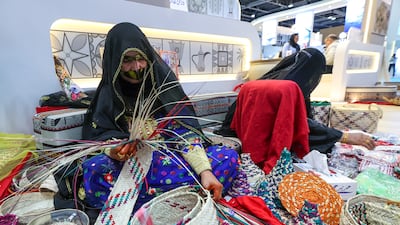
At ATM, snaking queues formed around stands offering hands-on experiences, particularly Bahrain’s pearl-shucking.

“Craft-led tourism is increasingly a theme, particularly with Gen Zs,” Hughes said, adding that jewellery-making “can be a driver to travel”.
The Wanderlust reader survey places makers, artists and cultural custodians as attracting 28 per cent reader interest; a fifth actively seek hands-on activities on their trips.
Hotels across the region are beginning to respond, with weaving workshops, pottery classes, mosaic sessions and jewellery ateliers appearing on activity menus. For a region rich with craft traditions – Bedouin textile work, Islamic metalwork, Omani silver, Palestinian tatreez – the packaging of those traditions into bookable traveller experiences is still largely in its early stages.
The Grand Tour
The UAE Grand Tour launches this September, treating the country as one destination. Seven multi-day itineraries now stitch the seven emirates into a single continuous journey, replacing the typical one-city stay with routes that move between desert dunes, mountain trails, coastal reserves, heritage forts, art institutions and wellness retreats.
The Grand Classic and Grand Adventure programmes each run for 11 days and 10 nights. The Grand Eco Friendly itinerary threads through Jubail Mangrove Park, Al Zorah Reserve, Kalba Eco Sanctuary and Sir Bani Yas Island. A Grand Wellness route takes in Ajman's Al Zorah, the Fujairah coast, Hatta's Hajar Mountains and Al Ain Oasis.
The concept – “one country, seven journeys” – acknowledges something the tourism industry has been slow to act on: visitors who move between emirates stay longer, spend more and leave with a more complete picture of what the UAE actually offers.
Nordic opening

From October 1, Emirates airline will add Helsinki to its network, launching with the A350. Finland offers forests covering the vast majority of the country, thousands of lakes, a Nordic capital with world-class design credentials and winter access to the Northern Lights.
The launch comes as Emirates enters the winter season in strong shape – the airline is operating at about 93 per cent of its pre-disruption capacity, with forward bookings tracking ahead of last year from Saudi Arabia, India, Egypt, Brazil and Nepal among others.
Himalayan climb

Of all the destinations tracked by Wego's 2026 leader board, Nepal recorded the largest single gain and highest ascent on the chart, climbing eight places. Emirates separately identifies the country – served via its flydubai partnership – as a market with winter bookings ahead of last year.
The data reflects something Hughes articulates at ATM: travellers’ instinct to seek places where they feel like explorers rather than tourists, sites “where they're not going to have to queue to get a photo”. The Himalayan trekking circuit, Kathmandu's spiritual heritage and mountain landscapes that remain, by global standards, remarkably unspoilt, sit within reach of the Gulf market.
While Nepal has been hit by natural disasters in recent decades, including flash floods in August, it remains high on the list of both adventurous and conscientious travellers.
Meet the locals
Ask Hughes to name her single standout trend, and she says authentic experiences that allow travellers to socialise with local residents. “This is the sort of emotional experience that will make people ambassadors for your product, for your brand, for your destination.”
In Copenhagen recently, she joined a scheme that pairs visitors with elderly residents. In Barbados, the Dine with a Local scheme delivered a Saturday dinner with a family.
Hughes argues that the model – genuine Arabian hospitality formalised into a structured, bookable experience – is one that the Gulf is uniquely positioned to deliver, pointing to the expansion of women guides, homestay networks and immersive dining as the components already taking shape.
Starcations
At ATM, Hughes describes travellers “becoming obsessed with the night sky, night safaris, sleeping under the stars”. Saudi Arabia has moved faster than any other country to formalise that obsession.

In August, Desert Rock Resort and Nujuma, a Ritz-Carlton Reserve – both part of the Red Sea tourism megaproject – became the first properties in the world to receive DarkSky International's Approved Resort certification, awarded for protecting natural night skies.
AlUla separately expanded its dark-sky certification in December 2025 to include Sharaan National Park and Wadi Nakhlah Nature Reserve. The result is a constellation of certified sites that makes Saudi Arabia one of the most credible dark-sky destinations – and one still, in large part, to be discovered.

