


Thursday's Champions League draw has delivered what Uefa promised: more football, more jeopardy and more of the best players in the world contesting one another.
This is exactly what the new format was meant to deliver: a calendar filled with blockbuster clashes, emotional returns and, in the case of Paris Saint-Germain, the weight of one of the toughest schedules of all – again.
Reminder of the new format – more big matches
The Uefa Champions League was overhauled last season for the first time in more than two decades, and it provided plenty of entertainment. The familiar groups of four have gone, replaced by a 36-team league phase. Every club plays eight games, four at home and four away, against opponents drawn from across the four seeding pots. The table then dictates everything: the top eight move straight into the last 16, teams from ninth to 24th fight it out in a play-off in February, and those finishing from 25th down are out of Europe entirely.
From the knockout stage, the competition looks as it always did, with two-legged ties through to the semi-finals and a single final to be played at the Puskas Arena in Budapest on May 30, 2026.
The seeding pots still determine the draw, but they no longer provide the advantages they once did. Being a national champion no longer secures Pot 1, which is reserved only for the holders, while every other slot is decided by Uefa’s five-year ranking. More importantly, each club must face two opponents from every pot, including its own.
Games between clubs from the top two pots have risen from 33 per cent to 50 per cent. Add in England’s record six participants and the impact is obvious. Continental giants such as Real Madrid and Bayern Munich have been handed some of the toughest fixtures.
British sports analytics company Opta’s analysis suggests that both PSG and Bayern have landed the most demanding set of matches. For PSG, it feels like history repeating itself, as Opta also judged them to have had the hardest path to last season's European Cup triumph. Once again the draw has not been kind, throwing up meetings with Bayern Munich, Barcelona, Atalanta and Tottenham among others.
-
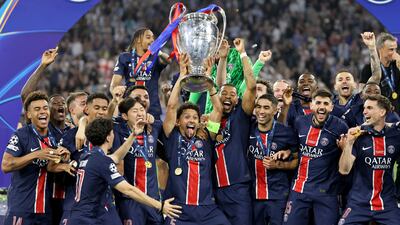
Paris Saint-Germain captain Marquinhos lifts the trophy after their 5-0 Uefa Champions League final win over Inter Milan at the Allianz Arena in Munich on May 31, 2025. EPA -
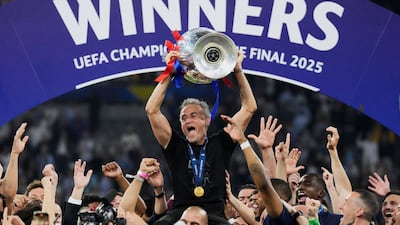
PSG manager Luis Enrique celebrates with the trophy after their stunning win over Inter Milan. AP -
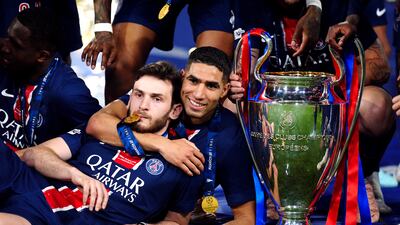
PSG goalscorers Khvicha Kvaratskhelia and Achraf Hakimi with the trophy. PA -
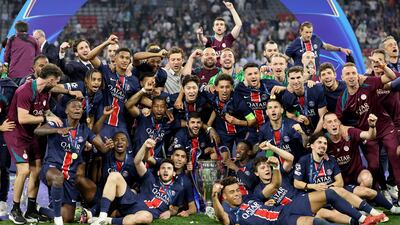
PSG celebrate after the French club became European champions for the first time in their history. EPA -
Desire Doue scores Paris Saint-Germain's third goal. Getty Images -
Khvicha Kvaratskhelia celebrates after scoring PSG's fourth goal in Munich. AP -
Substitute Senny Mayulu scores PSG's fifth goal in the 86th minute. Getty Images -
Desire Doue celebrates scoring his second and PSG's third goal against Inter Milan in Munich. Getty Images -
Khvicha Kvaratskhelia slots home PSG's fourth goal in the 73rd minute. Reuters -
PSG's Desire Doue after scoring his team's second goal in Munich. EPA -
Inter goalkeeper Yann Sommer is wrong-footed by Desire Doue's deflected shot that put PSG two up in Munich. Reuters -
PSG manager Luis Enrique, left, celebrates after Desire Doue put his team 2-0 ahead. Getty Images -
Desire Doue celebrates after scoring his PSG's second goal at the Allianz Arena. AP -
PSG fans set off flares in the stands during the Champions League final. PA -
Desire Doue scores PSG's second goal - via a deflection off Federico Dimarco (not in picture) - in the 20th minute. AP -
Inter manager Simone Inzaghi during the final. EPA -
Achraf Hakimi scores finishes past Inter Milan keeper Yann Sommer. Reuters -
Achraf Hakimi celebrates with teammate Ousmane Dembele after putting PSG 1-0 up in the 12th minute. Getty Images -
Achraf Hakimi side foots past Inter goalkeeper Yann Sommer to put PSG into an early lead. Getty Images -
PSG full-back Achraf Hakimi refuses to celebrate in front of the fans of his former club Inter. Getty Images


But how much does doing well in the League phase matter? Considering that last season's winners, PSG, finished as 15th, the new format shows how eight matches give clubs ample room to slip up and still qualify directly for the knockouts. Aston Villa, for example, advanced comfortably with 16 points.
Finishing in the top eight helps in that teams avoid having to play in the play-offs and adding another two games to an overcrowded fixture list.
Who are the favourites?
PSG
Despite the unkind draw, the French giants are the overwhelming favourites to defend their title. A team equipped for trophies and so magnificently assembled and trained by Luis Enrique, they don’t need to hit the ground running as long as they produce ar the business end of the season. Boasting Ballon d’Or favourite, Ousmane Dembele and the best full-backs in the world, PSG can attack from all areas of the pitch and boast the balance to keep opponents at bay. But repeating success is difficult and the expected departure of goalkeeper Gianluigi Donnarumma will weigh heavy.
Manchester City
It was a disappointing 2024/25 for Pep Guardiola’s team, who finished third in the Premier League, fell to Real Madrid in the Champions League knockout play-offs and ended the campaign without silverware. Two years on from their European Cup triumph, fresh signings have bolstered the squad as they set their sights on conquering Europe once more. With the best manager in the world at the helm, nothing can be ruled out.
Liverpool
While early matches have exposed defensive frailties, Liverpool are the reigning Premier League champions and have added a plethora of big names to the roster in the latest transfer market to ensure depth and balance. Not only is their starting XI one of the best on paper but they have match winners on the bench, including 16-year-old Rio Ngumoha.
Barcelona
The most exciting team to watch in Europe and blessed with an array of talent, yet the question remains: can they defend well enough? The high line continues to be a concern and, while Barca can outscore most opponents, the onus is on Hansi Flick to strike the right balance. At their best, few sides in world football can match their beauty on the ball or score with such ease.
Real Madrid
Speaking of the new Champions League format, Gianluigi Buffon once quipped: “The reason for all these changes is to stop Real Madrid from winning the UCL every time.” It’s the Blancos’ competition and almost always theirs to lose, but they did struggle last season. This year Madrid have moved to address the gaps in the squad. Dani Carvajal is back, and Xabi Alonso has shown he is willing to bench even the biggest names. His aim is to assemble a team with players fighting for their place in the starting XI. The question is whether his ideas can lead them back to glory.
Bayern Munich
For Bayern, squad depth could prove their biggest weakness. Jamal Musiala’s injury and the departure of Kingsley Coman leave them vulnerable should they suffer injuries to the attack. Yet their starting XI remains among the strongest in the competition. Michael Olise is in tremendous form, Harry Kane is a difference maker, Luis Díaz adds thrust from the left and Serge Gnabry looks revitalised. That frontline can overwhelm almost anyone, but the real test will be whether Bayern can stay solid defensively and injury free against Europe’s elite.
The dark horses
Arsenal come into this season as genuine dark horses after reaching the Champions League semi-finals last season, where Mikel Arteta even labelled them the best team in the competition. Their 5-1 dismantling of 15-time champions Real Madrid in the quarter-finals showed just how far they have come, and with a new striker in place and some astute business in the market, they look better equipped than ever. The lingering doubt is whether Arteta’s side have the mentality and experience to reach or win a final.
Antonio Conte’s Napoli might just be the best team in Italy and a favourable draw should see the side progress comfortably to the next stage. Conte is renowned for his ability to dominate domestically and win league titles but he has often disappointed in Europe. Now is the time to alter perceptions as Napoli have been handed a golden opportunity to shine in Europe. Can they seize the moment?
Fixtures to Look out for
PSG v Barcelona
Arguably the most compelling fixture of the round, this blockbuster tie sees Luis Enrique and Dembele face their former club. With both teams brimming with talent and ambition, the Champions League is at its best when it produces match-ups of this quality.
Real Madrid v Manchester City
It would not be the Champions League without these two sides meeting again. Ballon d’Or winner Rodri will go head-to-head with Madrid star Vinicius Junior, who finished just 41 points behind him in the vote, and that controversy provides the perfect backdrop to a fixture that rarely disappoints.
Manchester City v Napoli
One of the ties of the draw, bringing together Guardiola and Conte, two elite managers with contrasting philosophies. The game is loaded with storylines: Kevin De Bruyne making his return to Manchester in Napoli colours, Serie A MVP Scott McTominay back in his home city, and Tijjani Reijnders facing Italian opposition.

Chelsea v Barcelona
This clash will always bring back memories of that infamous 2009 Champions League semi-final at Stamford Bridge, when referee Tom Henning Ovrebo waved away a string of penalty appeals in what remains one of the competition’s most controversial nights. The faces have changed but the appeal remains.
Real Madrid vs Liverpool
Two of the most decorated clubs in Champions League history meet again. Madrid have beaten Liverpool in two finals over the past decade, but this time the spotlight will fall on Trent Alexander-Arnold lining up in white and Xabi Alonso on the Madrid touchline against the club where he once ruled the midfield.

