



The confetti was still being cleared, the stage being struck, and the players dispersing to various points of the globe, but the news agenda was already moving on apace.
A little over 12 hours after the Desert Vipers had set the seal on a much-deserved first title in the DP World International League T20 in Dubai, their owner had other pressing business in the UK.
Avram Glazer had watched his cricket team’s 46-run demolition of MI Emirates in Sunday’s final sat alongside Sheikh Nahyan bin Mubarak in the Royal Box at Dubai International Stadium.

The American businessman chose Dubai over one of his other concerns, Manchester United, who had been in action against Leeds United on the same day in English football’s Premier League.
The contrast between Glazer’s cricket and football operations is polar. The football team is one of glorious history but a dysfunctional present – as evidence by the decision on Monday morning to part with their latest head coach, Ruben Amorim.
The Vipers cricket team, meanwhile, are a four-year-old startup, playing in a league that is still a fair way from establishing a committed following.
And, clearly, the challenges pressing on the different sports are vastly different. For example, the entire budget for the Vipers’ Season 4 campaign is around the same as Casemiro earns in a month for playing in United’s midfield.

But the Vipers have quickly become the benchmark for how to run a new T20 cricket franchise. So much so that it would not have been too much of a surprise if Glazer had sidled over to Tom Moody, the Vipers director of cricket, during the celebrations and said: “Tom, we’re about to have a vacancy elsewhere in the company. Do you fancy it?”
Even though they had been the outstanding side across the campaign, there had been nerves for the Vipers ahead of the final.
They had won more matches than anyone else since the league started four years ago, yet still had no trophy to show for it, having lost twice in finals.
Plus they were playing against the biggest T20 behemoth in the world. Mumbai Indians and their affiliates had not lost a final anywhere, in either the men’s or women’s game, since 2010 before Sunday.
Billy Beane, the mastermind behind the Moneyball methods which inspire so much reverence in sport, would have approved of how the Vipers ultimately felled the giant.
From the league’s inception, the Vipers formula has been informed by statistical analysis of the sort promoted by Beane at the Oakland Athletics in baseball.
Led since the start by Phil Oliver, the co-founder of CricViz – the sport’s leading data analytics and statistics provider – and now Vipers chief executive, they have used data-driven methods to help construct a winning team.
The Vipers fit the template of Moneyball all too perfectly: for all their consistency over the four seasons, they had fallen short at finals time.
Beane always did regard post-season play-offs as a lottery. Given the small sample size of one-off matches, finals successes can never be guaranteed. And yet on Sunday, they made it over the line.
Moneyball is not a term you hear so much of in cricket these days. Primarily because everyone mines data to try to gain an edge now.
Also, the sums of money involved in franchise cricket have spiralled to the extent that putting together a winning team cannot possibly be done on the cheap.
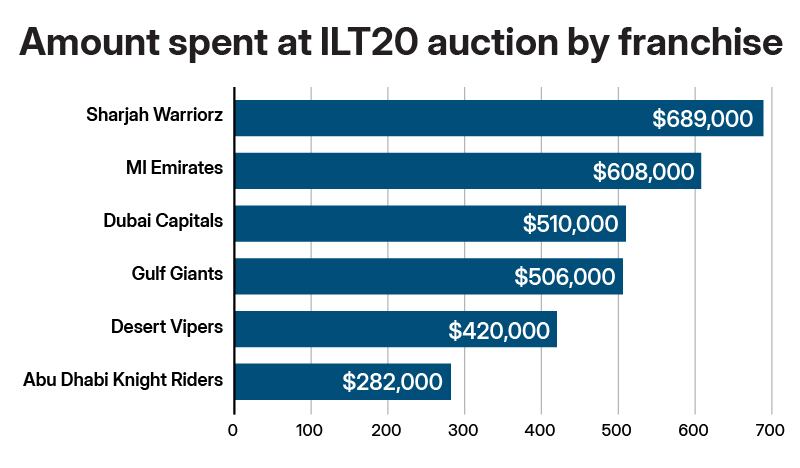
The Vipers’ wage bill for players was the third highest of the six teams in the ILT20, but how they spent their money is intriguing.
Players are recruited in the UAE’s T20 league via either retention, direct negotiation or, for the first time this season, via auction. Teams had a ceiling of $800,000 to spend at the auction, as part of a salary cap of $2 million.
The Vipers’ $420,000 outlay at the auction, back in October, was around a quarter of their overall salary spend of a little over $1.6m.
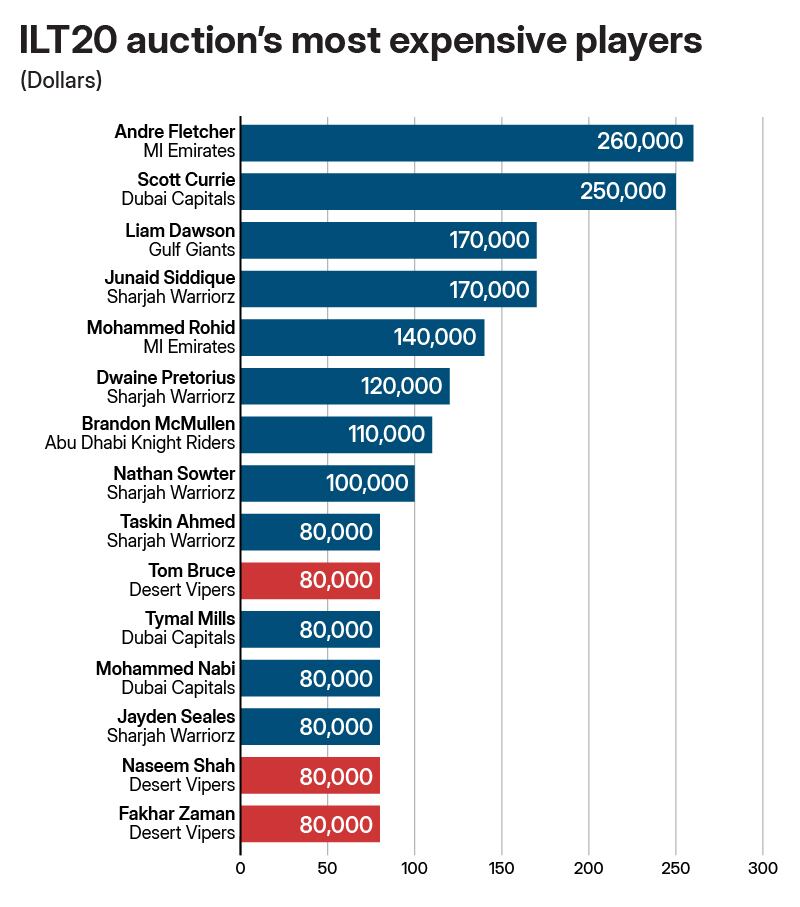
The majority of their budget went on retentions of trusted performers like Sam Curran – who was the league’s MVP for the second season running – and Khuzaima Tanveer, as well as direct negotiations.
One player they got through the latter route was Andries Gous, the USA wicketkeeper-batter. Salaries via direct negotiation are not disclosed, but whatever they paid for Gous, it was money well spent.
He filled the mandatory Associate player berth with great success, notably with his century in the qualifier play-off, which powered the Vipers straight through to the final.
It was how the Vipers managed the auction which was most telling. Each of the other franchises are linked to either Indian Premier League or Women’s Premier League teams. As such, all are well practiced in the auction process.
The Vipers are the outliers as the only single-team entity in the ILT20. As an organisation, they had no previous auction experience, even if many of their management staff have had similar roles in the IPL.
The Vipers spent the second least of the sides at auction. Their costs remained manageable thanks to one significant advantage, brought about by geopolitics. The auction happened shortly after the handshake row between India and Pakistan at the Asia Cup.
As the only non-Indian owned franchise, the Vipers had free rein to pick up any Pakistan international players they liked, with no prospect of a bidding war.
It meant they landed outstanding players like Fakhar Zaman ($80,000), Naseem Shah ($80,000), and Hasan Nawaz ($40,000) at their base prices.
Zaman was a consistent performer with the bat, Nawaz excelled most notably in the field, taking 12 catches in the season, and Naseem was the key force with the ball in the final.
Also, when availability issues struck, the Vipers again looked to Pakistan. They reinforced their squad with Usman Tariq, the mystery spinner, ahead of the play-offs, and he played a key role in the trophy win, too.
They leaned into the theme so much that they changed their colours for this season from the black and red of Manchester United, to the green of Pakistan. Officially, this was to reflect their commitment to sustainability, but the counter benefit was not just a lucky coincidence.
The Pakistan issue is a significant advantage as the other sides are limited in their recruitment. The other five sides do not have the counterweight of being able to select leading Indian players.
The only ones available to them are retirees like Sharjah Warriorz’ Dinesh Karthik or Abu Dhabi Knight Riders’ Piyush Chawla, or ones who have gone off to the United States to ply their trade instead, like Unmukt Chand. Ravichandran Ashwin was left on the shelf at the auction.
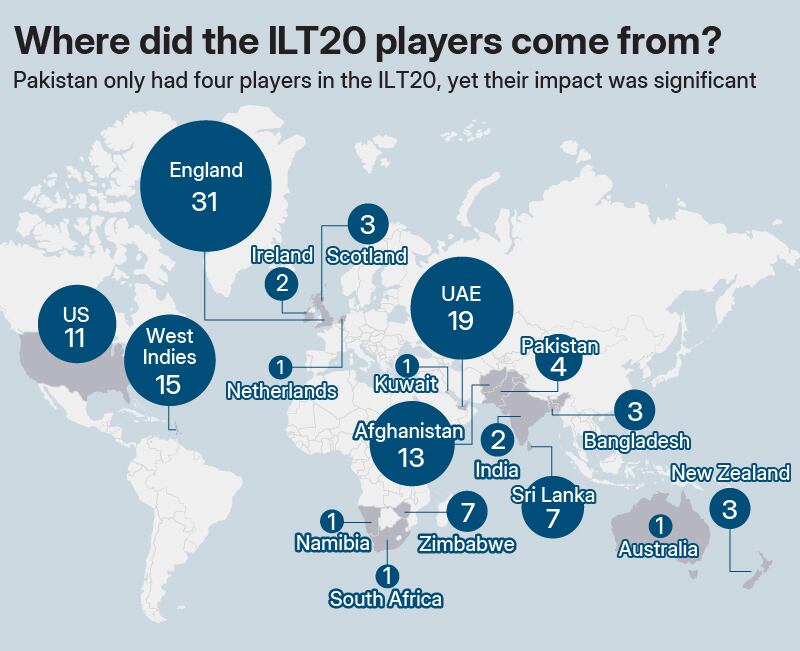
Although ILT20 teams have the world to recruit from – there are only two mandatory spaces for UAE players per XI, plus one extra Associate player – the pool of available players is not actually inexhaustible.
The league clashes with Australia’s BBL, meaning leading players from there are mostly out of commission, although Tim David did feature at the start of the ILT20.
The latter part also clashed with the start of the SA20, meaning issues for South African players.
The majority of overseas players were recruited from England, West Indies and Afghanistan. And yet the Vipers had four Pakistan internationals in their XI in the final, and finished as comprehensive winners.
What all this means long term remains to be seen. The Vipers deserve to celebrate a well-earned achievement, but their owners are almost certainly looking to expand.

Glazer’s purchase of an ILT20 franchise first came about after he missed out on one of the expansion franchises in the IPL.
Entry into that lucrative club might remain the long-term goal. Glazer also visited Saudi Arabia in the recent past, a country with big plans in cricket, even if those plans remain unclear at present.
But for now, the future can wait. For all the number crunching and analytics mining, the salient memory for the Vipers contingent from this season might have been scenes of triumph at the end.
As well as the obligatory pyrotechnics and trophy hoisting, it also included the young children of the players doing cartwheels on the outfield.
“This is what it is all about, and I am so very proud of everyone,” Oliver said.
“It is just a fantastic moment that we all hoped would happen and it was only really right at the end there we thought ‘We are going to do this.’ It is just an amazing feeling, the best you can get in cricket.”

