

Rohit Sharma has played down the idea that India have “home” advantage in the Champions Trophy, as the only side playing all their matches at one venue.
The tournament favourites will face Australia at Dubai International Stadium on Tuesday in the first semi-final. It will be their fourth game at the ground in Sports City. If they win, the final will also be played there on Sunday.
The schedule was decided after India’s government ruled their national team would not travel to Pakistan for the competition. It meant all their matches were to be played on neutral territory instead.
Many observers have pointed out the arrangement gives India a substantial advantage because of the familiarity it gives them with the conditions, as well as the fact they do not have to travel.
-

India's Varun Chakravarthy, left, celebrates the wicket of New Zealand's Glenn Phillips during their Champions Trophy match in Dubai on Sunday, March 2, 2025. AP -
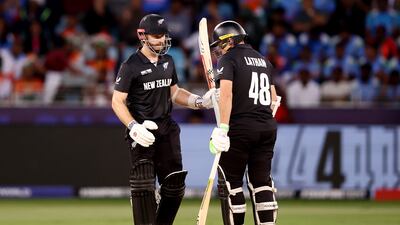
Kane Williamson made a valiant fifty for New Zealand at the Dubai International Stadium. Getty Images -

Varun Chakravarthy was the pick of the bowlers for India, taking 5-42. Getty Images -
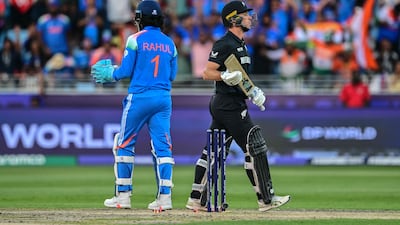
New Zealand's Will Young walks back to the pavilion after being bowled by Varun Chakravarthy. AFP -

Hardik Pandya celebrates with teammate Shubman Gill after taking the wicket of New Zealand's Rachin Ravindra. AFP -

Hardik Pandya scored a crucial 45 for India batting first. AP -
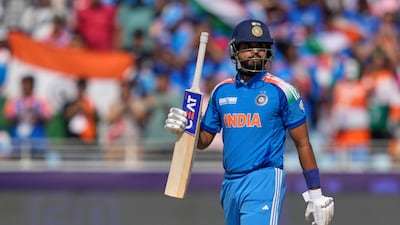
Shreyas Iyer scored a brilliant fifty on Sunday. AP -
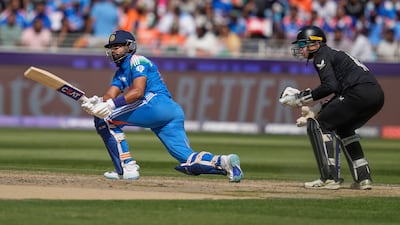
Shreyas Iyer rescued India after an early fall of wickets. AP


Every other side has had to travel between venues. The situation even meant that South Africa had to fly to Dubai from Pakistan, only to then have to return 36 hours later once it was decided India would be the group winners, and would instead face Australia in the last four. The Proteas will play New Zealand in the other semi-final in Lahore a day later.
“They [India] are at one place, one hotel, they don’t have to travel,” said Nasser Hussain, the former England captain who is commentating on the tournament.
“They have one dressing room. They know the pitch, they have picked for that pitch.”
Rassie van der Dussen, the South Africa batter, said: “If you can stay in one place, stay in one hotel, practice in the same facilities, play in the same stadium, on the same pitches every time, it’s definitely an advantage. I don't think you have to be a rocket scientist to know that.”
India successfully defended 249 in their last group match against New Zealand on Sunday. Nine of the wickets they took fell to spinners, of which they had four.
Matt Henry, the seamer who had taken five wickets for New Zealand, said that strategy was well informed. “I think having that luxury of knowing [the surface], they played to the conditions beautifully,” Henry said. “And that was probably what the challenge was for us.”
But Rohit, India’s captain, played down the idea that his side have any significant advantage, saying they have to adapt as well.
“In the semi-final, we don’t know which pitch is going to be played,” Rohit said.
“Whatever happens, we have to adapt and see what is happening. We will play on that. This is not our home, this is Dubai. We don't play so many matches here. This is new for us, too.”
India comfortably won their opening two matches in Dubai against Bangladesh and Pakistan after bowling first. They then had a similar result against New Zealand having been asked to bat first.
“The three matches we played, the nature of the surface was the same,” Rohit said. “But in all three games, the pitch has behaved differently.
“[Against New Zealand], we saw that when the bowlers were bowling, their ball was swinging a little. We didn't see that in the first two games when our bowlers were bowling.
“And in the evening, it's a little cold, so there are obviously a lot of chances of that swing. We know this.
“But the three games we played, there are four or five surfaces that are being used. Every surface has a different nature. We don't know which wicket will be played.
“The pitches look the same, but when you play on it, it's played in a different way. So, you can't go thinking that we played like this yesterday, and today we'll play like this.”

