
When the history of the 2025 Champions Trophy is written, India’s fourth wicket stand in their dead rubber group match against New Zealand will be long forgotten.
Even a day later, it has barely warranted mention, amid all the excitement over five-star Varun Chakravarthy’s arrival as a 50-over force, and the lingering awe over Glenn Phillips’s fielding skills.
The 23-over alliance worth 98 between Shreyas Iyer and Axar Patel was the definition of unspectacular.
Most of it was played out in silence, or as close to quiet as a stadium full of fervent India fans could ever manage, at least.
Everyone seemed shellshocked by the seventh over dismissal of Virat Kohli before he had had the chance to influence his 300th one-day international. Stunned, maybe more to the point, by the brilliance of the one-handed diving catch Phillips claimed to get rid of the star attraction.
-
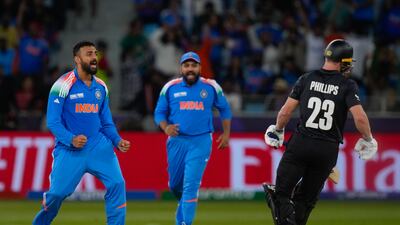
India's Varun Chakravarthy, left, celebrates the wicket of New Zealand's Glenn Phillips during their Champions Trophy match in Dubai on Sunday, March 2, 2025. AP -
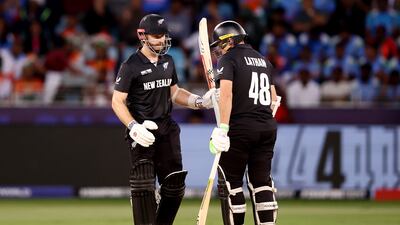
Kane Williamson made a valiant fifty for New Zealand at the Dubai International Stadium. Getty Images -
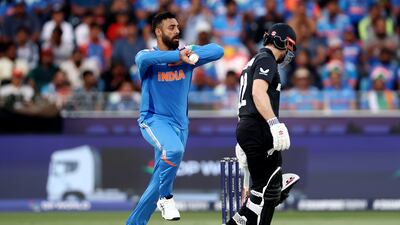
Varun Chakravarthy was the pick of the bowlers for India, taking 5-42. Getty Images -
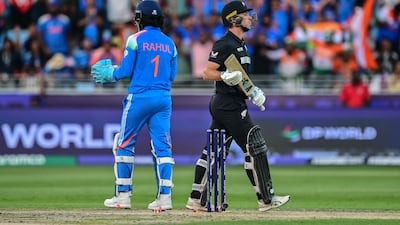
New Zealand's Will Young walks back to the pavilion after being bowled by Varun Chakravarthy. AFP -

Hardik Pandya celebrates with teammate Shubman Gill after taking the wicket of New Zealand's Rachin Ravindra. AFP -

Hardik Pandya scored a crucial 45 for India batting first. AP -
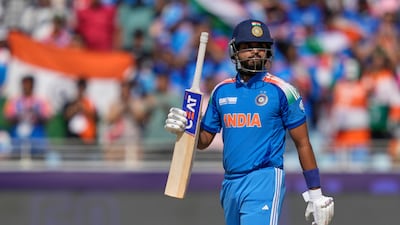
Shreyas Iyer scored a brilliant fifty on Sunday. AP -
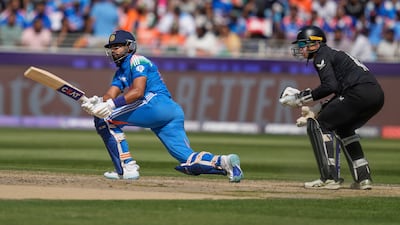
Shreyas Iyer rescued India after an early fall of wickets. AP


What followed that moment of high drama was attrition. Axar made a forgettable 42 in 61 balls, before chipping up a catch to Kane Williamson off Rachin Ravindra’s left-arm spin. Shreyas stayed for some while longer, making 79 from 98 deliveries.
It was just what India needed. It helped set a platform for Hardik Pandya to have a dash at the end of the innings, and allow them to set New Zealand a target. Old-fashioned cricket with an old-fashioned score to chase: 250.
The Iyer-Axar alliance came in stark contrast to what had happened a day earlier, when England brought down the curtain on the Jos Buttler era with a whimper against South Africa.
England lost a clatter of top order wickets, just as India had done. They were 37-3 after 6.4 overs, and India were 30-3 at the same point.
But India were able to rebuild. They were able to adapt to both the match situation and the conditions. They eked out 249-9; England were bowled out for 179 with almost 12 overs unused.
It is undeniable India have an advantage by playing all their Champions Trophy matches in Dubai. They are no doubt comfortable in their hotel rooms.
They are used to the practice facility, and perhaps more pertinently than anything else, they know the surface conditions at Dubai International Stadium better than anyone else.
But they still need to adapt when the match situation dictates. New Zealand threatened to blow them away on Sunday, but India were smart enough to work out a counter ploy.
Maybe the brains of the England batters are just fried. That happens when sides are on a downward spiral, and they were already out of the competition when they faced an upbeat South Africa.
But England, in contrast to India, do seem wedded far too rigidly to a macho gameplan rather than just playing the right gameplan.
“Our gameplan was to try and bring fast bowling over here and to try and stock our batting and give ourselves that sort of conviction and that method, and we may not have got it totally right,” Brendon McCullum, England’s coach, said.
“You’ve got to have conviction in something, and we went for that option this time. In another tournament we get across the line those first two games [when England scored in excess of 300 both times], and that strategy worked. On this occasion we weren’t quite able to do what we wanted to.”
McCullum is new to the post as England’s limited-overs coach. He is set for a rebuild now, after Buttler stepped down as captain.
Judged by the transformation he has overseen in England’s Test game, it is safe to assume the future could well be freewheeling, aggressive and musclebound.
But as Iyer and Co have shown so far in the Champions Trophy, the way forward is smart cricket.
“It is important to adapt,” Iyer said after his similarly understated yet crucial half-century against Pakistan earlier in the group phase.
“It’s not easy to go in and straightaway start smashing the ball because you need to gauge the pace of the wicket how it is coming on to the bat.
“I took few balls at the start to see how it’s coming on. If you show that intent on every ball it is difficult for a batsman, to be honest.
“But if you take some time see how the ball is coming to you and let the ball do the talking rather than you dictate out there in the middle.”

