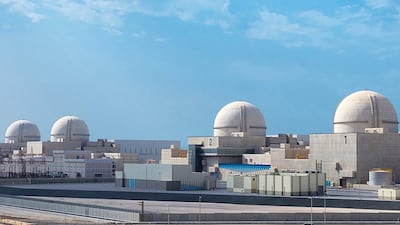
Abu Dhabi authorities on Sunday responded to an electrical generator fire on the grounds of the Barakah Nuclear Energy Plant, caused by a drone strike.
No injuries were reported and there was no effect on radiological safety levels, Abu Dhabi Media Office said.
The fire occurred outside the inner perimeter of the plant, in Al Dhafra region.

"All precautionary measures have been taken, and further updates will be provided as they become available," the Abu Dhabi Media Office said.
The Federal Authority for Nuclear Regulation confirmed that the fire did not affect the safety of the power plant or the readiness of its essential systems, and that all units are operating as normal.
Investigation into drone attacks
The UAE's Ministry of Defence said three drones entered the country from the western border on Sunday.
Two were successfully intercepted, with the third causing the fire outside the Barakah power plant.
The ministry said investigations were under way to determine the source of the attack and that further details would be announced once inquiries were completed.
The UAE and other Gulf states have come under heavy attack from Iran since the war broke out on February 28.
A conditional ceasefire agreed between the US and Iran on April 8 led to a halt in hostilities for several weeks, but Tehran resumed strikes on the Emirates this month.
The director general of the International Atomic Energy Agency (IAEA) on Sunday expressed grave concern about the incident and said military activity that threatens nuclear safety is unacceptable.
In post on the IAEA account on X, Mr Grossi was quoted as reiterating a call for maximum military restraint near any nuclear power plant to avoid the danger of a nuclear accident.
"The IAEA has been informed by the UAE that radiation levels at the Barakah nuclear power plant remain normal and no injuries were reported after a drone strike this morning caused a fire in an electrical generator located outside the inner site perimeter of the nuclear power plant," the post read.
"Emergency diesel generators are currently providing power to the nuclear power plant's Unit 3. The IAEA is following the situation closely and is in constant contact with the UAE authorities, ready to provide assistance if needed."
Key power plant
The Barakah plant is at the heart of the UAE's clean energy drive and is key to the country's wider environmental goals.
It began commercial operations in September 2024 after a phased opening over the course of several years.
President Sheikh Mohamed has previously hailed the opening of the plant as a “significant step on the journey towards net zero”, with the plant representing the largest decarbonisation effort in the UAE and the region.
Nuclear power is regarded as a clean energy because it does not create the same harmful emissions that fossil fuels like oil and gas do.
The plant generates 40 terawatt hours of clean electricity annually, which is about 25 per cent of the UAE’s electricity needs and is equivalent to the annual total power demand of Switzerland.
Carbon-free electricity from Barakah avoids 22.4 million tons of carbon emissions each year, equivalent to removing 4.8 million cars from the road.

