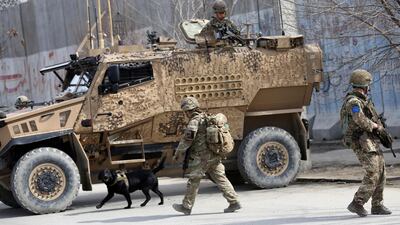
What does independence mean in Afghanistan? For the residents of Kabul, the country's capital, there was little time to ask the question, as Independence Day began this morning under a hail of mortar fire. Several areas of the city were targeted by as yet unknown assailants.
Afghanistan has the unusual distinction of having never been colonised, but it celebrates an independence day nonetheless. The holiday marks the signing of a treaty between Afghanistan’s then king, Amanullah Khan, and Great Britain on August 19, 1919, though Afghanistan follows a variant of the Persian calendar that results in it falling on August 18 this year.
The treaty involved a commitment by Britain to stop interfering in Afghan affairs. In the presence of a British envoy, King Amanullah declared Afghanistan to be “entirely free, autonomous and independent, both internally and externally”. Since then, Afghanistan has marked 100 Independence Day celebrations. Less than half of them occurred outside the shadow of foreign-backed civil wars – yet they were celebrated nonetheless.
In 1919, King Amanullah declared Afghanistan to be 'entirely free, autonomous and independent, both internally and externally'. Getty Images
Even today, there is an awkwardness to Afghan Independence Day, with government buildings protected by foreign soldiers, and the common view among the public is that most political, tribal and military leaders’ strings are pulled from neighbouring capitals or the West.
So what does independence mean in Afghanistan?
To quote King Amanullah’s original declaration of independence, it ought to mean something that applies both “internally and externally”. In recent decades, much attention has been devoted to celebrating the dream – if not the reality – of autonomy from external forces.
Independence Day in the 1980s was celebrated by a Soviet-sponsored communist government, with celebrations emphasising independence from Western powers amid the Cold War. The 75th anniversary of Afghan independence, in 1994, was downplayed by the US-sponsored mujahidin government so that it wouldn’t overshadow the anniversary of the defeat of the communists.
It took several years for the Taliban, which came to power in 1996, to get into the Independence Day spirit. Its first Independence Day parade in 2001 banned clapping, music, women and, if video footage is anything to go by, possibly even smiling. “Afghanistan is the graveyard of invaders,” read a banner, in English.
Implicit in King Amanullah’s original emphasis on “internal independence”, however, was a desire for the country to not only take back control of its own affairs from external powers, but to be responsible for them. After all, what is the point of an independent Afghanistan if it cannot or will not look after its people.
Every Afghan government – from the monarchy to the communists to the mujahidin to the Taliban – operated with the same equation in mind: first take control of the country, then take responsibility for its citizens.
So what does independence mean in Afghanistan?
In 2020, it is difficult to say. The country’s independence is questionable at best. It is not in control of its affairs. Seventy-five per cent of public expenditure comes from foreign aid. Roughly half of the territory is in the hands of the Taliban, ISIS or other militant groups whose own expenditure is funded largely by foreign interests, too.
The only way out, the only way to even begin to take control back into the country's sovereign hands, is to end the war and consolidate a workable, national government. This relies on the Taliban and the Afghan government, who are meant to be in peace negotiations right now but have instead conjured their own respective reasons to delay them. But the success of those talks, when they finally do happen, will be built on a mutual understanding of what the state's responsibilities are to its people.
The old equation must be flipped on its head: Afghan leaders must first take responsibility before they can take back control. If today's Independence Day attacks, however, are anything to go by, neither the government nor the Taliban is prepared to do that.
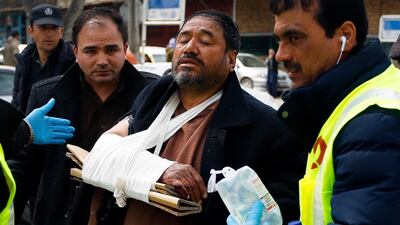
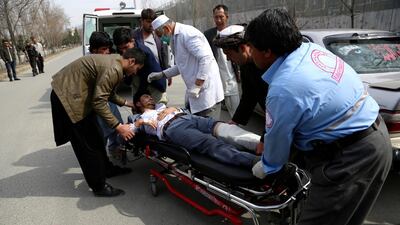
Ten people, including four children, were wounded. “No one has claimed responsibility,” say the news reports.
Afghan health workers carry a wounded man from a hospital after gunmen attacked a political gathering in Kabul. EPA
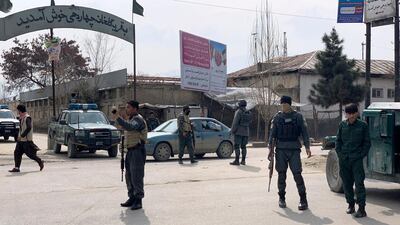
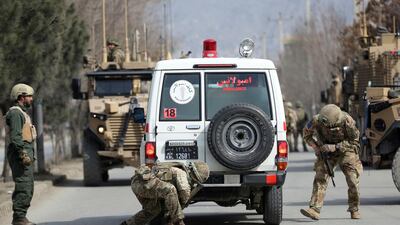
Afghan security personnel arrive at the site of an attack in Kabul, Afghanistan. AP Photo
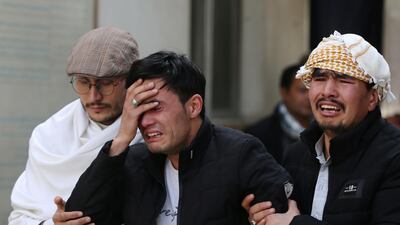
Afghan men cry at a hospital after they heard that their relative was killed during an attack in Kabul. Reuters
Afghan security personnel arrive at the site of an attack in Kabul, Afghanistan. AP Photo
An injured man is carried into an ambulance after an attack in Kabul. AP Photo
British soldiers with NATO-led Resolute Support Mission forces check an ambulance near the site of an attack in Kabul. AP Photo
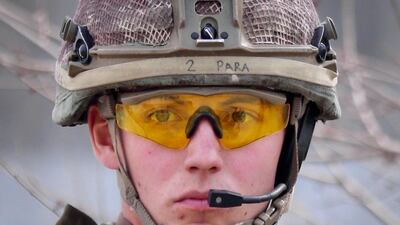
A British soldier stands guard at the site where gunmen attacked a political gathering in Kabul. EPA
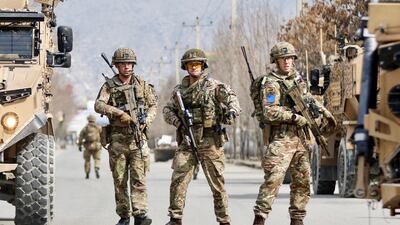
British soldiers stand guard at the site where gunmen attacked a political gathering in Kabul. EPA
British soldiers arrive at the site of an attack in Kabul. AP Photo
Afghan leaders must first take responsibility before they can take back control. If today's Independence Day attacks, however, are anything to go by, neither the government nor the Taliban are prepared to do that
And that is a popular refrain in the narrative of modern Afghanistan. Last week, a policewoman was dragged out of her home and shot dead. No one has claimed responsibility. On the same day, a parliamentarian and peace negotiator was shot in the arm while visiting a market with her sister. No one has claimed responsibility. In May, 40 people, including new-born babies, were killed in an attack on a maternity ward in Kabul. No one has claimed responsibility.
Last month, there were at least 125 deadly attacks against civilians, police officers and soldiers in Afghanistan. These range from bombs planted on minibuses to targeted assassinations of school teachers to entire families being wiped out by roadside bombs. In most of them, no one was caught. No one had to take responsibility.
There are, of course, rare occasions in which everyone wants to claim responsibility, though without actually taking it. On July 27, an Afghan army Black Hawk helicopter was shot down. The Taliban claimed to have shot the helicopter, and Afghan government officials claimed that their own technical issues caused it to crash. In instances like this one, responsibility for a death is somehow a face-saving measure. If only the mindset of responsibility was adopted in earnest rather than out of convenience.
So what does independence mean in Afghanistan?
The truth that must shape Afghanistan’s peace talks is that, for every deadly attack, every act of corruption, every foreign bribe and every failure to negotiate, everyone must take responsibility. An unwillingness to internalise that truth is the deadliest ammunition in a war that feels as though it will never end.
A culture of responsibility will not solve Afghanistan’s security problems or revitalise its economy – at least not right away. But it is the starting point for fostering the national cohesion that is badly needed if Afghanistan is to have a chance at prosperity, and if future Independence Days are to mean anything at all.
Sulaiman Hakemy is deputy comment editor at The National

Destroyer
Director: Karyn Kusama
Cast: Nicole Kidman, Toby Kebbell, Sebastian Stan
Rating: 3/5
UAE release: January 31
Various Artists
Habibi Funk: An Eclectic Selection Of Music From The Arab World (Habibi Funk)
Tax authority targets shisha levy evasion
The Federal Tax Authority will track shisha imports with electronic markers to protect customers and ensure levies have been paid.
Khalid Ali Al Bustani, director of the tax authority, on Sunday said the move is to "prevent tax evasion and support the authority’s tax collection efforts".
The scheme’s first phase, which came into effect on 1st January, 2019, covers all types of imported and domestically produced and distributed cigarettes. As of May 1, importing any type of cigarettes without the digital marks will be prohibited.
He said the latest phase will see imported and locally produced shisha tobacco tracked by the final quarter of this year.
"The FTA also maintains ongoing communication with concerned companies, to help them adapt their systems to meet our requirements and coordinate between all parties involved," he said.
Bogleheads follow simple investing philosophies to build their wealth and live better lives. Just follow these steps.
• Spend less than you earn and save the rest. You can do this by earning more, or being frugal. Better still, do both.
• Invest early, invest often. It takes time to grow your wealth on the stock market. The sooner you begin, the better.
• Choose the right level of risk. Don't gamble by investing in get-rich-quick schemes or high-risk plays. Don't play it too safe, either, by leaving long-term savings in cash.
• Diversify. Do not keep all your eggs in one basket. Spread your money between different companies, sectors, markets and asset classes such as bonds and property.
• Keep charges low. The biggest drag on investment performance is all the charges you pay to advisers and active fund managers.
• Keep it simple. Complexity is your enemy. You can build a balanced, diversified portfolio with just a handful of ETFs.
• Forget timing the market. Nobody knows where share prices will go next, so don't try to second-guess them.
• Stick with it. Do not sell up in a market crash. Use the opportunity to invest more at the lower price.
MATCH INFO
Newcastle United 2 (Willems 25', Shelvey 88')
Manchester City 2 (Sterling 22', De Bruyne 82')
Mercer, the investment consulting arm of US services company Marsh & McLennan, expects its wealth division to at least double its assets under management (AUM) in the Middle East as wealth in the region continues to grow despite economic headwinds, a company official said.
Mercer Wealth, which globally has $160 billion in AUM, plans to boost its AUM in the region to $2-$3bn in the next 2-3 years from the present $1bn, said Yasir AbuShaban, a Dubai-based principal with Mercer Wealth.
“Within the next two to three years, we are looking at reaching $2 to $3 billion as a conservative estimate and we do see an opportunity to do so,” said Mr AbuShaban.
Mercer does not directly make investments, but allocates clients’ money they have discretion to, to professional asset managers. They also provide advice to clients.
“We have buying power. We can negotiate on their (client’s) behalf with asset managers to provide them lower fees than they otherwise would have to get on their own,” he added.
Mercer Wealth’s clients include sovereign wealth funds, family offices, and insurance companies among others.
From its office in Dubai, Mercer also looks after Africa, India and Turkey, where they also see opportunity for growth.
Wealth creation in Middle East and Africa (MEA) grew 8.5 per cent to $8.1 trillion last year from $7.5tn in 2015, higher than last year’s global average of 6 per cent and the second-highest growth in a region after Asia-Pacific which grew 9.9 per cent, according to consultancy Boston Consulting Group (BCG). In the region, where wealth grew just 1.9 per cent in 2015 compared with 2014, a pickup in oil prices has helped in wealth generation.
BCG is forecasting MEA wealth will rise to $12tn by 2021, growing at an annual average of 8 per cent.
Drivers of wealth generation in the region will be split evenly between new wealth creation and growth of performance of existing assets, according to BCG.
Another general trend in the region is clients’ looking for a comprehensive approach to investing, according to Mr AbuShaban.
“Institutional investors or some of the families are seeing a slowdown in the available capital they have to invest and in that sense they are looking at optimizing the way they manage their portfolios and making sure they are not investing haphazardly and different parts of their investment are working together,” said Mr AbuShaban.
Some clients also have a higher appetite for risk, given the low interest-rate environment that does not provide enough yield for some institutional investors. These clients are keen to invest in illiquid assets, such as private equity and infrastructure.
“What we have seen is a desire for higher returns in what has been a low-return environment specifically in various fixed income or bonds,” he said.
“In this environment, we have seen a de facto increase in the risk that clients are taking in things like illiquid investments, private equity investments, infrastructure and private debt, those kind of investments were higher illiquidity results in incrementally higher returns.”
The Abu Dhabi Investment Authority, one of the largest sovereign wealth funds, said in its 2016 report that has gradually increased its exposure in direct private equity and private credit transactions, mainly in Asian markets and especially in China and India. The authority’s private equity department focused on structured equities owing to “their defensive characteristics.”
RACE CARD
5pm: Sheikh Mansour bin Zayed Al Nahyan Racing Festival Purebred Arabian Cup Conditions (PA); Dh 200,000 (Turf) 1,600m 5.30pm: Sheikha Fatima bint Mubarak Cup Conditions (PA); Dh 200,000 (T) 1,600m 6pm: Sheikh Sultan bin Zayed Al Nahyan National Day Cup Listed (TB); Dh 380,000 (T) 1,600m 6.30pm: Sheikh Sultan bin Zayed Al Nahyan National Day Group 3 (PA); Dh 500,000 (T) 1,600m 7pm: Sheikh Sultan bin Zayed Al Nahyan National Day Jewel Crown Group 1 (PA); Dh 5,000,000 (T) 2,200m 7.30pm: Sheikh Mansour bin Zayed Al Nahyan Racing Festival Handicap (PA); Dh 150,000 (T) 1,400m 8pm: Wathba Stallions Cup Handicap (PA) Dh 100,000 (T); 1,400m
EA Sports FC 25
Developer: EA Vancouver, EA Romania Publisher: EA Sports Consoles: Nintendo Switch, PlayStation 4&5, Xbox One and Xbox Series X/S Rating: 3.5/5
Eoin Morgan (capt), Moeen Ali, Jofra Archer, Jonny Bairstow, Jos Buttler (wkt), Tom Curran, Liam Dawson, Liam Plunkett, Adil Rashid, Joe Root, Jason Roy, Ben Stokes, James Vince, Chris Woakes, Mark Wood
Anthony Anderson, Black-ish
Don Cheadle, Black Monday
Ted Danson, The Good Place
Michael Douglas, The Kominsky Method
Eugene Levy, Schitt’s Creek
Ramy Youssef, Ramy
LEAD ACTRESS IN A COMEDY SERIES
Christina Applegate, Dead to Me
Rachel Brosnahan, The Marvelous Mrs. Maisel
Linda Cardellini, Dead to Me
Catherine O’Hara, Schitt’s Creek
Issa Rae, Insecure
Tracee Ellis Ross, Black-ish
OUTSTANDING VARIETY/TALK SERIES
The Daily Show with Trevor Noah Full Frontal with Samantha Bee Jimmy Kimmel Live Last Week Tonight with John Oliver The Late Show with Stephen Colbert
LEAD ACTOR IN A DRAMA SERIES
Jason Bateman, Ozark
Sterling K. Brown, This Is Us
Steve Carell, The Morning Show
Brian Cox, Succession
Billy Porter, Pose
Jeremy Strong, Succession
LEAD ACTRESS IN A DRAMA SERIES
Jennifer Aniston, The Morning Show
Olivia Colman, The Crown
Jodie Comer, Killing Eve
Laura Linney, Ozark
Sandra Oh, Killing Eve
Zendaya, Euphoria
OUTSTANDING REALITY/COMPETITION PROGRAM
The Masked Singer
Nailed It!
RuPaul’s Drag Race
Top Chef
The Voice
LEAD ACTOR IN A LIMITED SERIES/TV MOVIE
Jeremy Irons, Watchmen
Hugh Jackman, Bad Education
Paul Mescal, Normal People
Jeremy Pope, Hollywood
Mark Ruffalo, I Know This Much Is True
LEAD ACTRESS IN A LIMITED SERIES/TV MOVIE
Cate Blanchett, Mrs. America
Shira Haas, Unorthodox
Regina King, Watchmen
Octavia Spencer, Self Made
Kerry Washington, Little Fires Everywhere
OUTSTANDING LIMITED SERIES
Little Fires Everywhere
Mrs. America
Unbelievable
Unorthodox
Watchmen
OUTSTANDING COMEDY SERIES
Curb Your Enthusiasm
Dead to Me
The Good Place
Insecure
The Kominsky Method
The Marvelous Mrs. Maisel
Schitt’s Creek
What We Do In The Shadows
OUTSTANDING DRAMA SERIES
Better Call Saul
The Crown
The Handmaid’s Tale
Killing Eve
The Mandalorian
Ozark
Stranger Things
Succession
La Liga: 2016/17 Spanish Super Cup: 2017 Uefa Champions League: 2015/16, 2016/17, 2017/18 Uefa Super Cup: 2016, 2017 Fifa Club World Cup: 2016, 2017
The biog
Marital status: Separated with two young daughters
Education: Master's degree from American Univeristy of Cairo
Favourite book: That Is How They Defeat Despair by Salwa Aladian
Favourite Motto: Their happiness is your happiness
Goal: For Nefsy to become his legacy long after he is gon
Real estate tokenisation project
Dubai launched the pilot phase of its real estate tokenisation project last month.
The initiative focuses on converting real estate assets into digital tokens recorded on blockchain technology and helps in streamlining the process of buying, selling and investing, the Dubai Land Department said.
Dubai’s real estate tokenisation market is projected to reach Dh60 billion ($16.33 billion) by 2033, representing 7 per cent of the emirate’s total property transactions, according to the DLD.