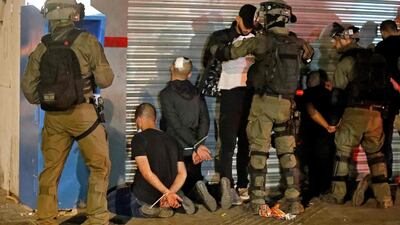
My sister is a nurse at Hadassah Hospital in Jerusalem. She felt unsafe going to work this week even though a few months ago, she and other Arab healthcare workers like her were applauded for their work in Israel during the pandemic. My two brothers, who work in Tel Aviv, are similarly afraid. Last week, the town in which my other sister lives, Jadeidi Al Makr, was sealed off by Israeli police. My nephew, who is three, is having nightmares because he was recently with his father in our hometown of Umm Al Fahm, near Haifa, when police started throwing tear gas at protesters. The targeting of Arabs by Jewish extremists in recent weeks, often as Israeli police stand by, gives my family good reason to be afraid.
Although my family is Palestinian, we have Israeli citizenship. In the aftermath of the Arab-Israeli war in 1948, our land was included within the borders of the newly formed State of Israel. Today, about 21 per cent of the Israeli population is like us – Arabs, mostly Muslim but also some Christians and Druze. Many live in mixed cities, such as Haifa.
Growing up in Umm Al Fahm, an overwhelmingly Muslim city that is proud of its Islamic identity and Palestinian heritage, I always had a strong sense of pride in my family’s ancestry and culture. But it also taught me what it feels like to be a second-class citizen. In Israel, Arab and Jewish children are segregated during their school years. As a child, I learned about how Arab houses were demolished by the Israeli state, which is viewed in my community as a mere continuation of the annexation of Arab land that preceded Israel’s establishment. I learned about how the Bedouins, the indigenous Arab residents of the Negev desert, live in “unrecognised” villages.
I also remember the tyres burning at the entrance to Umm Al Fahm during the Second Intifada, when Arab citizens of Israel participated in protests in solidarity with other Palestinians. As young men from my town ran away from Israeli police, I felt frustration, anger and grief, and the sense that we really do not belong anywhere.
But I haven’t always felt that way. There have been moments – albeit sometimes dark ones – when I have felt part of the Israeli experience. When I was 19, I left my childhood home to go to Beer Sheva, a primarily Jewish city, to study medical laboratory science at Ben Gurion University. It’s a unique university, because it houses Arab and Jewish students together. That was my first time having a direct connection to Israel’s Jewish community.
It was also the first time I experienced how it feels to be under rocket attacks from Hamas, the militant group ruling Gaza, which is not far from Beer Sheva. I heard the warning sirens for the first time during Operation Cast Lead, as Israelis call the three-week war between Israel and Hamas in 2008-2009.
The rocket attacks were constant, and the Jews and Arabs living in our dorm found themselves sharing bomb shelters – and awkward conversations about the Palestine-Israel conflict. In these moments, it was difficult not to understand the fear and frustration of Jewish Israelis. I felt, for a minute, like I was in their shoes.
But I did remind my Jewish colleagues and neighbours frequently that the Palestinians who live in the West Bank and Gaza fear attacks, too, and they do not have the privilege of sheltering in a bunker. The majority of them are helpless civilians, including women and children, stuck in the crossfire. After all, the technology and weapons Israel uses are capable of causing more damage than any rocket launched by Hamas.
One night, as I walked to a restaurant in Beer Sheva with a couple of friends, I was caught off guard by rocket fire, and panicked because we were in the middle of the street and didn’t know where to take shelter. We squatted behind a wall, listening to the explosions of the Iron Dome intercepting two Hamas rockets.
The Jews and Arabs in our dorm found themselves sharing bomb shelters – and awkward conversations
It occurred to me again that Gaza has no Iron Dome, and that even though I was Palestinian, if I had been born on the “wrong” side of the border, I would have had a very different experience in this conflict – one that is much less privileged than my experience of being born within the borders of the State of Israel. Suddenly, with that realisation, it became difficult for me to cling exclusively to my Palestinian identity and to forget about how my Israeli citizenship, and the socioeconomic and political effects that come with it, has influenced and amplified my opportunities in life.
As much as I am a Palestinian, I am a second-class citizen of Israel, and as much as I am that, I am better off than other Palestinians. These are the layers of contradiction the conflict forces into my life and the lives of others in my community, and my awareness of them shifted my sense of identity from Palestinian to Palestinian-Israeli.
Ten years ago, I moved to the US to pursue graduate studies, and being there has further reinforced my dual identity. In America, I have encountered people from all backgrounds, and have found myself identifying as either Palestinian or Israeli, depending on what was most likely to avoid conflict. Even though I am an Arab Muslim, the US immigration and legal systems treat me as an Israeli. My Israeli passport either validates me or invalidates me in countries all over the world.
Palestinian citizens of Israel are sometimes praised by others in the Arab world on the very rare occasions in which one of us participates in an attack on other Israelis. And yet there are so many Arab and Muslim countries I cannot visit, even as an Arab, because of my passport.
A few years ago, I travelled to Turkey, and there I got another taste of how Israeli Jews are treated even in a country Israelis are allowed to visit. In Istanbul, the first thing my Turkish friends were told was not to tell anyone that I am from Israel and not to show my passport.
The connections I developed with my Jewish roommates, friends, mentors and colleagues have been stronger than any feeling that either I or they were the “other”. These relationships have helped me, in fact, to put myself in the shoes of the Jewish “other” and to learn and understand their narratives, even when I do not agree with the way they explain or respond to the conflict between Palestinians and Israelis. But they have also reaffirmed my attachment to my own cultural identity as a Palestinian, and my empathy for my community across all of Palestine – inside and outside of what is now Israel. Whenever violence against Palestinians erupts in East Jerusalem, Gaza, the West Bank or in Israel, I feel it all over again.
Dr Anwar Mhajne is a political scientist and assistant professor at Stonehill College

Specs
Engine: Duel electric motors
Power: 659hp
Torque: 1075Nm
On sale: Available for pre-order now
Price: On request
The Comeback: Elvis And The Story Of The 68 Special
Simon Goddard
Omnibus Press
COMPANY%20PROFILE
%3Cp%3E%3Cstrong%3ECompany%20name%3A%3C%2Fstrong%3E%20Revibe%20%0D%3Cbr%3E%3Cstrong%3EStarted%3A%3C%2Fstrong%3E%202022%0D%3Cbr%3E%3Cstrong%3EFounders%3A%3C%2Fstrong%3E%20Hamza%20Iraqui%20and%20Abdessamad%20Ben%20Zakour%20%0D%3Cbr%3E%3Cstrong%3EBased%3A%3C%2Fstrong%3E%20UAE%20%0D%3Cbr%3E%3Cstrong%3EIndustry%3A%3C%2Fstrong%3E%20Refurbished%20electronics%20%0D%3Cbr%3E%3Cstrong%3EFunds%20raised%20so%20far%3A%3C%2Fstrong%3E%20%2410m%20%0D%3Cbr%3E%3Cstrong%3EInvestors%3A%20%3C%2Fstrong%3EFlat6Labs%2C%20Resonance%20and%20various%20others%0D%3C%2Fp%3E%0A
FINAL LEADERBOARD
1. Jordan Spieth (USA) 65 69 65 69 - 12-under-par
2. Matt Kuchar (USA) 65 71 66 69 - 9-under
3. Li Haotong (CHN) 69 73 69 63 - 6-under
T4. Rory McIlroy (NIR) 71 68 69 67 - 5-under
T4. Rafael Cabrera-Bello (ESP) 67 73 67 68 - 5-under
T6. Marc Leishman (AUS) 69 76 66 65 - 4-under
T6. Matthew Southgate (ENG) 72 72 67 65 - 4-under
T6. Brooks Koepka (USA) 65 72 68 71 - 4-under
T6. Branden Grace (RSA) 70 74 62 70 - 4-under
T6. Alexander Noren (SWE) 68 72 69 67 - 4-under
Key facilities
- Olympic-size swimming pool with a split bulkhead for multi-use configurations, including water polo and 50m/25m training lanes
- Premier League-standard football pitch
- 400m Olympic running track
- NBA-spec basketball court with auditorium
- 600-seat auditorium
- Spaces for historical and cultural exploration
- An elevated football field that doubles as a helipad
- Specialist robotics and science laboratories
- AR and VR-enabled learning centres
- Disruption Lab and Research Centre for developing entrepreneurial skills
2025 Fifa Club World Cup groups
Group A: Palmeiras, Porto, Al Ahly, Inter Miami.
Group B: Paris Saint-Germain, Atletico Madrid, Botafogo, Seattle.
Group C: Bayern Munich, Auckland City, Boca Juniors, Benfica.
Group D: Flamengo, ES Tunis, Chelsea, Leon.
Group E: River Plate, Urawa, Monterrey, Inter Milan.
Group F: Fluminense, Borussia Dortmund, Ulsan, Mamelodi Sundowns.
Group G: Manchester City, Wydad, Al Ain, Juventus.
Group H: Real Madrid, Al Hilal, Pachuca, Salzburg.
The specs
Engine: 3.0-litre 6-cyl turbo
Power: 435hp at 5,900rpm
Torque: 520Nm at 1,800-5,500rpm
Transmission: 9-speed auto
Price: from Dh498,542
On sale: now
The specs
Engine: 2.0-litre 4-cyl turbo
Power: 201hp at 5,200rpm
Torque: 320Nm at 1,750-4,000rpm
Transmission: 6-speed auto
Fuel consumption: 8.7L/100km
Price: Dh133,900
On sale: now
Key figures in the life of the fort
Sheikh Dhiyab bin Isa (ruled 1761-1793) Built Qasr Al Hosn as a watchtower to guard over the only freshwater well on Abu Dhabi island.
Sheikh Shakhbut bin Dhiyab (ruled 1793-1816) Expanded the tower into a small fort and transferred his ruling place of residence from Liwa Oasis to the fort on the island.
Sheikh Tahnoon bin Shakhbut (ruled 1818-1833) Expanded Qasr Al Hosn further as Abu Dhabi grew from a small village of palm huts to a town of more than 5,000 inhabitants.
Sheikh Khalifa bin Shakhbut (ruled 1833-1845) Repaired and fortified the fort.
Sheikh Saeed bin Tahnoon (ruled 1845-1855) Turned Qasr Al Hosn into a strong two-storied structure.
Sheikh Zayed bin Khalifa (ruled 1855-1909) Expanded Qasr Al Hosn further to reflect the emirate's increasing prominence.
Sheikh Shakhbut bin Sultan (ruled 1928-1966) Renovated and enlarged Qasr Al Hosn, adding a decorative arch and two new villas.
Sheikh Zayed bin Sultan (ruled 1966-2004) Moved the royal residence to Al Manhal palace and kept his diwan at Qasr Al Hosn.
Sources: Jayanti Maitra, www.adach.ae
Kathryn Hawkes of House of Hawkes on being a good guest (because we’ve all had bad ones)
- Arrive with a thank you gift, or make sure you have one for your host by the time you leave.
- Offer to buy groceries, cook them a meal or take your hosts out for dinner.
- Help out around the house.
- Entertain yourself so that your hosts don’t feel that they constantly need to.
- Leave no trace of your stay – if you’ve borrowed a book, return it to where you found it.
- Offer to strip the bed before you go.
COMPANY%20PROFILE
%3Cp%3E%3Cstrong%3EName%3A%3C%2Fstrong%3E%20Carzaty%2C%20now%20Kavak%3Cbr%3E%3Cstrong%3EBased%3A%3C%2Fstrong%3E%20Dubai%3Cbr%3E%3Cstrong%3ELaunch%20year%3A%20%3C%2Fstrong%3ECarzaty%20launched%20in%202018%2C%20Kavak%20in%20the%20GCC%20launched%20in%202022%3Cbr%3E%3Cstrong%3ENumber%20of%20employees%3A%3C%2Fstrong%3E%20140%3Cbr%3E%3Cstrong%3ESector%3A%3C%2Fstrong%3E%20Automotive%3Cbr%3E%3Cstrong%3EFunding%3A%20%3C%2Fstrong%3ECarzaty%20raised%20%246m%20in%20equity%20and%20%244m%20in%20debt%3B%20Kavak%20plans%20%24130m%20investment%20in%20the%20GCC%3C%2Fp%3E%0A
Origin
Dan Brown
Doubleday
Story%20behind%20the%20UAE%20flag
%3Cp%3EThe%20UAE%20flag%20was%20first%20unveiled%20on%20December%202%2C%201971%2C%20the%20day%20the%20UAE%20was%20formed.%C2%A0%3C%2Fp%3E%0A%3Cp%3EIt%20was%20designed%20by%20Abdullah%20Mohammed%20Al%20Maainah%2C%2019%2C%20an%20Emirati%20from%20Abu%20Dhabi.%C2%A0%3C%2Fp%3E%0A%3Cp%3EMr%20Al%20Maainah%20said%20in%20an%20interview%20with%20%3Cem%3EThe%20National%3C%2Fem%3E%20in%202011%20he%20chose%20the%20colours%20for%20local%20reasons.%C2%A0%3C%2Fp%3E%0A%3Cp%3EThe%20black%20represents%20the%20oil%20riches%20that%20transformed%20the%20UAE%2C%20green%20stands%20for%20fertility%20and%20the%20red%20and%20white%20colours%20were%20drawn%20from%20those%20found%20in%20existing%20emirate%20flags.%3C%2Fp%3E%0A
KLOPP%20AT%20LIVERPOOL
%3Cp%3EYears%3A%20October%202015%20-%20June%202024%3Cbr%3ETotal%20games%3A%20491%3Cbr%3EWin%20percentage%3A%2060.9%25%3Cbr%3EMajor%20trophies%3A%206%20(Premier%20League%20x%201%2C%20Champions%20League%20x%201%2C%20FA%20Cup%20x%201%2C%20League%20Cup%20x%202%2C%20Fifa%20Club%20World%20Cup%20x1)%3C%2Fp%3E%0A
The specs: 2018 Nissan 370Z Nismo
Price, base / as tested: Dh182,178
Engine: 3.7-litre V6
Power: 350hp @ 7,400rpm
Torque: 374Nm @ 5,200rpm
Transmission: Seven-speed automatic
Fuel consumption, combined: 10.5L / 100km
Sukuk
An Islamic bond structured in a way to generate returns without violating Sharia strictures on prohibition of interest.
Simran
Director Hansal Mehta
Stars: Kangana Ranaut, Soham Shah, Esha Tiwari Pandey
Three stars
UPI facts
More than 2.2 million Indian tourists arrived in UAE in 2023
More than 3.5 million Indians reside in UAE
Indian tourists can make purchases in UAE using rupee accounts in India through QR-code-based UPI real-time payment systems
Indian residents in UAE can use their non-resident NRO and NRE accounts held in Indian banks linked to a UAE mobile number for UPI transactions
'Laal Kaptaan'
Director: Navdeep Singh
Stars: Saif Ali Khan, Manav Vij, Deepak Dobriyal, Zoya Hussain
Rating: 2/5
