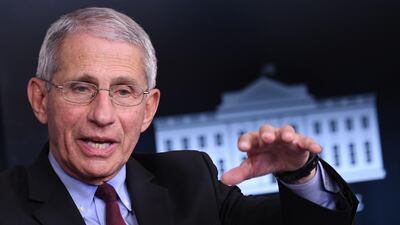

Anthony Fauci, America's top infectious disease expert, has been something of a cult hero during the coronavirus pandemic. So far he has even been viewed as unsackable by President Donald Trump.
But even heroes have off days. Dr Fauci last week carped about the British announcement that it has approved the vaccine produced by Pfizer and its partner BioNTech, and that the first doses would be handed out as early as next week.
His suggestion that the UK had cut corners to beat the world to roll out the vaccine was immediately damaging. A tsunami of disinformation has been unleashed surrounding the Covid-19 vaccines. Anything that gives grist to the mill of conspiracists is bound to be damaging.
Dr Fauci is a rare character: a specialist expert who is known around the world. Quoting him knocking the vaccine will fuel the social media disinformation onslaught. The good doctor soon backtracked, explaining that he had reacted badly to the triumphalist tone of a British interviewer. He then vouched for the British regulator.
It is important to note that different national bodies deal with the approval process in their own way and the US is looking at a mid-December approval of the Pfizer application. Meanwhile, the European Medicines Agency is due to make its decision on December 29.
All this provides an insight with regard to the fraught nature of the race to deploy vaccines. Once the medicine is ready, countries can move to break the cycle of lockdowns and restrictions that constrain daily social and economic life. Cyprus announced it would be first country to end the quarantine for those who have been vaccinated. Big business will flow from the provision of secure vaccine passports in 2021.
For all that, the concept of the vaccine race is deeply flawed. We won't know until January or February, at the earliest, how well the campaign is working. Even if "race" is a valid term, there remains a daunting series of challenges ahead – for those countries with the vaccine and those further down the line.
The world passed the grim milestone of 1.5 million global coronavirus deaths on Thursday, putting into stark relief the joy of those nations that plan to deliver the vaccines. Since November 23, more than 10,000 worldwide have died every day – the longest sustained period of fatalities at that level.

Mike Ryan, the World Health Organisation official who has steadily dispensed medical wisdom throughout 2020, declared bluntly on Friday that a vaccine will not mean zero Covid-19 in circulation. "By themselves, they will not do the job," he said. "And therefore we have to add vaccines into an existing public health strategy."
London’s breakthrough has unleashed great hopes but politicians have exhibited an unsavoury one-upmanship. Germany has built vast deep-freeze warehouses that will store batches of the vaccine before they are transported to Britain. For its part, the European Medicines Agency seems extraordinarily bureaucratic in waiting for a regular scheduled meeting at the end of the month before it authorises a vaccine.
But while Britain is getting the first supplies, it remains to be seen if it can really get the vaccine to the public. A network of more than 50,000 people with basic medical skills will be needed to administer the doses. There is scant evidence that this has been built.

It was noticeable that the Germans are quietly building this distribution system ahead of the vaccine approval decision.
Then there is the issue of how the vaccine gets distributed globally. How does that chime with the "me first" flag waving?
A major analysis published last week from the Eurasia Group, a political risk consultancy, assessed the impact of global vaccine distribution for 10 major economies, including the UAE. It said that funding for the Gavi Alliance's global distribution mechanism, known as the Covax-Advance Market Commitment, was vital. It aims to get vaccines delivered to 92 low-income countries through its own facility.
The Eurasia report said the economic boost for the UAE alone in 2021-22 would amount to $18.1 billion and add up to a cumulatively $69.7bn boost over five years. The 10 rich countries, as a whole, would gain almost half a billion dollars from getting the economy moving again.

President Emmanuel Macron of France gave a very strong endorsement of a global push to roll out the vaccine at a UN symposium last week. It is worth quoting his words at length.
“These doses, whether they come from Europe, China, Russia or the United States, whether they are the fruit of donations from states or pharmaceutical companies, would thus be allocated effectively and fairly, on the basis of WHO recommendations,” Mr Macron said.
Getting to this point within a calendar year of the new virus being detected is a landmark achievement in the history of humanity. In countries where faith in the medical profession is high, vaccine rates can still be expected to be high.
However, the pitfalls ahead are myriad. The vaccine is no doubt a great achievement of 2020, but the history of the recovery is being written even as the suffering escalates. Delivering it is not just a managerial challenge. It is a task that requires strategic wisdom and careful messaging to get everybody onboard.
Damien McElroy is the London bureau chief of The National

