

Since his return to power in January, US President Donald Trump has indulged in an unconventional approach to resolving the world’s outstanding issues. Niceties have given way to blunt and loud diplomacy from the White House.
While the final outcomes of these issues remain uncertain – notably the wars in Ukraine and Gaza – one thing is clear: regardless of how crude the US President’s methods are, shaking up the status quo was necessary. This wasn’t just about trying to end the world’s two most critical conflicts; it was also an attempt to issue wake-up calls to all relevant stakeholders in Europe and the Middle East.
In recent days, Mr Trump has shifted his focus to Iran. He has offered Tehran a deal to normalise ties with Washington, end sanctions and reclaim its global standing in return for two things: abandon its nuclear weapons programme and stop using proxy militias to destabilise sovereign states.
As expected, Tehran has publicly rejected Mr Trump’s offer given that these programmes are the cornerstones of its foreign policy. While it perceives its nuclear ambitions as ensuring regime survival, its reliance on proxies helps to impose its primacy over large parts of the Middle East.
However, Iran’s influence has been greatly reduced in recent months by the fall of Bashar Al Assad’s government in Syria last year. Interim President Ahmad Al Shara is determined to push back against this influence in his country, while competing regional powers such as Turkey and Israel have moved swiftly to block any form of Iranian resurgence in the broader region.
Mr Trump’s messaging to Iran couldn’t be clearer: it is encircled in the region and needs to adapt. He is not demanding regime change but leaving Tehran with a choice between recalibrating its ideology on the one hand, and facing relentless economic strangulation and possibly even US-backed Israeli military strikes to dismantle its nuclear infrastructure on the other.
The US President has infused his Iran policy with overt respect for the country, its history and its people. He has paired this approach with the threat of military action – not just against its military installations, but against its proxies. Could Washington’s wave of air strikes on the Iran-backed Houthi rebels in Yemen on Saturday – citing the group’s attacks on shipping in the Red Sea – have been a signal to the leadership in Tehran?
Meanwhile, even as Hezbollah, Iran’s most powerful proxy in the region, struggles to recover from its decapitation after Israel’s recent war in Lebanon, Mr Trump has sought to pressure the Israeli government to finalise land border demarcation, blocking its territorial claims on Lebanese land. At the same time, Washington has warned that it will reject any attempt by Iran to use Hezbollah as leverage in these negotiations. Indeed, Tehran will not be allowed to continue to weaponise its proxies as bargaining chips.
Mr Trump’s approach to Iran has been less provocative than his confrontational stance towards the US’s European allies on the Ukraine war – except when it comes to Tehran’s support for Hamas in Gaza. But Iran, fearing the repercussions, has distanced itself from the group, avoiding any obstruction to Arab diplomatic efforts to counter Mr Trump’s outrageous proposals for the Palestinian territory. The Iranian government’s priority, at least for now, is Iran – not the Palestinian cause.
-
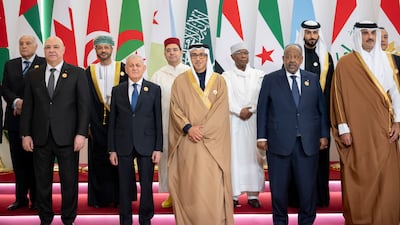
Sheikh Mansour bin Zayed, UAE Vice President, Deputy Prime Minister and Chairman of the Presidential Court, attends the Extraordinary Arab Summit for Palestine with other leaders in Cairo. Eissa Al Hammadi / UAE Presidential Court -

Egypt's President Abdel Fattah El Sisi greets Syria's interim President Ahmad Al Shara. AP -
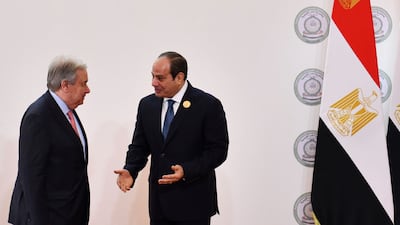
Mr El Sisi greets UN Secretary General Antonio Guterres to the emergency summit. AP -
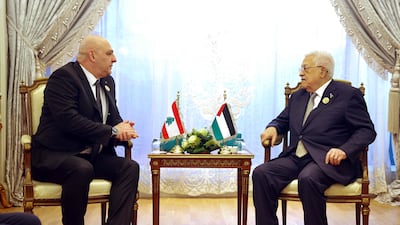
Palestinian President Mahmoud Abbas, right, with Lebanese President Joseph Aoun in Cairo. AFP -
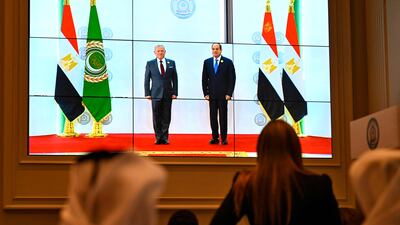
People watch on a screen as Mr El Sisi welcomes Jordan's King Abdullah II. AFP -
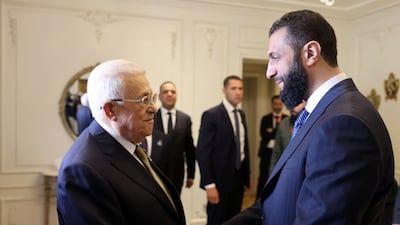
Mr Abbas with Mr Al Shara in Cairo. Reuters -
A summit logo at the press centre hall in Egypt's New Administrative Capital, outside Cairo. AP


This brings us to Mr Trump’s evolving stance on Gaza. He initially called for mass displacement of Palestinians from their homeland, envisioning the enclave’s coastline as the “Riviera of the Middle East”. But last week, he declared that no one is forcing Palestinians to leave and that no one will be expelled from the land.
This is, in large part, the outcome of a calculated strategy employed by key Arab states, in demonstrating to Mr Trump how his Gaza plan could undermine his own ambition of bringing the Arab world and Israel closer together. Pushback from many of the region’s key leaders and their proposal of an alternative for the enclave have nudged the US President to moderate his rhetoric without forcing him to climb down.
Of course, much needs to be done to start the process of rebuilding Gaza. Talks to sustain the ceasefire between Israel and Hamas are still ongoing, and it would be a mistake to assume that Mr Trump has completely abandoned his broader vision for the territory. Reports that Washington is directly negotiating with Hamas for the release of several hostages in its custody should not be misinterpreted as a strategic shift towards recognising the group’s rule over the enclave.
This is all part of Mr Trump’s unconventional approach to geopolitics. It is an approach that has led Arab leaders to reassess the Palestinian-Israeli crisis with renewed urgency. But given that Israel continues to wield influence on the US President’s thinking, it is incumbent upon Arab countries to persist with their own newfound strategy to dealing with him.

