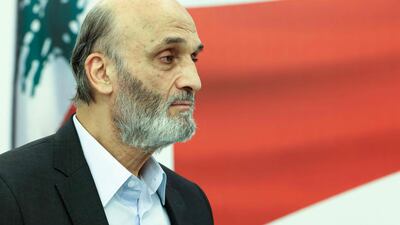

Since Lebanon’s general elections in 2022, the Lebanese Forces party has had the largest Christian bloc in Parliament. Yet its leader, Samir Geagea, has rarely exploited this advantage to shape policy in a certain direction. He has stayed out of the government, and while his bloc may be active in legislative affairs, there have been few tangible outcomes that could be directly linked to his party’s efforts.
Yet on September 1, at the Lebanese Forces’ annual mass for party “martyrs”, Mr Geagea made an intriguing speech, implying that he is aiming to use his party’s status more forcefully. He repeated familiar rhetorical points from the past – for instance how Hezbollah was advancing an Iranian regional plan at the expense of the Lebanese state and its interests – but also opened doors that were genuinely new.
There were five main takeaways from his speech. The first was Mr Geagea’s insistence that the Arab world and international community would not speak to Hezbollah after the current conflict with Israel, but would speak instead to the likes of the Lebanese Forces: “Everyone, on the day after, will negotiate with those who hold the keys to the day after, the keys to the future – those who have a vision, a plan, and a drive to reform.” That’s why, he concluded, “Tomorrow is ours.”
This underlined a second of Mr Geagea’s points, namely that even if Christian demographic numbers are declining, the community continues to play a central role in Lebanon. In light of this, the main interlocutor with the Muslim communities (and with the international community) on the Christian side was the Lebanese Forces, not the Free Patriotic Movement of Michel Aoun and Gebran Bassil, which is currently racked by internal dissension.

Mr Geagea went on to affirm that the Lebanese president, traditionally a Maronite Christian, could not be chosen by the Shiite duo of Hezbollah and its ally, Speaker of Parliament Nabih Berri: “The road to the Presidential Palace in Baabda does not pass through [Hezbollah’s headquarters in] Haret Hreik, nor does entry to Baabda Palace happen through the gates of [Mr Berri’s residence in] Ain Al-Tineh.”
A fourth takeaway was that Mr Geagea positioned himself as a defender of a state project. He did this at a time when the Lebanese state is disintegrating, was absent from the decision to enter the war with Israel, is devoured by corruption, and faces a parallel military structure in the form of Hezbollah. Mr Geagea must have learnt a lesson from Mr Aoun, whose popularity in 1988 derived from his defending the state against the wartime militias, of which Mr Geagea was one of the leaders.
Finally, Mr Geagea made a statement that had considerable resonance. He directed it primarily at Hezbollah: “Let us first elect a president of the Republic, as per the Constitution. Afterwards, we are ready [to] call for a truthful national dialogue table at Baabda Palace where we will address all our national concerns. The discussion should focus on one single question: what kind of Lebanon do we want? ... The time has come to resolve the fundamental disputes that prevent the establishment of a functioning state and keep Lebanon as a realm of chaos, corruption, and instability.”
Mr Geagea effectively expressed a willingness here to discuss a revamping of the Lebanese political system with Hezbollah. Not surprisingly, this alarmed some within the country’s Sunni community who saw in his words a potential desire to abandon the post-Taif Constitution, which many in the community believe advantages them.
By taking this approach, Mr Geagea appeared to be trying to impose a new equation in the political system. His first aim was to portray himself as someone who had a vision for a “strong state”, as he put it, who is the paramount Maronite Christian figure, and who could no longer be circumvented by Hezbollah. In other words, he is someone who must and will have a significant say in Lebanon’s future.
-

An Israeli strike hits southern Lebanon, as seen from Zibqin, Lebanon. Reuters -
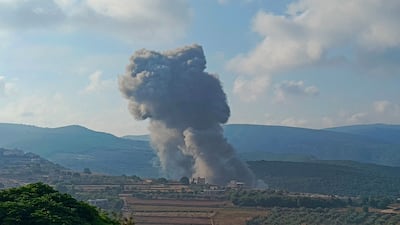
Smoke and dust from an Israeli attack on Zibqin in southern Lebanon. Hezbollah says that on August 25 it launched more than 320 rockets at Israeli military positions. AFP -
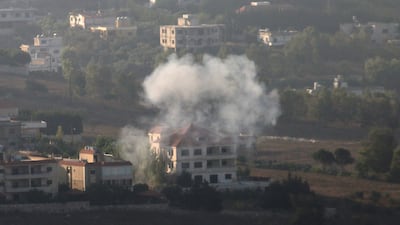
Israeli bombardment of the southern Lebanese town of Khiam. Reuters -
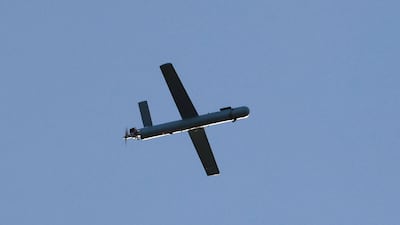
A Hezbollah drone over northern Israel. AFP -
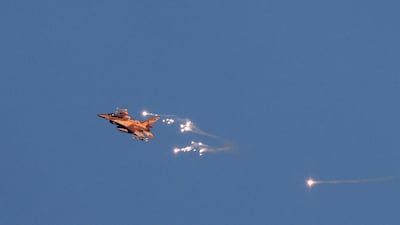
From northern Israel, an Israeli warplane fires flares as a countermeasure against an hostile aircraft launched from Lebanon. AFP -
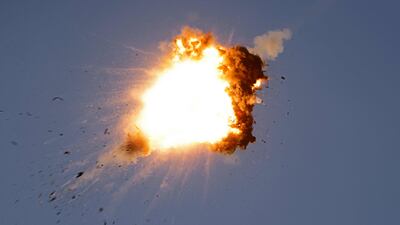
A Hezbollah drone is intercepted by the Israeli Air Force over northern Israel. AFP -
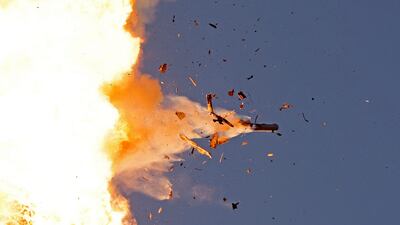
A Hezbollah drone is intercepted by the Israeli Air Force over northern Israel. AFP -
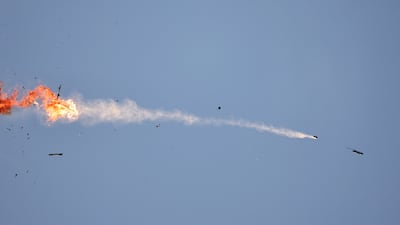
A Hezbollah drone is intercepted by the Israeli Air Force over northern Israel. EPA -
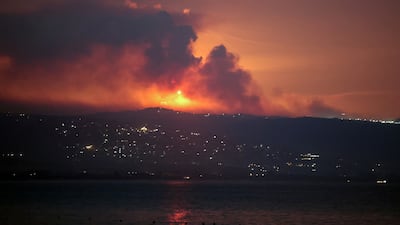
Smoke and fire on the Lebanese side of the border with Israel. Reuters -
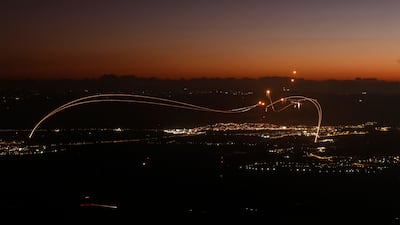
Rockets fired from southern Lebanon are intercepted by Israeli air defences in the Upper Galilee region of northern Israel on August 23. AFP


This sounded very much like a presidential project, even if Mr Geagea realises that he can never be president for as long as he opposes Hezbollah. Yet he does have several objectives that fall short of the presidency. He wants to rally most Christian voters to his side, thereby permanently marginalising the Aounists as a major Christian political force and preventing Hezbollah from exploiting divisions in the Christian community.
Mr Geagea also appears to want to stake out a position as the alternative to Hezbollah, one with whom the Arab world and international community can speak down the road, particularly in the absence of a president. By doing so, he also is trying to become the kingmaker for any future president.
And by talking about reviving the state, Mr Geagea seeks to reinvent himself as a national politician, not merely a sectarian Maronite one. The problem is that he largely failed to mention the Sunni population, Lebanon’s largest community, preferring to address his comments directly or indirectly at the Shiite Hezbollah. Indeed, as one participant at the mass noticed, virtually none of the Christians who had been in the bloc of leading Sunni politician Saad Hariri was invited to the ceremony.
Some might warn that Mr Geagea is overplaying his hand. Perhaps, but at this point he has little to lose. The rifts in the Aounist camp have created an opening for him to emerge as Lebanon’s paramount Maronite figure, while many Lebanese are looking for someone who purports to have a national vision as they see their state crumbling.
If Hezbollah is looking to assuage the other communities and find a more solid basis for its highly contested armed presence in Lebanon than the one existing today, the party may find it difficult to ignore Mr Geagea. That’s his wager, anyway.

