


Live updates: Follow the latest on Israel-Gaza
As Israeli jets strike targets in southern Lebanon and Hezbollah intensifies rocket attacks on northern Israel, Lebanese officials are calling for a return to a 2006 UN Security Council resolution in an effort to broker a ceasefire.
But with tension flaring on both sides, the question remains: can Resolution 1701 pave the way for lasting stability between Israel and Lebanon, or has the current conflict advanced too far beyond its limits?
Matthew Levitt, a Hezbollah and terrorism expert at the Washington Institute, told The National that UN Resolution 1701 is worth “nothing more than the paper it is written on” unless properly enforced. “That has always been the case,” he said.
“It wasn't enforced after the 2006 war, allowing Hezbollah to rearm multiple times and deploy even deeper into southern Lebanon.”
He stressed the need for stricter enforcement this time, stating: “Nobody is going to take anybody’s word for anything, here will have to be enforcement with teeth. The Israelis will do whatever is necessary to mitigate the threats posed by Hezbollah.”
UN Security Council Resolution 1701, which ended the 2006 war between Israel and Hezbollah, called for a complete cessation of hostilities and stipulated only the Lebanese army and UN peacekeepers should be deployed between the Israeli border and the Litani river.
It also allows only the Lebanese army and the UN Interim Force in Lebanon (Unifil) to possess weapons and military equipment in the region, ensuring full sovereignty of the Lebanese state over its southern region.
The agreement offered substantial benefits for both nations. Lebanon, emerging from years of Syrian occupation, seized the opportunity to reassert control over its territory while securing a UN commitment to address the Shebaa Farms dispute. And Israel gained a safety buffer along its northern border as Hezbollah forces were pushed back to the Litani river, reducing immediate threats from the Iran-backed militia group.
Israel and Hezbollah have accused each other of failing to uphold the terms of Resolution 1701. Israel has consistently argued the provisions were never fully enforced, citing this as a major factor in continuing tension.
Since the Gaza war began a year ago, Israel and Hezbollah have engaged in near-daily cross-border clashes, with Hezbollah saying it is acting in solidarity with its ally Hamas. Israeli Prime Minister Benjamin Netanyahu and other officials have stressed the need to secure the north near the border with Lebanon, so uprooted residents can return home.
As Israel renewed its ground incursion into Lebanon last week, it suggested these unresolved issues had contributed to the conflict.
“Eighteen years after 1701, Hezbollah is the world’s largest non-state army and southern Lebanon is swarming with Hezbollah terrorists and weapons,” Israeli military spokesman Daniel Hagari said last week.
“If the state of Lebanon and the world can’t push Hezbollah away from our border, we have no choice but to do it ourselves.”
Large-scale Israeli strikes deep into Lebanon, including Beirut, have killed more than 2,000 people over the last year – and 1,500 in just the past two weeks, according to the UN.
“The toll has already surpassed the 2006 war in Lebanon,” UN Secretary General Antonio Guterres told reporters on Tuesday.
Randa Slim, a Middle East expert, noted that Resolution 1701 remains the framework for negotiation but questioned its future relevance, as the conflict between Israel and Hezbollah continues to escalate.
“Whether it will be sustained, time will tell,” she said, emphasising that the outcome largely depends on Israel's position – whether it leads to a stalemate or if Israel feels empowered to impose new conditions. This could result in another resolution, potentially under Chapter 7, with enhanced enforcement measures.
But Karim Bitar, professor of international relations at St Joseph University of Beirut, argued that 1701 is “no longer enough” for Israel, and the US “seems to be also on a more hawkish line, asking … for a complete disarmament of Hezbollah”.
“Hezbollah is in such a situation of disarray, unable to communicate with its own members, it remains doubtful whether we could reach a new agreement that would be acceptable by both parties. It should have been applied years ago,” he added.
For Lebanon’s caretaker prime minister Najib Mikati, “the solution lies in the implementation of UN Resolution 1701, which involves total co-operation between the army and Unifil to secure the region”.

Iran's Foreign Minister Abbas Araghchi said on Friday after his meeting with Mr Mikati that Tehran had backed efforts for a simultaneous ceasefire in Lebanon and the Palestinian territory.
The meeting between Mr Mikati and Mr Araghchi was fraught with tension, an Arab diplomat who was present told The National. Described as “extremely tense”, the discussions focused on Mr Mikati’s firm stance to decouple Lebanon’s situation from the Gaza conflict. The prime minister advocated the full implementation of Resolution 1701, emphasising that a ceasefire in Lebanon should not be contingent on a ceasefire in Gaza. Mr Araghchi strongly disagreed.
Mr Bitar told The National: “It’s significant to see members of the Lebanese establishment, who have been reluctant so far, finally recognise that 1701 needs to be implemented.
“There are many challenges and both sides would need to abide by this resolution. But there is no alternative, because the Security Council is currently in a state of sclerosis, so I do not see the possibility of a brand-new resolution. What we have at this stage is 1701.”
Hanin Ghaddar, senior fellow at the Washington Institute's Linda and Tony Rubin Programme on Arab Politics, said the recent pager attacks marked a turning point for Israel, with Mr Netanyahu realising that UN Resolution 1701 is no longer sufficient.
“They obviously want to destroy Hezbollah to create a new reality on the ground,” Ms Ghaddar said. If and when a ceasefire is reached, Israel will claim it has secured its northern border, no longer relying solely on diplomacy for protection, she added.
Ms Slim said it's evident that “some right-wing ministers in the Israeli government are contemplating a long-term occupation of southern Lebanon, or a large portion of it.”
She said she did not see US President Joe Biden's administration stepping in with sufficient leverage to halt Israel's actions in Lebanon. “I don’t foresee the Israeli public at this point … mounting the kind of internal pressure on the Israeli government that will force them to bring an end to their military to their attacks on Lebanon, nor do I see the international community capable of exerting enough influence on either Israel or the US”.
-
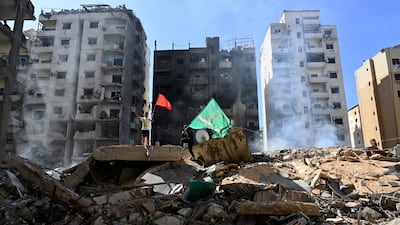
Damage in Beirut after an overnight Israeli strike. EPA -
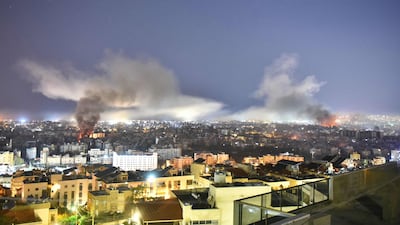
Smoke rises from the site of an Israeli strike in the south of Lebanon's capital. AFP -
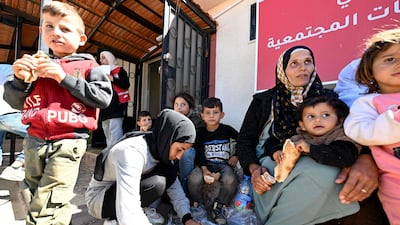
Displaced Syrians and Lebanese enter Syria from Lebanon at the Jusiyah border crossing. AFP -

The site of the Israeli air strike that killed Hezbollah leader Hassan Nasrallah, in Beirut. AP -
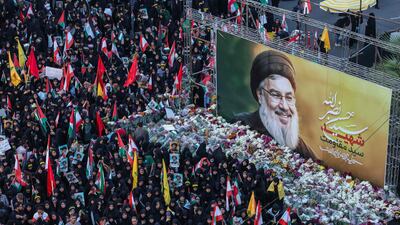
Iranians lay flowers before a portrait of Nasrallah. AFP -

Smoke billows over Tyre, southern Lebanon following an Israeli strike. Reuters -
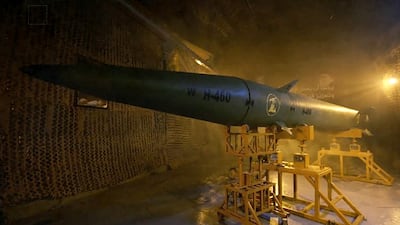
A Qader 1 ballistic missile from Hezbollah's arsenal. AFP -
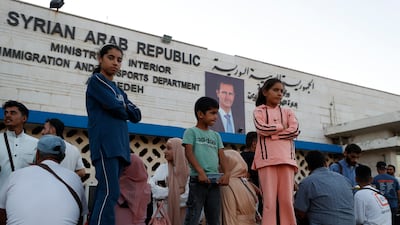
Syrians fleeing the war in Lebanon arrive at the Syrian-Lebanese border crossing in Jdeidet Yabous. AP -
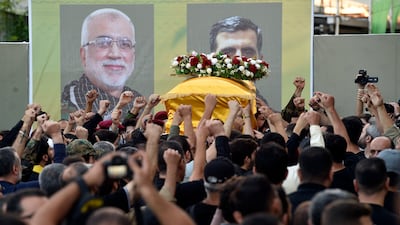
Hezbollah fighters carry the coffin of Hezbollah commander Ibrahim Qubaisi during his funeral in Beirut. EPA -
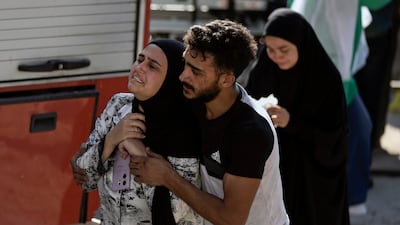
People react at the scene of an Israeli air strike in the town of Maisara, north of Beirut. AP -
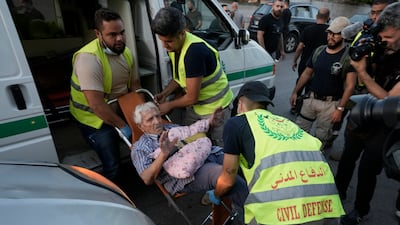
Civil defence workers carry an elderly man who fled from the south of Lebanon, as he arrives at a school turned into a displaced shelter in Beirut. AP -
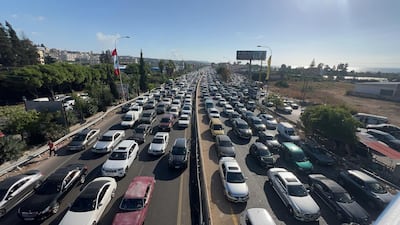
A traffic jam in Ghazieh as people fleeing from the south of Lebanon drive towards Sidon and Beirut. EPA -
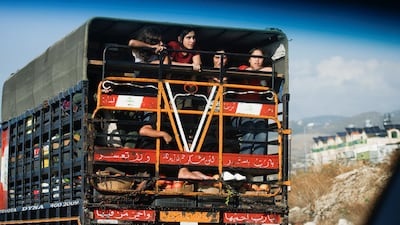
People in heavy traffic drive north from Lebanon's southern coastal city of Sidon, as they flee Israeli bombardment. Reuters -
Smoke billows over southern Lebanon following Israeli strikes, as seen from Tyre. Reuters -
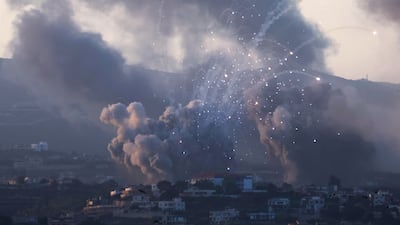
Smoke billows over southern Lebanon following Israeli strikes, as seen from Tyre. Reuters -
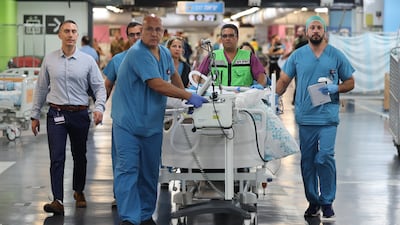
Medics move patients at Rambam Hospital's underground emergency centre, in Haifa, northern Israel. EPA -
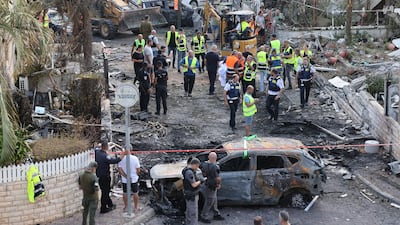
Israeli emergency teams work at the scene of a missile strike on a residential neighbourhood in Kiryat Bialik, northern Israel. EPA -
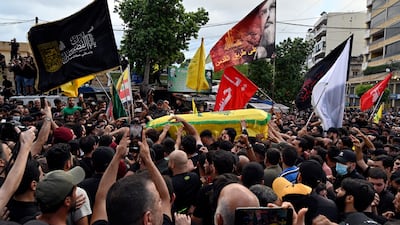
Hezbollah fighters carry the coffin of the group's senior commander Ibrahim Aqil, who was killed in an Israeli strike on September 20, in Beirut. EPA -
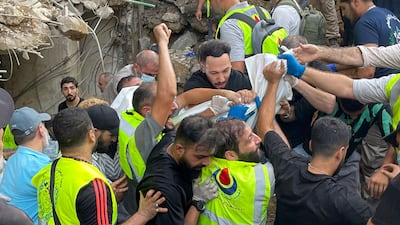
Rescuers carry a body at the scene of a missile strike in the southern suburbs of Beirut. AP



