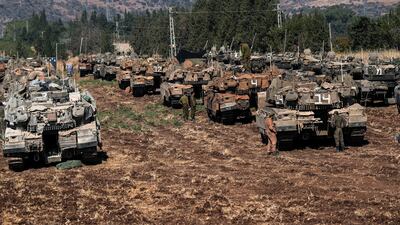
Israeli armoured vehicles massed in northern Israel on September 27. Reuters

How Israel's bitter 2006 war with Hezbollah could shape possible Lebanon invasion


Robert Tollast
  • English
  • Arabic

Live updates: Follow the latest from Israel-Gaza

Israel and Hezbollah are facing off over the prospect of a ground war, which could see Israel attempt to force the group up to 30km deeper inside Lebanon, Israeli Chief of Staff Lt Gen Herzi Halevi told troops on Friday.

The Israelis say an invasion would place most Hezbollah rockets and missiles out of range of Israeli communities, where about 60,000 Israelis have been displaced following Hezbollah’s intervention in the Gaza war, which began a day after Hamas’ assault on Israel on October 7. In a massive Israeli bombardment this week, up to 500,000 Lebanese have also fled their homes.

Both sides will have been thinking deeply about their brief, destructive war in 2006, that ended inconclusively, but was widely seen as an Israeli defeat. For Israel, it led to 50 internal inquiries reviewing its armed forces, leading to the Teffen 2012 plan, that emphasised better training and use of drones.

Since then, Hezbollah has become far better armed, with deeper tunnels and bunkers. It may have 10 times the infantry strength (about 40,000 today) and 10 times its rocket arsenal, perhaps 150,000 rockets and missiles despite expending about 9,000, and having others bombed.

It has far more drones, both the fixed wing explosive type which fly into buildings over hundreds of kilometres away and are difficult to shoot down, and smaller quadcopter drones that can drop bombs or can fly directly into targets. Its forces also have more combat experience, from supporting Bashar Al Assad in the Syrian civil war.

Hezbollah fighters pictured in 2023. EPA

Israel too, has grown in power, largely after evaluating its disastrous 2006 war. Its forces, according to a government inquiry on the 2006 invasion, the Winograd Commission, said they lacked training for high intensity combat, having spent years chasing lightly armed militants in the occupied West Bank or controlling riots there. The Israelis went into Lebanon badly equipped, with weakly armoured vehicles such as the Humvee, which can be easily destroyed by roadside bombs or missiles.

Today, it has some of the most heavily protected tanks such as the Merkava, able to parry missiles with an explosive Trophy “active protection system”, and fighting vehicles like the Namer, based on the chassis of the same heavily armoured tank. This could make a significant difference – Israel lost 11 Merkava tanks in one missile ambush in 2006.

A Merkava 4 tank in northern Israel. Thomas Helm / The National

Nonetheless, Lebanon presents deep valleys and rolling hills, ideal for hidden observation and ambushes. Amid that environment, Israeli soldiers found their logistics were unprepared, and some units ran low on food and water in blazing heat. Fighting in southern Lebanon in hot weather is “no fun,” one Israeli officer recently told The National off record.

Israel now also has far more drones, including dedicated units fielding them, and regularly trains for war with Hezbollah, including drills based on simultaneous war with the group and Hamas. Its air force is vastly more deadly than in 2006.

Israel's lost war

The Israelis lost 121 soldiers in that conflict, despite air supremacy, and hundreds more were wounded, failing to clear south Lebanon of Hezbollah.

Its initial advances were no more than a few kilometres, because experts say forces were sent in bit by bit, negating Israel's numerical advantage. In one case, a postwar report noted, a battalion of less than 1,000 men asked to control a town of 5,000 buildings.

When a deeper advance happened with 30,000 men in the final days of the war, it was criticised by some Israeli officers as being for show, rather than having concrete objectives. Finally, the war ended with Israeli withdrawal, under international pressure.

A neighborhood in southern Beirut destroyed by Israeli bombing campaign, in August 2006. Getty Images

“They bowed to international pressure quite quickly. They're not going to do that this time. If they step across that border, they are going to stop when Hezbollah is not a threat,” says Sam Cranny-Evans, an associate fellow at RUSI, a UK defence think tank, and independent defence consultant.

Officers complained bitterly that in addition to inadequate equipment, intelligence briefings were poor and many soldiers had no idea they would encounter deeply buried bunkers and tunnels, from which Hezbollah ambushed them.

“In 2006 there are a lot of examples where the Israelis were more passive than you would expect. Tanks would be hit with multiple anti-tank guided missiles, because they were very visible on a hill, and they were supposed to provide presence and deterrence by just being there. I don't think a ground incursion this time, given the context, is going to be like that,” Mr Cranny-Evans says.

Lebanon suffered around 1,200 deaths, mostly civilians, and estimates of Hezbollah killed vary from less than 200 to around 500. Israeli air strikes, hitting bridges, roads, fuel storage sites, Beirut International Airport and other infrastructure, along with hundreds of Hezbollah-linked targets, caused billions of dollars’ worth of damage. Forty-four Israeli civilians were killed by Hezbollah rockets.

Limits of air power

On the face of it, few Hezbollah fighters could survive Israel’s current bombing. Israel said it struck 1,600 targets in 24 hours of operations on Monday, 22 per cent of the entire target count of the 2006 war, killing around 700 Lebanese in a terrifyingly short period.

But according to a US assessment, the air bombardment before 2006’s ground attack, known as Operation Ice Breaker, might have diminished Hezbollah’s combat power by 7 per cent. Many strikes hit decoy bunkers, and it's not clear the extent Hezbollah has pursued the same approach.

Nonetheless, the group has likely been hit hard, experts told The National last week, coming after a series of covert attacks where thousands of Hezbollah pagers and radios were secretly rigged with bombs by the Israelis, killing scores and injuring thousands.

Those attacks, and many strikes on high level commanders, show just how badly Hezbollah’s internal communications have been compromised. It’s not clear therefore, how the group could co-ordinate its forces if the Israelis invade.

Fighting for every metre

Exactly how much they co-ordinate will be a strategic decision, Mr Cranny-Evans says. The group may choose to stand and fight, incurring heavy losses, also requiring some means of communication, while knowing the Israelis are listening.

Or they could choose to fight “ephemerally,” Mr Cranny-Evans says, ditching uniforms, hiding underground or in villages, and waiting for the Israelis to give up, before rebuilding their power.

The defence expert says modern Israeli doctrine has taken this into account, allowing small units to rapidly strike enemy fighters who themselves are mounting hit and run attacks, shooting off a couple of magazines of bullets or firing a rocket before fleeing.

The system for rapid attack is called Fireweaver, which its designers say “connects all battlefield elements in real time and instantly selects the most relevant shooter for each target – enabling comprehensive situational awareness and simultaneous, precision strikes.”

“Fireweaver is in some of the armoured brigades, it enables a commander to have an oversight of every single linked sensor on the battlefield, and connect it with effectors (weapons). And it's built around that ephemeral threat where the enemy knows, ‘we're going to empty this magazine, we're going to fire these two rockets, and we've got to be out of there.’ It's built around getting them in between those two magazines being changed,” Mr Cranny-Evans says.

“Granted, not every single unit will operate at that level of capability, but the ones they have that can will be very punchy, and the lethality and the firepower that they carry with them is significant. I think if a ground incursion comes and if Hezbollah chooses to fight at all, there will be a lot of destruction.”

This technological dominance will not necessarily determine a victor. Even with no secure communications and being spotted by swarms of drones, “people just find a way to adapt, because they don't want to die. So if communications are key, they'll find a way to communicate,” he says, saying civilians could be used to pass messages, a common tactic used by militias.


MATCH SCHEDULE

Uefa Champions League semi-final, first leg
Tuesday, April 24 (10.45pm)

Liverpool v Roma

Wednesday, April 25
Bayern Munich v Real Madrid (10.45pm)

Europa League semi-final, first leg
Thursday, April 26

Arsenal v Atletico Madrid (11.05pm)
Marseille v Salzburg (11.05pm)

Profile of VoucherSkout

Date of launch: November 2016

Founder: David Tobias

Based: Jumeirah Lake Towers

Sector: Technology

Size: 18 employees

Stage: Embarking on a Series A round to raise $5 million in the first quarter of 2019 with a 20 per cent stake

Investors: Seed round was self-funded with “millions of dollars” 

The Sand Castle

Director: Matty Brown

Stars: Nadine Labaki, Ziad Bakri, Zain Al Rafeea, Riman Al Rafeea

Rating: 2.5/5

The specs
Engine: Long-range single or dual motor with 200kW or 400kW battery
Power: 268bhp / 536bhp
Torque: 343Nm / 686Nm
Transmission: Single-speed automatic
Max touring range: 620km / 590km
Price: From Dh250,000 (estimated)
On sale: Later this year
VEZEETA PROFILE

Date started: 2012

Founder: Amir Barsoum

Based: Dubai, UAE

Sector: HealthTech / MedTech

Size: 300 employees

Funding: $22.6 million (as of September 2018)

Investors: Technology Development Fund, Silicon Badia, Beco Capital, Vostok New Ventures, Endeavour Catalyst, Crescent Enterprises’ CE-Ventures, Saudi Technology Ventures and IFC

Other key dates
  • Finals draw: December 2
  • Finals (including semi-finals and third-placed game): June 5–9, 2019
  • Euro 2020 play-off draw: November 22, 2019
  • Euro 2020 play-offs: March 26–31, 2020
COMPANY%20PROFILE
%3Cp%3E%3Cstrong%3ECompany%20name%3A%3C%2Fstrong%3E%20Clinicy%3Cbr%3E%3Cstrong%3EStarted%3A%3C%2Fstrong%3E%202017%3Cbr%3E%3Cstrong%3EFounders%3A%3C%2Fstrong%3E%20Prince%20Mohammed%20Bin%20Abdulrahman%2C%20Abdullah%20bin%20Sulaiman%20Alobaid%20and%20Saud%20bin%20Sulaiman%20Alobaid%3Cbr%3E%3Cstrong%3EBased%3A%3C%2Fstrong%3E%20Riyadh%3Cbr%3E%3Cstrong%3ENumber%20of%20staff%3A%3C%2Fstrong%3E%2025%3Cbr%3E%3Cstrong%3ESector%3A%3C%2Fstrong%3E%20HealthTech%3Cbr%3E%3Cstrong%3ETotal%20funding%20raised%3A%3C%2Fstrong%3E%20More%20than%20%2410%20million%3Cbr%3E%3Cstrong%3EInvestors%3A%3C%2Fstrong%3E%20Middle%20East%20Venture%20Partners%2C%20Gate%20Capital%2C%20Kafou%20Group%20and%20Fadeed%20Investment%3C%2Fp%3E%0A
Company profile

Date started: December 24, 2018

Founders: Omer Gurel, chief executive and co-founder and Edebali Sener, co-founder and chief technology officer

Based: Dubai Media City

Number of employees: 42 (34 in Dubai and a tech team of eight in Ankara, Turkey)

Sector: ConsumerTech and FinTech

Cashflow: Almost $1 million a year

Funding: Series A funding of $2.5m with Series B plans for May 2020

Going grey? A stylist's advice

If you’re going to go grey, a great style, well-cared for hair (in a sleek, classy style, like a bob), and a young spirit and attitude go a long way, says Maria Dowling, founder of the Maria Dowling Salon in Dubai.
It’s easier to go grey from a lighter colour, so you may want to do that first. And this is the time to try a shorter style, she advises. Then a stylist can introduce highlights, start lightening up the roots, and let it fade out. Once it’s entirely grey, a purple shampoo will prevent yellowing.
“Get professional help – there’s no other way to go around it,” she says. “And don’t just let it grow out because that looks really bad. Put effort into it: properly condition, straighten, get regular trims, make sure it’s glossy.”

Sweet%20Tooth
%3Cp%3E%3Cstrong%3ECreator%3A%20%3C%2Fstrong%3EJim%20Mickle%3Cbr%3E%3Cstrong%3EStarring%3A%20%3C%2Fstrong%3EChristian%20Convery%2C%20Nonso%20Anozie%2C%20Adeel%20Akhtar%2C%20Stefania%20LaVie%20Owen%3Cbr%3E%3Cstrong%3ERating%3A%20%3C%2Fstrong%3E2.5%2F5%3C%2Fp%3E%0A

Engine: 80 kWh four-wheel-drive

Transmission: eight-speed automatic

Power: 402bhp

Torque: 760Nm

Price: From Dh280,000

BIGGEST CYBER SECURITY INCIDENTS IN RECENT TIMES

SolarWinds supply chain attack: Came to light in December 2020 but had taken root for several months, compromising major tech companies, governments and its entities

Microsoft Exchange server exploitation: March 2021; attackers used a vulnerability to steal emails

Kaseya attack: July 2021; ransomware hit perpetrated REvil, resulting in severe downtime for more than 1,000 companies

Log4j breach: December 2021; attackers exploited the Java-written code to inflitrate businesses and governments

Labour dispute

The insured employee may still file an ILOE claim even if a labour dispute is ongoing post termination, but the insurer may suspend or reject payment, until the courts resolve the dispute, especially if the reason for termination is contested. The outcome of the labour court proceedings can directly affect eligibility.


- Abdullah Ishnaneh, Partner, BSA Law 

Breast cancer in men: the facts

1) Breast cancer is men is rare but can develop rapidly. It usually occurs in those over the ages of 60, but can occasionally affect younger men.

2) Symptoms can include a lump, discharge, swollen glands or a rash. 

3) People with a history of cancer in the family can be more susceptible. 

4) Treatments include surgery and chemotherapy but early diagnosis is the key. 

5) Anyone concerned is urged to contact their doctor


Why it pays to compare

A comparison of sending Dh20,000 from the UAE using two different routes at the same time - the first direct from a UAE bank to a bank in Germany, and the second from the same UAE bank via an online platform to Germany - found key differences in cost and speed. The transfers were both initiated on January 30.

Route 1: bank transfer

The UAE bank charged Dh152.25 for the Dh20,000 transfer. On top of that, their exchange rate margin added a difference of around Dh415, compared with the mid-market rate.

Total cost: Dh567.25 - around 2.9 per cent of the total amount

Total received: €4,670.30 

Route 2: online platform

The UAE bank’s charge for sending Dh20,000 to a UK dirham-denominated account was Dh2.10. The exchange rate margin cost was Dh60, plus a Dh12 fee.

Total cost: Dh74.10, around 0.4 per cent of the transaction

Total received: €4,756

The UAE bank transfer was far quicker – around two to three working days, while the online platform took around four to five days, but was considerably cheaper. In the online platform transfer, the funds were also exposed to currency risk during the period it took for them to arrive.

Islamophobia definition

A widely accepted definition was made by the All Party Parliamentary Group on British Muslims in 2019: “Islamophobia is rooted in racism and is a type of racism that targets expressions of Muslimness or perceived Muslimness.” It further defines it as “inciting hatred or violence against Muslims”.

UAE currency: the story behind the money in your pockets

Voices: How A Great Singer Can Change Your Life
Nick Coleman
Jonathan Cape

Tonight's Chat on The National

Tonight's Chat is a series of online conversations on The National. The series features a diverse range of celebrities, politicians and business leaders from around the Arab world.

Tonight’s Chat host Ricardo Karam is a renowned author and broadcaster with a decades-long career in TV. He has previously interviewed Bill Gates, Carlos Ghosn, Andre Agassi and the late Zaha Hadid, among others. Karam is also the founder of Takreem.

Intellectually curious and thought-provoking, Tonight’s Chat moves the conversation forward.

Facebook | Our website | Instagram

Polarised public

31% in UK say BBC is biased to left-wing views

19% in UK say BBC is biased to right-wing views

19% in UK say BBC is not biased at all

Source: YouGov

Under 19 World Cup

Group A: India, Japan, New Zealand, Sri Lanka

Group B: Australia, England, Nigeria, West Indies

Group C: Bangladesh, Pakistan, Scotland, Zimbabwe

Group D: Afghanistan, Canada, South Africa, UAE


UAE fixtures

Saturday, January 18, v Canada

Wednesday, January 22, v Afghanistan

Saturday, January 25, v South Africa

Updated: September 27, 2024, 3:27 PM