

Live updates: Follow the latest on Israel-Gaza
President Joe Biden on Thursday told Prime Minister Benjamin Netanyahu that US policy will change towards Gaza unless Israel immediately takes concrete steps to address the humanitarian crisis there.
The comments, which followed an Israeli strike that killed seven aid workers in Gaza, mark the first meaningful shift in rhetoric from the Biden administration since Israel launched its war in Gaza after the October 7 Hamas attacks.
During a phone call between Mr Biden and Mr Netanyahu, the US President “emphasised that the strikes on humanitarian workers and the overall humanitarian situation are unacceptable”, the White House said in a readout.
“He made clear the need for Israel to announce and implement a series of specific, concrete and measurable steps to address civilian harm, humanitarian suffering and the safety of aid workers,” it added.
“He made clear that US policy with respect to Gaza will be determined by our assessment of Israel’s immediate action on these steps.”
Observers remarked on the change of tone for Mr Biden, who is under crushing domestic pressure to stop the bloodshed in Gaza.
“These are different words, different phrases that the President is using, and they're clearly designed to get Netanyahu's attention and to institute changes,” said Daniel Kurtzer, who served as US ambassador to Israel from 2001 to 2005.
Mr Kurtzer said the strike on World Central Kitchen, an organisation headed by renowned chef Jose Andres that helps feed millions around the world, represents a “turning point” in the conflict.
“The organisation itself, which has such credibility, the chef is very well known and the fact that the organisation was feeding both Palestinians in Gaza and Israelis I think was quite important, number one,” Mr Kurtzer told The National.
“Number two … these vehicles were targeted and it may have been that the mistake was in the targeting. But it wasn't an accident or incidental fire. That's what really has impacted.”
In addition to calling for change, Mr Biden also reiterated demands for an immediate ceasefire, but did not directly link it to the release of hostages by Hamas, a subtle but important difference.
“We've walked up to the question of immediacy, but this is the first time that it apparently is now part of US policy,” Mr Kurtzer explained.
Secretary of State Antony Blinken, meanwhile, said that humanitarian conditions in Gaza “are woefully insufficient and unacceptable”.
He described Monday's strike on World Central Kitchen aid workers as “horrific”.
It “was not the first such incident” he added, but “it must be the last”.
“If we lose that reverence for human life, we risk becoming indistinguishable from those we confront.”
Mr Blinken rebuffed accusations that he had not expressed enough outrage in the immediate aftermath of the strike and made clear that he condemned the killing of the aid workers.
At the White House, National Security Council spokesman John Kirby said Mr Biden and Mr Netanyahu had a “very direct, very businesslike, very professional” call that lasted about 30 minutes.
“What we want to see are some real changes on the Israeli side. If we don't see changes from their side, there'll have to be changes from our side, but I won't predict what that to look like,” Mr Kirby said, noting that the US expects to see changes within “hours and days”.
The White House did not elaborate on what the changes should be.
“Until you see any consequences, any specific policy changes, all they are words and I think that's what people are now waiting for,” said Mr Kurtzer.
While it is clearly Washington's strongest rebuke yet of Israel over the course of its six-month military campaign in Gaza, the US has created a scenario in which Israel should be able meet the criteria set out by the White House.
“In my view, if there's a big fight here, the Prime Minister has no one to blame but himself because the administration is creating a sort of probationary period with a set of steps that are reasonable and doable,” said Aaron David Miller, a former State Department Middle East analyst and current senior fellow at the Carnegie Endowment for International Peace.
The US President's call to Mr Netanyahu came as Israel is on high alert after Iran vowed to retaliate for an attack on the country's embassy in Syria that killed several generals.
Mr Kirby said that Mr Biden made clear during the call that US support for Israel's ability to defend itself against Hamas as well as other threats in the region remains “ironclad”.
The Israeli military said it had halted leave for all combat units on Thursday based on the “situational assessment” as it braced for a potential attack by Iran or one of its allied militias.
On Wednesday, the military said it had drafted reservists to boost its aerial defences. Tel Aviv residents said on Thursday that GPS services had been disrupted, an apparent measure meant to ward off guided missiles.
World Central Kitchen workers killed in Israeli strike – in pictures
-
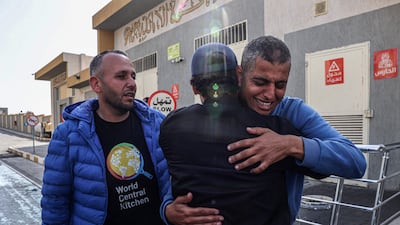
Relatives and friends mourn Saif Abu Taha, a worker with World Central Kitchen who was killed when Israeli strikes hit the NGO's vehicles in Gaza, during his funeral in Rafah. AFP -
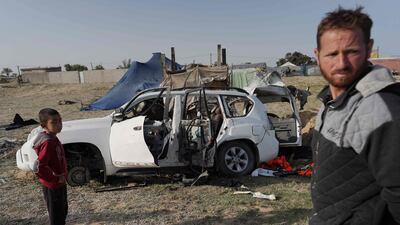
The wreckage of a car used by aid group World Central Kitchen that was hit by an Israeli strike in Deir Al Balah, central Gaza. AFP -
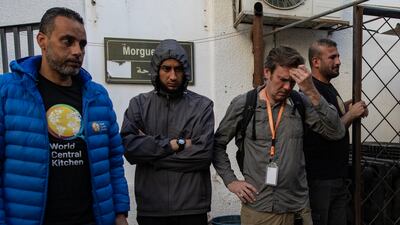
World Central Kitchen workers gather around the bodies of their colleagues after they were transferred to Al Najjar Hospital in Rafah, southern Gaza. EPA -

United Nations staff members inspect one of the World Central Kitchen vehicles hit by the deadly Israeli strike. AFP -

World Central Kitchen suspended operations in Gaza after seven of its staff were killed in the Israeli air strike. Reuters -
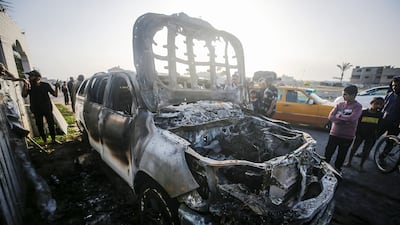
The team was killed while travelling through a deconflicted zone in armoured vehicles branded with the WCK logo. EPA -
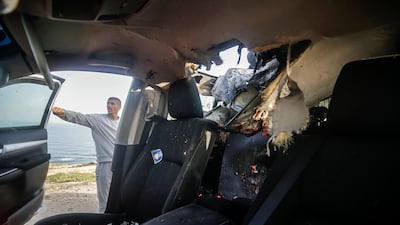
The group's car was hit after leaving a warehouse in Deir Al Balah, despite co-ordinating its movements with the Israeli military. EPA -

The Israeli military said it was conducting a thorough review at the highest levels to understand the circumstances of this 'tragic' incident. Reuters -
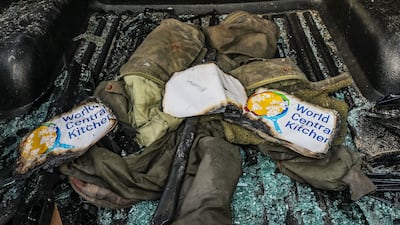
Clothes of members of the NGO are seen inside their destroyed car on Al Rashid road in the Gaza Strip. EPA -

Australian Lalzawmi Frankcom, left, was among the WCK employees killed in the strike. Reuters -

The uniform of a woman WCK employee who was killed in Israeli air strike in Deir Al Balah. EPA -

Employees of World Central Kitchen mourn after their colleagues were killed in the Israeli air strike. Reuters -

A man displays blood-stained British, Polish, and Australian passports after the Israeli air strike that killed WCK workers, including foreigners, in Deir Al Balah. AP -

A World Central Kitchen barge loaded with food arrives off the Gaza coast, where there is risk of famine after five months of Israel's military campaign. Reuters



