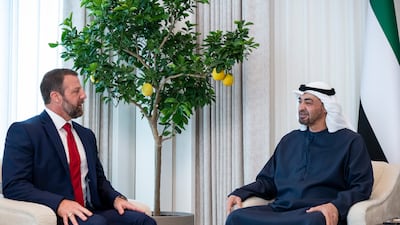
President Sheikh Mohamed discussed efforts to address the latest developments in the Middle East during high-level talks with Markwayne Mullin, the US Secretary of Homeland Security, in Abu Dhabi.
The talks took place amid escalating tensions in the region, as Iran continues to carry out renewed strikes against Gulf states and Saudi Arabia comes under sustained attack from the Iran-backed Houthis.
Bahrain's Interior Ministry said an Iranian attack struck a civilian industrial site, sparking a fire and causing material damage.

Civil Defence teams were working to bring the blaze under control, the ministry said in a post on X shortly before midnight on Saturday. Preliminary reports indicated no injuries.
Meanwhile, Saudi air defences intercepted a drone launched by the Houthi rebels in Yemen towards the Riyadh region on Saturday night.
The Saudi-led coalition fighting in Yemen said air defences also intercepted and destroyed a ballistic missile launched by the Houthis towards Saudi Arabia's western region, the kingdom's official media reported.
The coalition did not provide further details on either interception, including the precise locations or whether there were any casualties or damage.
Boosting UAE-US ties
Sheikh Mohamed and Mr Mullin also explored ways to further strengthen strategic co-operation, state news agency Wam reported on Saturday evening.
The meeting was attended by Sheikh Hamdan bin Mohamed bin, Deputy Chairman of the Presidential Court for Special Affairs; Sheikh Mohammed bin Hamad, Advisor to the UAE President; and a number of officials.
The key talks took place following a call between Sheikh Abdullah bin Zayed, Deputy Prime Minister and Minister of Foreign Affairs, and US Secretary of State Marco Rubio.
Sheikh Abdullah and Mr Rubio discussed regional developments and the humanitarian consequences of the war in Sudan.
During the call, Sheikh Abdullah emphasised "the UAE's support for international and regional efforts aimed at securing an immediate and unconditional ceasefire and launching a comprehensive, civilian-led political process".
The war between the Sudanese Armed Forces and the paramilitary Rapid Support Forces has caused one of the world’s worst humanitarian crises since it broke out in April 2023. At least 59,000 people have been killed and about 14 million have been displaced, with parts of the country pushed into famine, aid agencies said.

