Iran is waging a disinformation war in the Strait of Hormuz, with daily boasts of mine explosions that experts say do not stand up to scrutiny but may succeed in scaring off sailors and driving up costs.
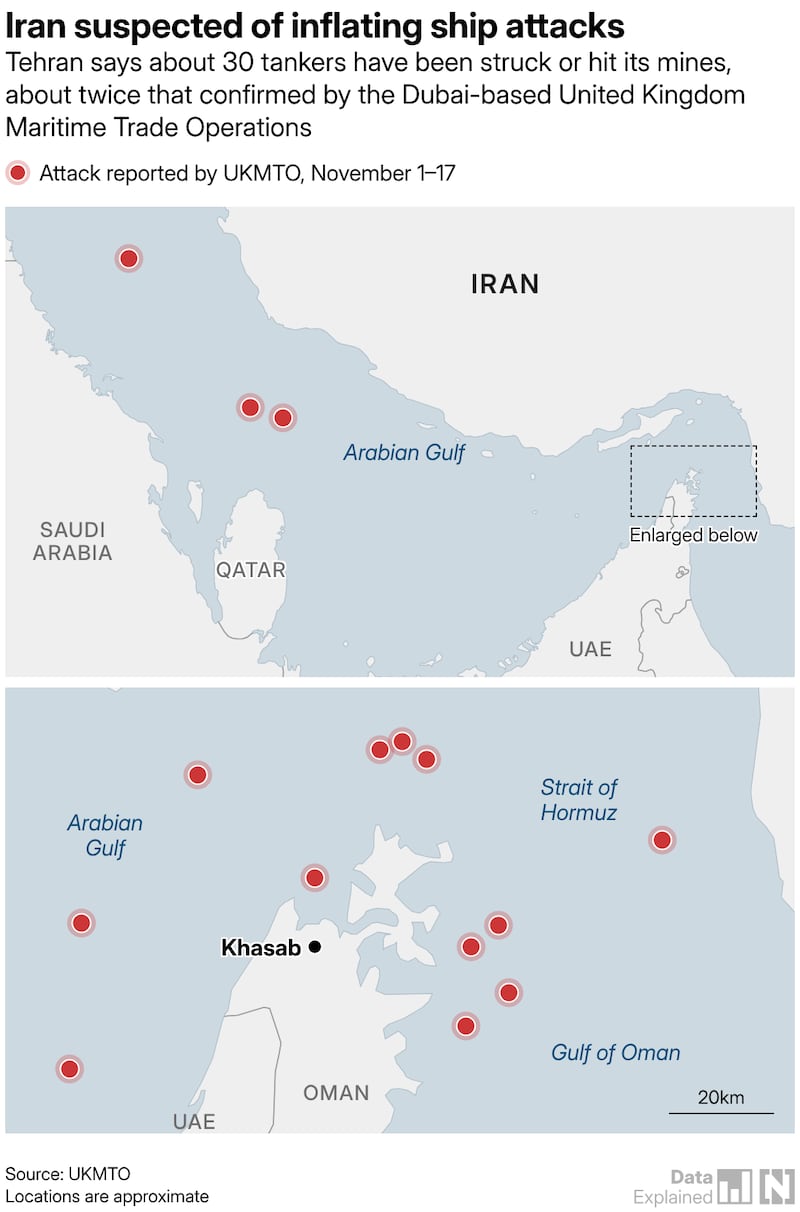
In a propaganda surge, Iran's Islamic Revolutionary Guard Corps claims more than 30 ships have run into sea mines since the start of November. The IRGC announcements often come with grainy videos of smoke billowing from a tanker, used as a warning to shipowners not to challenge Iran's grip on the strait.
But unlike drone attacks – which lead to security alerts, are confirmed by shipping companies and leave survivors with stories to tell – none of the purported mine incidents have been independently verified. Five experts, including a former navy captain, told The National that the IRGC claims do not add up.
“From what I have seen so far, there has been almost zero evidence of any damage caused by sea mines,” said Farzin Nadimi, a senior fellow at the Washington Institute for Near East Policy, who has examined photos and videos of the conflict.
While debunking Iranian claims is one thing, persuading shipowners to take on the strait is another. The number of ships making the crossing is 80 per cent down on prewar levels, according to Lloyd's List Intelligence. With the conflict in a volatile state, many are choosing not to take the risk.
“It’s possible to make an effective minefield with zero mines, if someone can make a credible claim that they have mined specific waters,” said Scott Savitz, an expert in mine warfare at the Rand Corporation think tank. He said mines were psychologically powerful because of a “primal fear” of being attacked from underwater.
“There is a reason that many cultures have legends of sea monsters, and why they keep recurring in popular culture, from Jaws to the current TV show Below," he said.
Phil Belcher, the marine director at Intertanko, a global trade association for independent owners and operators of oil, gas and chemical tankers, said his organisation does not believe there are mines that pose a risk to shipping in the Gulf or in the Strait of Hormuz.
"We cannot identify, apart from one instance of one ship hitting a floating object which caused damage at the waterline, any mines posing risks to any ship at the moment," Mr Belcher said.
Debunking Iran's claims
A typical example came on Thursday. The IRGC navy said two tankers carrying more than four million barrels of oil had “hit a naval mine and exploded”. It said they had tried to cross the strait in secret using an “unauthorised route” near the coast of Oman. Iran says ships must take a northern route after seeking its permission.
State television showed a low-resolution video of smoke on the horizon, accompanied by ominous music. But the ships were not identified. The UK's Maritime Trade Operations agency, which regularly issues alerts about incidents in the strait, was silent. And no other independent source reported a mine explosion.
The IRGC has made such announcements almost daily since mid-October. “If those reports were true, we would have independent verification quite quickly,” said Emma Salisbury, a naval expert at the Foreign Policy Research Institute.
“An oil tanker hitting a mine and exploding is quite a big deal, and to just have that come from the Iranians and from nowhere else seems suspicious."
Chris O'Flaherty, a former Royal Navy captain who served on British minesweepers, said the damage observed on ships “doesn't tie in with what mines would be doing”.
“Mines tend not to cause fires,” he said. “Mines tend to cause lots of bent metal plates and holes that allow water in. And holes that are allowing thousands of tonnes of water in don't tend to catch fire because the water puts the fires out.”
Iran has good reason to assert a tight grip on the strait. The shipping blockade is one of its most potent weapons in the war, causing an energy crunch and price increases that contributed to widespread gains by the US Democrats against President Donald Trump's Republican Party in the midterm elections.
Ms Salisbury said the mine claims could also be for domestic purposes. “To be able to boast to people – 'Look, we've successfully blown up this big western oil tanker, aren't we fantastic' – I think there's an element of that in there as well."

Psychological threat
So the strait is safe? It is not that simple.
US Central Command says “primary routes” have been cleared of mines. But that does not necessarily mean every part of the strait is free of mines, or that new ones could not be laid.
The Americans are also enforcing their own blockade, firing on at least five vessels since July.
At one recent briefing it was revealed that 27 mines have been cleared by forces allied to the US, Mr O'Flaherty said – suggesting some threat does exist.
“We know the Iranians have the capability of laying more mines,” he said. “They may watch a merchant ship drive through, and then have a fishing boat in the vicinity and just literally roll one over the side.”
Mr Belcher said the US Navy is doing a "remarkable job" of clearing any mines that the Iranians are trying to place.
There are other known tactics that could confuse the picture. Iran could use mines that are designed not to detonate until a certain number of ships has passed, Mr Savitz said. Mines could also lie dormant for a time or have a set probability of detonating each time a ship passes.
“The whole point of mine warfare is the extent of unknowns,” Mr Savitz said.
Iranian drone attacks are real, and the International Maritime Organisation says at least 25 sailors have been killed in the conflict.
Mr Nadimi said his examination of images showed explosive surface drones had caused damage to ships. He said US Central Command had limited minesweeping abilities. American assurances have not led to broad enthusiasm for crossing the strait from companies facing huge insurance costs.
“Normally I would be able to take what Centcom says as gospel, but under this administration that's been undermined,” Ms Salisbury said. “It really does undermine US efforts to bolster confidence, because international shipping companies have a lot of really smart people assessing risk, and if they don't believe what the administration is saying it causes problems.”
Mr Belcher noted that attacks involving Iranian drones and missiles are continuing on a daily basis, despite US naval efforts to protect ships.
Intertanko's members are "incredibly worried about the effects on crew", he said. "The concern is maintaining safety of the crew, safety of life, and then making sure that the ships themselves are safe."
With peace negotiations showing little signs of progress, it is up to shipowners to make these risk assessments and decide whether to attempt a crossing.
Each safe passage could encourage other ships to follow suit but while Iran's daily propaganda may be an illusion, it can still increase concern in sailors' minds.
“Every mine has two warheads. One is high-explosive, which is the one most people think of,” Mr O'Flaherty said.
“The other warhead is psychological, and you can detonate the psychological warhead with a press release, simply by sowing a seed of fear.”

