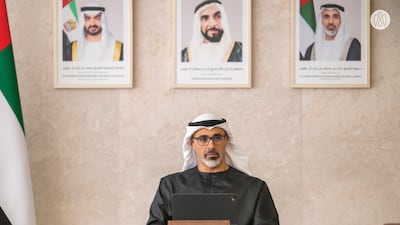
Abu Dhabi's Executive Council has deployed an agentic artificial intelligence platform for the first time to support government decision-making at its highest level.
Sheikh Khaled bin Mohamed, Crown Prince of Abu Dhabi and Chairman of Abu Dhabi Executive Council, chaired the meeting, during which the AI Committee System was used to analyse proposals, generate executive summaries and provide real-time insights to support discussion. The platform ensures all outputs and decisions remain traceable to their original source documents.
Among the key decisions taken, Sheikh Khaled approved the expansion of the Abu Dhabi Liveability Strategy into a second five-year phase.

The first phase saw more than 60 major projects completed, valued at more than Dh12 billion, as part of a broader Dh42 billion ($11.44 billion) programme, with the emirate's District Completion Index rising from 67 per cent to 84 per cent over two years.
The new phase will shift focus from building community facilities to improving their operational quality, using predictive, data-driven planning to direct government investment where it has the greatest impact.
Sheikh Khaled also approved a significant expansion of the Al Ghad Nurseries project, which currently serves 3,253 children, 80 per cent of whom have working mothers, across 10 nurseries in Abu Dhabi and Al Ain.
Capacity will increase to 12,000 places by 2029, covering Abu Dhabi, Al Ain and Al Dhafra, with the expansion expected to create more than 1,000 jobs for Emirati women in the early childhood sector.
A new Abu Dhabi Programme for the Future of Reproductive Health was also approved, to be overseen by the emirate's Department of Health. The programme aims to build an integrated ecosystem covering prevention, genetic screening, fertility treatment and assisted reproductive technology, targeting an IVF success rate of 80 per cent by 2030 through precision medicine, genomics and AI.
The council also reviewed progress on integrating AI education into private school curriculums across the emirate, from kindergarten to Grade 12.

The forefront of AI adoption
Sheikh Mohammed bin Rashid, Vice President, Prime Minister and Ruler of Dubai, announced in April that half of UAE government services will be delivered using cutting-edge AI agents within two years.
The UAE government has been at the forefront of global efforts to harness the responsible and safe use of AI to boost efficiency and raise standards. Omar Al Olama was appointed as the world's first AI minister in 2017 to help guide the UAE's efforts to adopt the emerging technology.
The nation's commitment to the field was further demonstrated when it established the Mohamed bin Zayed University of Artificial Intelligence in 2019.
"AI is no longer a tool. It analyses, decides, executes and improves in real time. It will become our executive partner to enhance services, accelerate decisions and raise efficiency," Sheikh Mohammed wrote on X in April.
"This transformation has a clear timeline. Two years. Performance across government will be measured by speed of adoption, quality of implementation and mastery of AI in redesigning government work."

