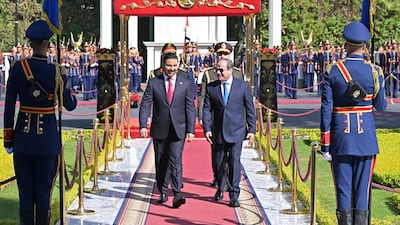

Egypt's President Abdel Fattah El Sisi and Iraqi Prime Minister Ali Al Zaidi discussed expanding co-operation in energy, investment, trade and military affairs during the Iraqi leader's first official visit to Cairo on Monday.
The talks covered both bilateral ties and regional crises, the Egyptian presidency's spokesman said. Mr El Sisi told a joint news conference that the two sides had agreed to "strengthen mechanisms of political consultation" given the "intertwined challenges" facing the region.
The visit by Mr Al Zaidi, a 41-year-old businessman who took office in May as Iraq's youngest Prime Minister, coincides with the fourth session of the Egyptian-Iraqi joint higher committee. The Iraqi Prime Minister and his Egyptian counterpart, Mostafa Madbouly, were expected to sign a number of agreements after chairing the committee meeting in the New Administrative Capital on Monday evening.

Iraq's Trade Ministry said the agreements would cover finance, planning, agriculture, transport, trade and industry.
On the sidelines, Iraqi officials said the two countries were discussing Iraq supplying Egypt with about 10 million barrels of crude – without specifying the delivery period – and looking at export routes that avoid the Strait of Hormuz.
Iraq and other oil-producing states around the Gulf have been seeking alternative routes to the strait after Iran effectively shut the waterway following the US-Israeli attacks in February.
Iraq's oil exports, which account for more than 90 per cent of its budget, collapsed from 3.36 million barrels per day in February to 131,000 bpd in April. They have since recovered to about 2.7 million bpd, according to Iraq's oil ministry, as Baghdad turned to alternative routes, including restarting exports through a pipeline to Turkey.
Mr Al Zaidi said Iraq values Egypt's efforts to reduce regional tension, and wants closer consultation with Egypt "to prevent a renewed regional escalation", the Egyptian presidency said.
Mr El Sisi said the two leaders reject "attempts to undermine the freedom and security of navigation" in the Gulf, the Bab Al Mandeb strait and the Red Sea. He added that security and the governing of the Red Sea are "the exclusive responsibility of the Arab and African states bordering it, and no others". Egypt has made this argument repeatedly in opposing a naval role for countries that do not border the sea.
The two leaders also discussed water security. Mr El Sisi noted that both countries were "downstream states" and called for international law on cross-border rivers to be respected. He rejected "unilateral measures" and called for prior notification and consultation. Egypt has long been in a dispute with Ethiopia over the Grand Ethiopian Renaissance Dam on the Blue Nile. Iraq depends on the Tigris and Euphrates, which rise in Turkey.
On Gaza, Mr El Sisi called on Israel to meet its obligations under the first phase of US President Donald Trump's peace plan, including allowing in aid and supplies for early recovery. He urged implementation of the second phase, which involves a full Israeli withdrawal, the entry of a Palestinian technocratic committee to administer the territory, and the deployment of an international stabilisation force.
The leaders also backed efforts to reach a political settlement in Yemen.