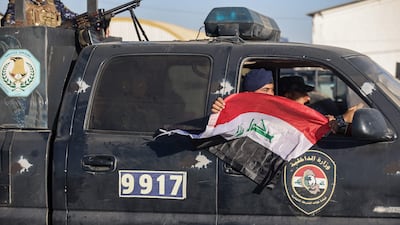

Iraqi security forces began to enter Jurf Al Sakhar on Friday under a government plan aimed at restoring state power in an area long controlled by the Iran-backed Kataib Hezbollah militia.
Tanks and armoured vehicles rolled into the district as government forces began taking up positions under a security agreement with Kataib Hezbollah, marking Baghdad's most significant move in years to reassert authority over the area.
A compromise deal was established late on Thursday to ease tension with Iran's most powerful militia ally in the country. Under the deal, Kataib Hezbollah members were expected to withdraw to other parts of the country while federal police and the Popular Mobilisation Forces were set to take over parts of the area.
“The deployment of forces and the handover of areas of responsibility are taking place starting today. The command headquarters has been granted full powers by Prime Minister Ali Al Zaidi to maintain security and enforce the law in the Jurf Al Nasr area,” government spokesman Sabah Al Numan said at a media conference on the outskirts of the area on Friday morning, using the name given to the area by the PMF after liberating it from ISIS.
The government established a new joint security headquarters in the district south of Baghdad, bringing together units from the army, federal police, energy police and PMF. The command is tasked with overseeing security, protecting oil infrastructure and reopening key roads in the area.
The operation is a test of Baghdad's broader effort to bring armed groups under state control while avoiding a confrontation between competing Shiite groups.
Experts say the outcome in Jurf Al Sakhar could shape the government's wider campaign to curb the influence of militias and strengthen central authority across Iraq.

"This is a significant change to the past 12 years, when the area was out of reach to the government. If it’s enforced as planned, it will be break the last stronghold of Kataib Hezbollah since the war on ISIS," Lahib Hagel, an Iraq expert at Crisis Group, told The National. "But questions remain regarding the areas that will be controlled by the Hashd Brigades [PMF] and whether Kataib Hezbollah will be able to exercise influence through them."
Jurf Al Sakhar, about 60km south-west of Baghdad, has remained largely closed to civilians and the government for more than a decade.
The predominantly Sunni area was recaptured from ISIS in 2014 by the Kataib Hezbollah fighters alongside the Iraqi army, but most former residents have been barred from returning. Iraqi officials have increasingly linked the restoration of state authority in the district to plans for reopening the area and addressing the long-standing displacement issues.

