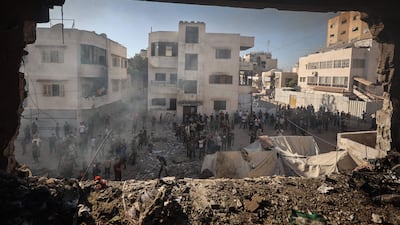
Gaza city, once the beating heart of the Israeli-occupied Palestinian territory, is now a shattered landscape.
Before the war began in October 2023, the city was home to about 700,000 people crammed into a 45 square-kilometre space, making it the largest urban centre in the occupied Palestinian territories.
The city stood as the political, cultural and economic capital of Gaza, bearing layers of ancient history and modern conflict, only 3km east of the port and beach that offered a rare reprieve for its people under siege.
Al Rimal, one of its 13 neighbourhoods, was the most affluent in the entire strip.
A mere 3km from the city centre, Al Rimal housed government buildings and the headquarters for the UN agency for Palestinian refugees (UNRWA).
It was also one of the first areas to be annihilated in the early days of the war, before the rest of the city followed.
Satellite imagery and aerial footage show entire neighbourhoods now flattened, with landmarks reduced to rubble. Homes that were not destroyed have been rendered uninhabitable.

Hundreds of thousands fled under Israeli evacuation orders at the start of the war but many returned during a temporary ceasefire this year.
Israel already controls, and has largely destroyed, about 75 per cent of Gaza, with most of the population of more than two million Palestinians now sheltering in Gaza city, the main urban area of Deir Al Balah and the sprawling displacement camps in the southern Al Mawasi area along the coast.
What remains is a city lacking functioning hospitals, clean water and electricity.
Despite this, Israel has approved plans to launch a renewed military push into Gaza city, as part of its plans to reoccupy the enclave.
Since the Nakba in 1948, the city's population has grown significantly with the arrival of Palestinian refugees.
It became a stronghold of identity and resilience, despite periodic wars and a damaging Israeli-Egyptian blockade that began after Hamas took power in 2007.
That blockade strangled the economy, limiting access to basic goods, construction materials and employment.
Gaza’s once-thriving sectors – textile manufacturing, agriculture, artisan crafts – crumbled under siege and war. What was once Gaza’s centre of life is now its epicentre of loss.
The city’s destruction is not merely physical, it represents the erasure of a proud place where Palestinian political, cultural and human life once flourished.
Still, even in ruins, Gaza city remains central to the Palestinian story.