

Live updates: Follow the latest on Israel-Gaza
The US and several partners including three Arab states have called for an immediate 21-day ceasefire between Israel and Hezbollah to allow for negotiations and pause a spiralling conflict that has seen more than 600 people killed by Israeli strikes in Lebanon in recent days.
A joint statement released late on Wednesday described the recent fighting as “intolerable” and said it “presents an unacceptable risk of a broader regional escalation”.
“We call on all parties, including the governments of Israel and Lebanon, to endorse the temporary ceasefire immediately consistent with UNSCR 1701 during this period, and to give a real chance to a diplomatic settlement,” it said, referring to the 2006 Security Council resolution that established the demilitarised Blue Line along Lebanese border.
The statement, negotiated on the sidelines of the UN General Assembly in New York, was signed by the US, Australia, Canada, the EU, France, Germany, Italy, Japan, Saudi Arabia, the UAE and Qatar, according to the White House.
“We were able to generate significant support from Europe as well as the Arab nations. It’s important the war not widen. I’ll have more to say about it tomorrow,” President Joe Biden said as he returned to the White House.

France’s Foreign Minister Jean-Noel Barrot said earlier that his country has been working with the US on a 21-day temporary ceasefire proposal.
“We are counting on both parties to accept it without delay, in order to protect civilian populations and allow for diplomatic negotiations to begin,” he told the 15-member UN Security Council.
He urged the council, which held a session on Lebanon during the UN General Assembly in New York, to seize the opportunity to ensure a diplomatic solution to the rapidly intensifying conflict between Hezbollah and Israel, emphasising that “war is not inevitable”.
Mr Barrot said France and the US had consulted with the warring sides on the “final parameters for a diplomatic way out of this crisis under Resolution 1701”.
The resolution was adopted after the 2006 Israel-Hezbollah war and expanded the mandate of the UN peacekeeping force (Unifil), empowering it to assist the Lebanese army in maintaining weapon-free zones in southern Lebanon, other than those of the Lebanese state.
Unifil, along with the Lebanese military, is responsible for ensuring the area between the Litani river and the southern border with Israel is “free of any armed personnel, assets and weapons” other than those belonging to the government.
This has led to tension with Hezbollah, which maintains significant influence in the region despite the Lebanese army's presence.
“It's a demanding path, but it is a possible path,” Mr Barrot said.
Mr Barrot, who will be travelling to Beirut by the end of the week to work with local stakeholders, later said: “Important progress has been made in the last few hours on a temporary ceasefire.”
US deputy ambassador Robert Wood said Washington is trying to avert a broader war that is “in no party's interest, not the people of Israel, not the people of Lebanon”.
The American diplomat encouraged the council to lend its support to “these diplomatic efforts” in the coming days.
“We are working with other countries on a proposal that we hope will lead to calm and enable discussions to a diplomatic solution,” he said.
-
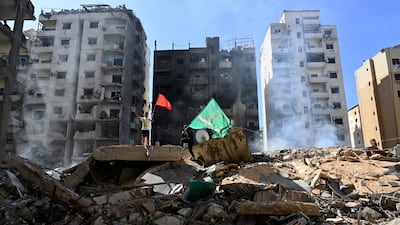
Damage in Beirut after an overnight Israeli strike. EPA -
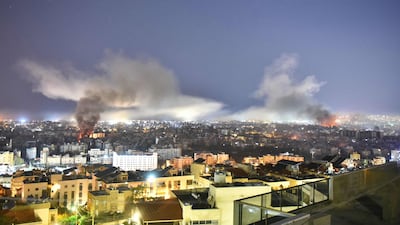
Smoke rises from the site of an Israeli strike in the south of Lebanon's capital. AFP -
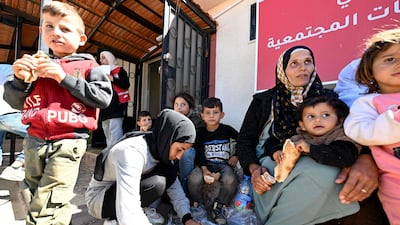
Displaced Syrians and Lebanese enter Syria from Lebanon at the Jusiyah border crossing. AFP -

The site of the Israeli air strike that killed Hezbollah leader Hassan Nasrallah, in Beirut. AP -
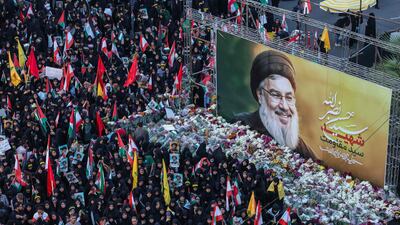
Iranians lay flowers before a portrait of Nasrallah. AFP -

Smoke billows over Tyre, southern Lebanon following an Israeli strike. Reuters -
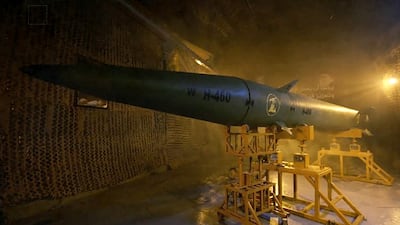
A Qader 1 ballistic missile from Hezbollah's arsenal. AFP -
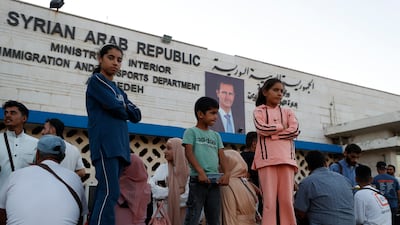
Syrians fleeing the war in Lebanon arrive at the Syrian-Lebanese border crossing in Jdeidet Yabous. AP -
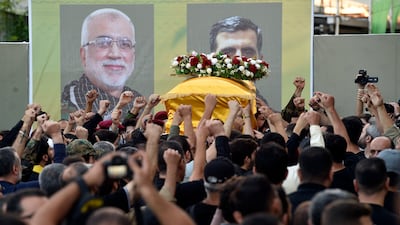
Hezbollah fighters carry the coffin of Hezbollah commander Ibrahim Qubaisi during his funeral in Beirut. EPA -
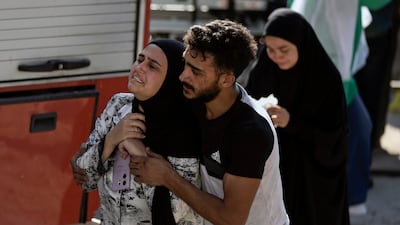
People react at the scene of an Israeli air strike in the town of Maisara, north of Beirut. AP -
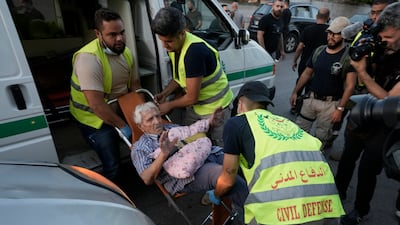
Civil defence workers carry an elderly man who fled from the south of Lebanon, as he arrives at a school turned into a displaced shelter in Beirut. AP -
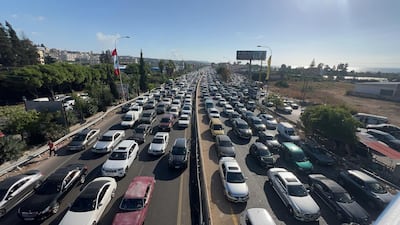
A traffic jam in Ghazieh as people fleeing from the south of Lebanon drive towards Sidon and Beirut. EPA -
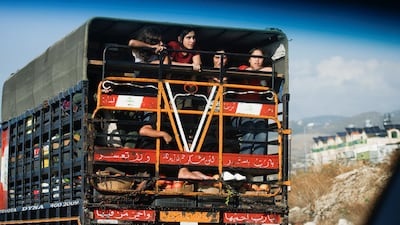
People in heavy traffic drive north from Lebanon's southern coastal city of Sidon, as they flee Israeli bombardment. Reuters -
Smoke billows over southern Lebanon following Israeli strikes, as seen from Tyre. Reuters -
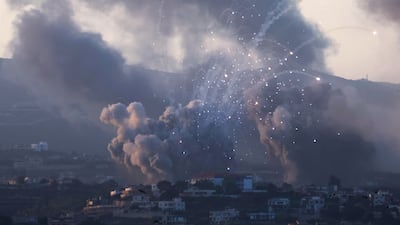
Smoke billows over southern Lebanon following Israeli strikes, as seen from Tyre. Reuters -
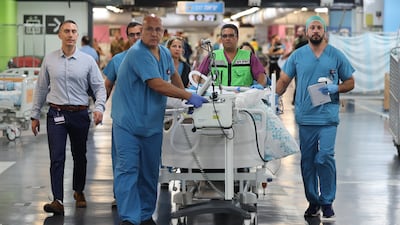
Medics move patients at Rambam Hospital's underground emergency centre, in Haifa, northern Israel. EPA -
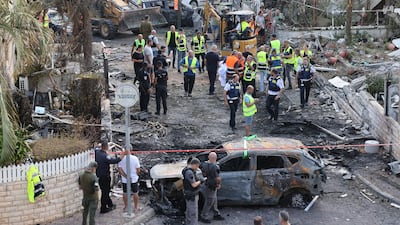
Israeli emergency teams work at the scene of a missile strike on a residential neighbourhood in Kiryat Bialik, northern Israel. EPA -
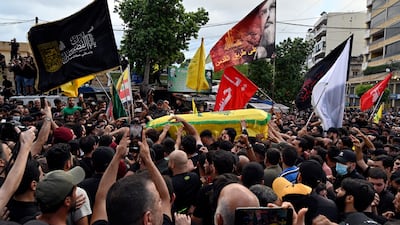
Hezbollah fighters carry the coffin of the group's senior commander Ibrahim Aqil, who was killed in an Israeli strike on September 20, in Beirut. EPA -
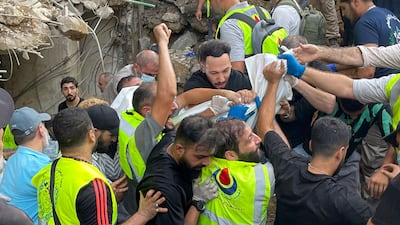
Rescuers carry a body at the scene of a missile strike in the southern suburbs of Beirut. AP


A senior US administration official said Mr Biden and senior advisers had been engaging with Israel and Hezbollah, as well as “partners around the world … to reach a consensus for a call for a ceasefire that you have seen that we are issuing tonight”.
“The ceasefire will be for 21 days along the Blue Line. During those 21 days, the parties will negotiate towards a potential solution of the conflict that has been ongoing since Hezbollah launched the attack on October 8, and to reach a comprehensive agreement along the Blue Line that allows for residents to return to their home in both Lebanon and Israel,” the official said.
Lebanon's Prime Minister Najib Mikati accused Israel of violating his country's sovereignty by “sending their war planes and drones to our skies, by killing our civilians, including youth, women and children destroying homes and forcing families to flee harsh humanitarian conditions”.
Mr Mikati called on the council to “act seriously and immediately” to guarantee the withdrawal of Israel from all the occupied Lebanese territories, and to end abuses “that are repeated on a daily basis”.
Israel's ambassador to the UN Danny Danon clarified that his country has been conducting “precise strikes” in Lebanon against Hezbollah command centres, weapons stores and leadership, in addition to sites where rockets and missiles have been launched.
Ahead of the emergency session, Iran’s Foreign Minister Abbas Araghchi warned that Israel has crossed all red lines.
He said Tehran, which has so far avoided launching retaliatory strikes after attacks by Israel on Iranian interests, may no longer be restrained.
“The region is on the brink of a full-scale catastrophe. If unchecked, the world will face catastrophic consequences,” he said in New York.

