Live updates: Follow the latest on Israel-Gaza
The conflict between Israel and Hezbollah reached unprecedented levels on Friday after Israel killed senior Hezbollah commanders in Beirut, saying no political solution could solve tensions on its northern border and military pressure on the group must be stepped up.
An Israeli official told The National that Israel was taking a new approach towards Hezbollah, the clearest sign yet that after 11 months of fighting the two sides are on the brink of a full-scale war.
The change paves the way for more intense Israeli military action in Lebanon, following a week of aggressive attacks including intensifying its bombing campaign, assassinating senior Hezbollah leaders and allegedly detonating communication devices belonging to Hezbollah members, killing dozens and injuring thousands, including civilians.
The latest Israeli attack killed senior Hezbollah commander Ibrahim Aqil along with at least 45 people on Friday. The strike, which destroyed a residential building in Beirut's southern suburb of Dahieh, also wounded 68.
Hezbollah officially confirmed the death of its senior commander in a statement in the early hours of Saturday. Several hours later, the group announced the death of a second commander, Ahmed Wahbi, who oversaw the military operations of its Radwan special forces during the Gaza war until early 2024.
Dozens of relatives of missing people waited near a security cordon for news of their family members, possibly still trapped under the rubble.
A woman in a black hijab asked Red Cross workers for news of her daughter. “I went to St George hospital and St Therese and no one knows where my daughter is. There has to be some way you can find out,” she said to a group of paramedics.
“There is nothing we can do in these cases because most of the time we don’t know if the person who was rescued is alive or dead, or still under the rubble, or what hospital they went to,” a civil defence worker told The National.
Israeli army spokesman Daniel Hagari said Israeli forces killed Mr Aqil, along with other top operatives and the chain command of Hezbollah's elite Radwan forces.
“They gathered underground, under a residential building, in the heart of Dahieh, while using civilians as a human shield. They met to co-ordinate terror activities against Israeli civilians,” he said at a press conference.
Hezbollah did not comment on the alleged killing of other top operatives.
“It’s a dark series [of events] for Hezbollah,” Karim El Mufti, a professor of international relations at Sciences Po in Paris, told The National. “Israel has shifted from a defensive stance to an aggressive one. For Israel, the front has become a unified battlefield across the entire axis of resistance. There is no need to ask when the war is coming – it’s already unfolding before our eyes.”
Mr Mufti described the conflict as a “strategic war of attrition”. “Israel doesn’t need to bomb the whole southern suburbs when it can target commanders and thousands of militiamen without worrying about collateral damage and while keeping international support, particularly from the US,” he said. “Now, Hezbollah is cornered, as it does not want a full-scale war but is seeking retaliation – yet, what kind of response could match these attacks?”
-
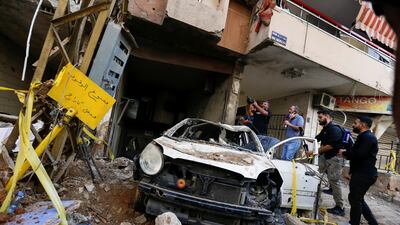
A damaged car at the site of the September 20 Israeli strike on a building in Beirut's southern suburb, Dahiyeh, as search and rescue operations continue. Reuters -

Emergency personnel work at the site of the deadly Israeli strike. The day after the strike, Lebanon's Health Minister said at least 31 people had been killed. Reuters -

A view of a damaged building after the strike, which the Israeli army said targeted Hezbollah commander Ibrahim Aqil. Reuters -
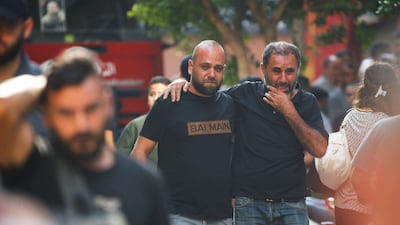
People gather near the site of the strike, waiting for news of loved ones believed to be trapped under the rubble. Reuters -
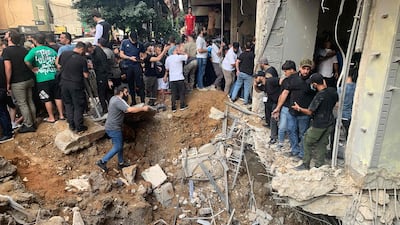
People search the rubble of what was once a 10-storey apartment building. AFP -
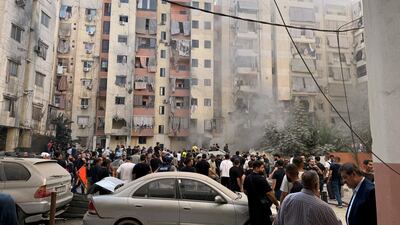
Hezbollah confirmed that Ibrahim Aqil and another senior commander were killed in the strike, among 14 of its fighters. Reuters -
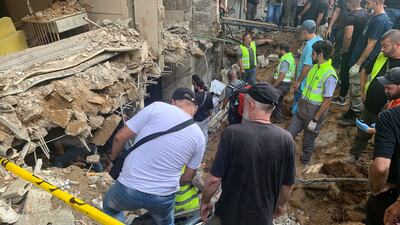
First responders gather at the scene of the Israeli strike in Beirut. AFP -

Medical staff wait for the arrival of an ambulance carrying injured casualties in Beirut. Reuters -
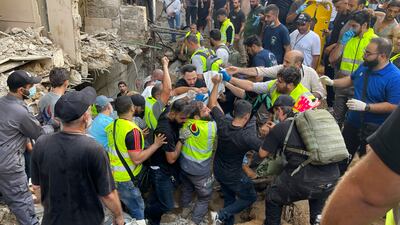
Rescuers lift an injured person out of the rubble. AP Photo -

People stand on top of a damaged car in the rubble. AP Photo -

The building was hit by four missiles, state media reported. AP Photo -
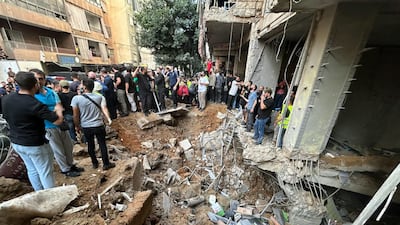
A large number of women and children were reported injured in the strike. AFP


The Beirut strike is the third by Israel on the Lebanese capital since Israel and Hezbollah started exchanging fire on October 8 amid the Gaza war. The militant group announced the death of two of its fighters in Friday's attack. Lebanon's ministry of health said 14 people were killed and 66 wounded.
Israeli media reported that Mr Aqil was one of the primary commanders responsible for drawing up Hezbollah battle plans for a future takeover of northern Israel’s Galilee region.
Images from Dahieh showed plumes of smoke over the area. Clips shared on social media portrayed scenes of chaos, a building completely levelled, and mangled cars across a busy street. Ambulances were rushed to the scene.
Calls for blood donations for the victims were multiplying on social media. People searching for their loved ones also took to social media to ask for help, sharing pictures of their missing relatives, including children.
The General Directorate of Civil Defence urged “citizens to evacuate the site of the collapsed building” as rescue operations were under way to find those missing under the rubble. The security services imposed a cordon across the site, it added.
Lebanese Prime Minister Najib Mikati said the Israeli strike showed Israel “gives no weight to any humanitarian, legal, or moral considerations”.
White House National Security Council spokesman John Kirby said the US was “not aware of any prior notification of Israeli strikes on Beirut”.
“We continue to believe that a diplomatic solution is the best way to move forward in the Middle East,” added Mr Kirby, who said “no one has lost hope” regarding a hostage-release and ceasefire agreement in Gaza between Hamas and Israel.

Heightened tensions
The strike follows attacks across Lebanon on communication devices used by members of Iran-backed Hezbollah on Tuesday and Wednesday. Those explosions killed 37 people, injured thousands, and were widely blamed on Israel.
On Friday, Hezbollah fired around 150 rockets into northern Israel and the occupied Golan Heights, according to the Israeli army, in response to Israel's extensive overnight air strikes on south Lebanon. The intensification of Israel's air campaign came hours after a speech by Hezbollah chief Hassan Nasrallah in which he dared Israel's military to set foot on Lebanese soil.
Hezbollah said it fired “volleys of Katyusha rockets” at six Israeli military installations, including the northern command’s main air defence missile base, near Safad city, and another defence headquarters in the occupied Golan. Israel renewed its orders for civilians in the north and the Golan Heights to stay close to bomb shelters and limit their movements. The barrage caused several fires in parts of Safad, Israeli media reported.
The previous night, Israeli strikes ignited fires in parts of south Lebanon, including Jezzine, with the army saying it “struck hundreds of rocket launcher barrels that were ready to be used immediately to fire towards Israeli territory”. The Israeli army also said it hit “additional terrorist infrastructure sites” and it restated a commitment to “continue demolishing Hezbollah's infrastructure and capabilities”.
The bombardment occurred shortly after Hezbollah launched a barrage of Falaq missiles at Metulla in northern Israel, destroying about half of the houses in the town, according to media reports.
Israel's escalation of air strikes and espionage operations has stoked international fears that they are a prelude to a ground invasion of Lebanon.
Almost a year of cross-border fighting has prevented tens of thousands of residents on both sides of the border from returning to their homes. Hezbollah has vowed to prevent Israelis from returning if a ceasefire is not achieved in Gaza, while Israeli officials have consistently threatened an invasion that aims to create a security buffer zone between Israel and Lebanon and allow Israelis to return.
Fighter jets had carried out a series of heavy strikes on south Lebanon's frontier shortly before Mr Nasrallah's speech on Thursday.

