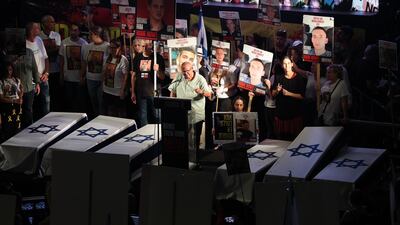
Protesters demanding Israeli Prime Minister Benjamin Netanyahu accept a ceasefire deal rally in Tel Aviv on September 4. Bloomberg

Netanyahu's excuse to stall Gaza ceasefire is a scam, Israeli politician says


Holly Johnston
  • English
  • Arabic

Live updates: Follow the latest on Israel-Gaza

A prominent Israeli politician has denounced Benjamin Netanyahu's insistence on keeping troops in Gaza's border strip with Egypt, calling the move "a scam" and saying the Israeli Prime Minister is using the issue to sacrifice Israeli and Palestinian civilians for political reasons.

"Philadelphi is a scam. It's fake. Netanyahu never mentioned it before," Hadash member Ofer Cassif told The National, using the Israeli name for the Salah Al Din corridor. "It's lies upon lies – all for political survival."

Mr Cassif has been one of the most vocal Israeli critics of the war and Israel's occupation of Palestine. He almost lost his parliamentary seat as a result, surviving a February vote against him after he signed a petition supporting South Africa's genocide case at the International Court of Justice.

"I said it months ago – had the government loved the Israelis more than they hated the Palestinians, the hostages would have been home ages ago," he said. "Unfortunately, that is not the case. The government doesn't care about the well-being or life of anyone. Netanyahu, time and time again, has foiled any possibility of a deal to release the hostages on purpose."

Israeli MP Ofer Cassif has been a fierce critic of the country's occupation of Palestine. EPA

Crowds descended once again on Tel Aviv and Jerusalem on Thursday, carrying mock coffins to represent the six hostages found dead in a Rafah tunnel on Saturday. Three of them were reportedly on a list of hostages to be released in a July ceasefire deal.

"If Netanyahu continues as planned, more hostages will be killed," Gil Dickman, whose cousin Carmel Gat was killed in Gaza, told crowds in Tel Aviv. Roni Adar, whose cousin's body is being held in the enclave, said: "Bibi [Mr Netanyahu] – there's only one way to save the hostages, and that's to sign a deal."

Mr Netanyahu gave two press conferences this week to defend his stance on keeping troops in the Salah Al Din corridor, which he claims is vital to Hamas weapons supplies. The area could also be used to transfer hostages to Iran and Yemen through Egypt.

While the White House has said a ceasefire deal must include an Israeli withdrawal from the corridor, US officials say Hamas remains the "main obstacle" to a ceasefire in Gaza, where almost 41,000 Palestinians have been killed since the war began in October last year. But Hamas has said it is committed to the principles of the ceasefire proposal.

Regardless of the strategic advantages of the border strip, many Israelis, particularly hostage families, have called on Mr Netanyahu to withdraw from the corridor to make a deal happen – with the mother of hostage Almog Sarusi saying he was "sacrificed for Philadelphi and Rafah".

While Mr Netanyahu insists the corridor is necessary to prevent Hamas from rearming and repeating the October 7 attack on Israel, critics maintain that he is prolonging the war to protest his political career. He faced corruption charges and massive protests against planned judicial reforms before the war began.

  • Demonstrators, many with Israeli and yellow flags to symbolise solidarity with the hostages, during a protest demanding a ceasefire deal and the immediate release of those held by Hamas, in Tel Aviv, on Tuesday. AP
    Demonstrators, many with Israeli and yellow flags to symbolise solidarity with the hostages, during a protest demanding a ceasefire deal and the immediate release of those held by Hamas, in Tel Aviv, on Tuesday. AP
  • Demonstrators clash with police during an anti-government protest in Tel Aviv. AFP
    Demonstrators clash with police during an anti-government protest in Tel Aviv. AFP
  • A demonstrator holds a placard during a protest in Tel Aviv, on Tuesday. Reuters
    A demonstrator holds a placard during a protest in Tel Aviv, on Tuesday. Reuters
  • A flare burns during a protest against the government in Tel Aviv. Reuters
    A flare burns during a protest against the government in Tel Aviv. Reuters
  • A demonstrator confronts a police officer in Tel Aviv. Reuters
    A demonstrator confronts a police officer in Tel Aviv. Reuters
  • Powder was released from a fire extinguisher during a protest against the government in Tel Aviv. Reuters
    Powder was released from a fire extinguisher during a protest against the government in Tel Aviv. Reuters
  • Police arrest protesters breaking through a checkpoint outside the residence of Prime Minister Benjamin Netanyahu in Jerusalem. EPA
    Police arrest protesters breaking through a checkpoint outside the residence of Prime Minister Benjamin Netanyahu in Jerusalem. EPA
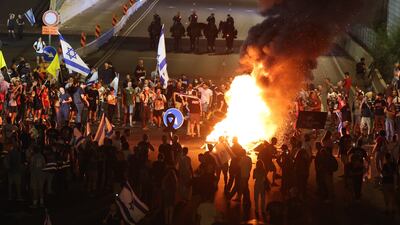
  • Protesters set fires during a rally on the second day of demonstrations in Tel Aviv, Israel. Getty Images
    Protesters set fires during a rally on the second day of demonstrations in Tel Aviv, Israel. Getty Images
  • Demonstrators gathered in Tel Aviv to demand a Gaza deal and secure the release of the hostages. Getty Images
    Demonstrators gathered in Tel Aviv to demand a Gaza deal and secure the release of the hostages. Getty Images
  • Protesters use a smoke torch during a rally on the second day of demonstrations in Tel Aviv, Israel. Getty Images
    Protesters use a smoke torch during a rally on the second day of demonstrations in Tel Aviv, Israel. Getty Images
  • Demonstrators lift placards and chant slogans as they stop traffic during an anti-government protest in central Jerusalem on Monday. AFP
    Demonstrators lift placards and chant slogans as they stop traffic during an anti-government protest in central Jerusalem on Monday. AFP
  • Israeli trade unionist and the chairman of Histadrut, Arnon Bar-David, addresses thousands of demonstrators supporting the families of Israeli hostages held by Hamas in Gaza, during a protest in Tel Aviv. EPA
    Israeli trade unionist and the chairman of Histadrut, Arnon Bar-David, addresses thousands of demonstrators supporting the families of Israeli hostages held by Hamas in Gaza, during a protest in Tel Aviv. EPA
  • Demonstrators light bonfires as they block the Ayalon main highway during a protest in Tel Aviv. EPA
    Demonstrators light bonfires as they block the Ayalon main highway during a protest in Tel Aviv. EPA
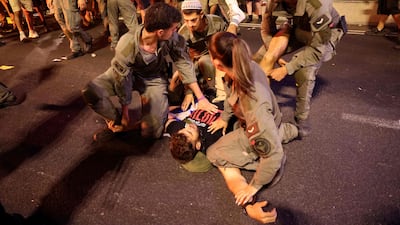
  • Police officers detain a protester during clashes after a rally calling for the release of Israelis held hostages. AFP
    Police officers detain a protester during clashes after a rally calling for the release of Israelis held hostages. AFP
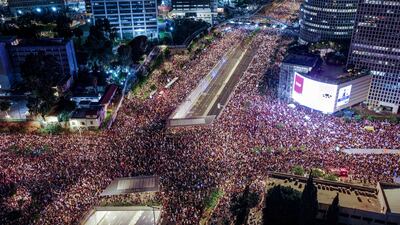
  • An aerial view of the scale of the protests in Tel Aviv. Reuters
    An aerial view of the scale of the protests in Tel Aviv. Reuters
  • People attend a demonstration calling for the immediate return of hostages held in Gaza, in Jerusalem. Reuters
    People attend a demonstration calling for the immediate return of hostages held in Gaza, in Jerusalem. Reuters

Netanyahu 'doesn't care'

Speaking to the press on Monday, the grandson of elderly hostage Oded Lifshitz said he hoped Mr Netanyahu would withdraw troops from the corridor and sign a ceasefire deal soon.

"Stop losing the time for our hostages," Daniel Lifshitz said, hours before a general strike was announced by Israel's largest trade union to push for a deal. "We will do everything to make pressure inside Israel, that Israel will do everything to take the deal. I hope they will change the decision about the Philadelphi corridor."

Mr Cassif, who met this week with the parents of hostage Hersh Goldberg-Polin, among the six recovered from Gaza, said: "[Mr Netanyahu] doesn't care about the lives of the hostages, he doesn't care about the lives of the soldiers, he doesn't care about the thousands and thousands of people who have been evacuated from their homes in the north of Israel.

"The government has destroyed Gaza to ashes and sacrificed the lives of hostages and soldiers on the altar of their own political survival.

"Hersh and the others – all of them, and many before – could have been home months ago, but the government didn’t do anything. They have foiled any chance to release them on purpose. I’ve brought this up in the Knesset plenum before, but I didn’t have enough time – only three to five minutes – to bring up all the incidences where he has foiled a deal."

Mr Cassif accused Mr Netanyahu of using Israeli soldiers as "cannon fodder" and said more international pressure needed to be put on the Israeli cabinet to secure a deal.

"None of these things could have happened without the active support of the US and other European countries. Biden and his cabinet have been criticising Netanyahu over the deal, but they keep arming Israel and veto [UN] Security Council decisions to keep the war," he said.

"The US bears a lot of responsibility for the continuing massacre, and the fate of the hostages. They're not supporting Israel, they're supporting the government of Israel. You have to distinguish the two."


MATCH INFO

Uefa Champions League semi-finals, first leg
Liverpool v Roma

When: April 24, 10.45pm kick-off (UAE)
Where: Anfield, Liverpool
Live: BeIN Sports HD
Second leg: May 2, Stadio Olimpico, Rome

COMPANY%20PROFILE
%3Cp%3E%3Cstrong%3EName%3A%20%3C%2Fstrong%3ETelr%3Cbr%3E%3Cstrong%3EBased%3A%20%3C%2Fstrong%3EDubai%2C%20UAE%3Cbr%3E%3Cstrong%3ELaunch%20year%3A%3C%2Fstrong%3E%202014%3Cbr%3E%3Cstrong%3ENumber%20of%20employees%3A%20%3C%2Fstrong%3E65%3Cbr%3E%3Cstrong%3ESector%3A%20%3C%2Fstrong%3EFinTech%20and%20payments%3Cbr%3E%3Cstrong%3EFunding%3A%20%3C%2Fstrong%3Enearly%20%2430%20million%20so%20far%3C%2Fp%3E%0A
Ten tax points to be aware of in 2026

1. Domestic VAT refund amendments: request your refund within five years

If a business does not apply for the refund on time, they lose their credit.

2. E-invoicing in the UAE

Businesses should continue preparing for the implementation of e-invoicing in the UAE, with 2026 a preparation and transition period ahead of phased mandatory adoption. 

3. More tax audits

Tax authorities are increasingly using data already available across multiple filings to identify audit risks. 

4. More beneficial VAT and excise tax penalty regime

Tax disputes are expected to become more frequent and more structured, with clearer administrative objection and appeal processes. The UAE has adopted a new penalty regime for VAT and excise disputes, which now mirrors the penalty regime for corporate tax.

5. Greater emphasis on statutory audit

There is a greater need for the accuracy of financial statements. The International Financial Reporting Standards standards need to be strictly adhered to and, as a result, the quality of the audits will need to increase.

6. Further transfer pricing enforcement

Transfer pricing enforcement, which refers to the practice of establishing prices for internal transactions between related entities, is expected to broaden in scope. The UAE will shortly open the possibility to negotiate advance pricing agreements, or essentially rulings for transfer pricing purposes. 

7. Limited time periods for audits

Recent amendments also introduce a default five-year limitation period for tax audits and assessments, subject to specific statutory exceptions. While the standard audit and assessment period is five years, this may be extended to up to 15 years in cases involving fraud or tax evasion. 

8. Pillar 2 implementation 

Many multinational groups will begin to feel the practical effect of the Domestic Minimum Top-Up Tax (DMTT), the UAE's implementation of the OECD’s global minimum tax under Pillar 2. While the rules apply for financial years starting on or after January 1, 2025, it is 2026 that marks the transition to an operational phase.

9. Reduced compliance obligations for imported goods and services

Businesses that apply the reverse-charge mechanism for VAT purposes in the UAE may benefit from reduced compliance obligations. 

10. Substance and CbC reporting focus

Tax authorities are expected to continue strengthening the enforcement of economic substance and Country-by-Country (CbC) reporting frameworks. In the UAE, these regimes are increasingly being used as risk-assessment tools, providing tax authorities with a comprehensive view of multinational groups’ global footprints and enabling them to assess whether profits are aligned with real economic activity. 

Contributed by Thomas Vanhee and Hend Rashwan, Aurifer

WITHIN%20SAND
%3Cp%3EDirector%3A%20Moe%20Alatawi%3C%2Fp%3E%0A%3Cp%3EStarring%3A%20Ra%E2%80%99ed%20Alshammari%2C%20Adwa%20Fahd%2C%20Muhand%20Alsaleh%3C%2Fp%3E%0A%3Cp%3ERating%3A%203%2F5%3C%2Fp%3E%0A
Attacks on Egypt’s long rooted Copts

Egypt’s Copts belong to one of the world’s oldest Christian communities, with Mark the Evangelist credited with founding their church around 300 AD. Orthodox Christians account for the overwhelming majority of Christians in Egypt, with the rest mainly made up of Greek Orthodox, Catholics and Anglicans.

The community accounts for some 10 per cent of Egypt’s 100 million people, with the largest concentrations of Christians found in Cairo, Alexandria and the provinces of Minya and Assiut south of Cairo.

Egypt’s Christians have had a somewhat turbulent history in the Muslim majority Arab nation, with the community occasionally suffering outright persecution but generally living in peace with their Muslim compatriots. But radical Muslims who have first emerged in the 1970s have whipped up anti-Christian sentiments, something that has, in turn, led to an upsurge in attacks against their places of worship, church-linked facilities as well as their businesses and homes.

More recently, ISIS has vowed to go after the Christians, claiming responsibility for a series of attacks against churches packed with worshippers starting December 2016.

The discrimination many Christians complain about and the shift towards religious conservatism by many Egyptian Muslims over the last 50 years have forced hundreds of thousands of Christians to migrate, starting new lives in growing communities in places as far afield as Australia, Canada and the United States.

Here is a look at major attacks against Egypt's Coptic Christians in recent years:

November 2: Masked gunmen riding pickup trucks opened fire on three buses carrying pilgrims to the remote desert monastery of St. Samuel the Confessor south of Cairo, killing 7 and wounding about 20. IS claimed responsibility for the attack.

May 26, 2017: Masked militants riding in three all-terrain cars open fire on a bus carrying pilgrims on their way to the Monastery of St. Samuel the Confessor, killing 29 and wounding 22. ISIS claimed responsibility for the attack.

April 2017Twin attacks by suicide bombers hit churches in the coastal city of Alexandria and the Nile Delta city of Tanta. At least 43 people are killed and scores of worshippers injured in the Palm Sunday attack, which narrowly missed a ceremony presided over by Pope Tawadros II, spiritual leader of Egypt Orthodox Copts, in Alexandria's St. Mark's Cathedral. ISIS claimed responsibility for the attacks.

February 2017: Hundreds of Egyptian Christians flee their homes in the northern part of the Sinai Peninsula, fearing attacks by ISIS. The group's North Sinai affiliate had killed at least seven Coptic Christians in the restive peninsula in less than a month.

December 2016A bombing at a chapel adjacent to Egypt's main Coptic Christian cathedral in Cairo kills 30 people and wounds dozens during Sunday Mass in one of the deadliest attacks carried out against the religious minority in recent memory. ISIS claimed responsibility.

July 2016Pope Tawadros II says that since 2013 there were 37 sectarian attacks on Christians in Egypt, nearly one incident a month. A Muslim mob stabs to death a 27-year-old Coptic Christian man, Fam Khalaf, in the central city of Minya over a personal feud.

May 2016: A Muslim mob ransacks and torches seven Christian homes in Minya after rumours spread that a Christian man had an affair with a Muslim woman. The elderly mother of the Christian man was stripped naked and dragged through a street by the mob.

New Year's Eve 2011A bomb explodes in a Coptic Christian church in Alexandria as worshippers leave after a midnight mass, killing more than 20 people.

How to wear a kandura

Dos

  • Wear the right fabric for the right season and occasion 
  • Always ask for the dress code if you don’t know
  • Wear a white kandura, white ghutra / shemagh (headwear) and black shoes for work 
  • Wear 100 per cent cotton under the kandura as most fabrics are polyester

Don’ts 

  • Wear hamdania for work, always wear a ghutra and agal 
  • Buy a kandura only based on how it feels; ask questions about the fabric and understand what you are buying
Updated: September 06, 2024, 6:31 AM