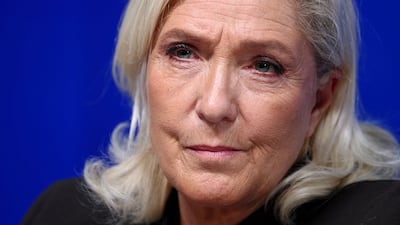

France's front-runner for the presidency, far-right leader Marine Le Pen, took her followers by surprise this week when she revealed she had family ties to Egypt. “My grandmother and my great-grandmother were born in Egypt. We share a common history and I want to deepen our relations in areas such as defence, trade and freedom of navigation,” she told Egyptian TV.
The interest in Egypt shown by Ms Le Pen – who has been leading in the polls for months with more than 30 per cent of the vote – is not new. In 2017, she claimed her great-grandmother was Coptic, though French media that tried to trace her suggested she was Egyptian and born to Maltese and Swiss parents.
Yet for the first time since she has started campaigning for the presidential election in May, Ms Le Pen has spoken at length about her views on the Middle East and Africa. She also called for strengthening ties with Egypt, praising its fight against the Muslim Brotherhood.

After months of paying scant attention to foreign affairs, beyond reiterating her intention to cut aid to Ukraine, the discussion offered a glimpse into her thinking on France's role beyond Europe.
She called for stronger French diplomacy, shunned the European Union and pushed for direct talks with China and the US to negotiate lower tariffs – a series of striking policy shifts that would send shock waves across Europe.
'Fully involved'

“France no longer has a diplomatic role, because it has entrusted its diplomacy to the EU, which is bad at diplomacy,” Ms Le Pen said. “To resolve conflicts that threaten freedom of navigation and countries like Egypt, I want France to get fully involved.”
Yet how Ms Le Pen would strengthen French international diplomacy without EU backing, and amid a looming financial crisis, remains unclear to those who have followed her career for decades.
Centrist President Emmanuel Macron, who has spent the last year of his presidency highly invested in foreign policy, has struggled to have his voice heard internationally due to domestic instability. He has failed to curb his country's soaring debt, which reached 120 per cent of gross domestic product this year, its highest level since 1946.
“French influence is diminished by what France can do now because it's constrained by its level of debt,” Catherine Fieschi, a visiting scholar at Carnegie Europe, recently told the Anglo-American Press Association of Paris.
The real question, Ms Fieschi added, is the following: what happens after six months of a Marine Le Pen presidency? Either she veers back to the European line, or “France goes rogue”, Ms Fieschi said.

Despite her calls for a stronger French presence on the international stage, Ms Le Pen has signalled she would scale back France's involvement in military operations abroad. “We will not send our young people to die in ill-conceived or irresponsible military adventures – and certainly not in wars that are not our own,” she said last month.
She is expected to reverse many of Mr Macron's most recent initiatives, including the deployment of French soldiers to protect Saudi Arabia following Houthi attacks.
Her embrace of Israel – viewed widely as an attempt to bury her father's anti-Semitic past – means she is unlikely to pursue policies in the region that the Israeli government may oppose. While she supports a two-state solution, she criticised France's acknowledgement of Palestinian statehood last year, saying it was akin to “recognising Hamas”.
She would potentially end attempts to influence the security situation in Israeli-occupied south Lebanon. France has been unsuccessful in trying to convince the US to accept a multinational military deployment to replace the decades-old UN deconfliction mission.
A French withdrawal from Lebanese affairs would be viewed widely as a setback for the country's international standing, given its long-standing efforts to maintain a strong diplomatic and cultural presence there. Much of the Lebanese elite speak French, a legacy of the former French mandate, and the country has an extensive network of francophone schools.

Ms Le Pen visited Lebanon during her 2017 presidential campaign but has vowed she would not set a foot outside France in this election cycle. “In 2017, I travelled abroad a great deal and that convinced me that for the 2027 presidential campaign I should not do any such travelling,” she said this week.
Empire fascination
While Ms Le Pen has “huge foreign policy blind spots”, she is also acutely aware of the foreign policy powers available to the president, Ms Fieschi said. “One of the things we could expect from her is that she would be extremely transactionalist.”
The root to understanding Ms Le Pen's view of the world may lie in her fascination with France's former colonial empire, Ms Fieschi added. The party she inherited from her father Jean-Marie Le Pen was founded in the wake of Algeria's independence, which he opposed. This carries through in his daughter, who looks down on the EU as a collection of countries that lack the power of an empire.
“In a sense, you could imagine her saying, “Right, well, we're going to go back and reinvest in the parts of Africa that we should never have left,” Ms Fieschi said. “France doesn't have the means for that, obviously. But I think that's what we should expect, potentially.”
The clearest example of Ms Le Pen's transactional yet nostalgic view of the former French empire may be her position on Africa and immigration, as explained to Egyptian TV. African states “look forward to France's return” after years of rising Chinese and Russian influence following a French retreat that left “a void”, she said.

In return, she hopes to curb illegal migration by developing partnerships to “foster economic development”, encouraging African countries to prevent their citizens from travelling illegally to Europe.
“This is also the other side of our migration policy,” Ms Le Pen said. “We must control our borders and we must state very clearly to the African nations from which migrants arriving in France originate: you cannot abandon control of your own borders.”
This is a strategy that European nations have pursued for years, with limited results. Whether Ms Le Pen's proposed approach to foreign policy could change that remains an open question.

