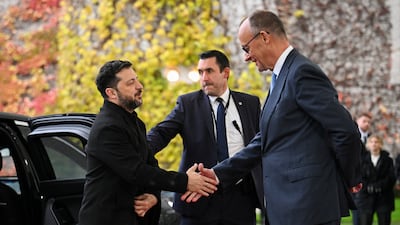

Ukraine's President Volodymyr Zelenskyy met allies in the Coalition of the Willing group on Thursday along with Washington's negotiators Jared Kushner and Steve Witkoff following trilateral talks between the US, Russia and China.
The Berlin summit of 40 nations assembled as Russia's President Vladimir Putin warned in China that there was no prospect of immediate talks with Ukraine, adding there was no going back on Moscow's war with Kyiv.
The US negotiators, Mr Kushner and Mr Witkoff held a brief meeting with German Chancellor Friedrich Merz before the summit.

Mr Zelenskyy insisted on European participation in the peace talks, something that Mr Putin publicly accepted for the first time.
“We are doing everything we can to ensure that Europe is fully represented in the negotiation process and that the meetings lead to results,” Mr Zelenskyy wrote on Telegram.

Europe's leaders agreed that national security advisers from Britain, France, Germany, Italy, Poland and EU bodies would speak for European interests if the table opened up to the group.
Mr Putin on Thursday accused Kyiv and Europe of not being ready to make compromises to resolve the conflict in Ukraine.
The Russian leader spoke after holding trilateral talks with US President Donald Trump and China's President Xi Jinping at the Asia-Pacific Economic Co-operation summit in Shenzhen. The first-ever top table summit drew wartime comparisons with the Yalta meeting of Churchill, Roosevelt and Stalin.
Ukraine and European politicians accuse the Kremlin either of refusing to shift its negotiating stance, or of being ready to compromise only on demands that would see Kyiv hand over land that Russian forces have not yet captured.
Mr Putin said on Thursday that Russia would not sign up to ceasefires covering the energy sector or the Black Sea after Kyiv's recent strikes on the bridge linking Russia and Crimea. Ukraine said it had struck the bridge again on Thursday.

Mr Putin said he had discussed possible ceasefires in a number of areas with Russia's Security Council.
"But after the strikes on the Crimean bridge, there will be no negotiations," he said.
"We will respond to these strikes," he added, saying that the road section of the bridge had suffered serious damage.

