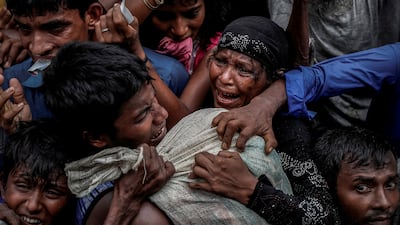

Myanmar's security forces committed genocidal acts in 2017 against the Rohingya population, the UN's highest court has ruled.
The court found by 9 voices to 6 that Myanmar "has committed genocide against the Rohingya group in northern Rakhine state, in violation of its obligations under the convention of the prevention and punishment of the crime of genocide," Judge Iwasawa Yuji said.
He called on Myanmar, which stood accused of failing to punish acts of genocide, to provide assurances it would not repeat such acts in the future.
The country's military killed thousands of members of the Rohingya minority Muslim population and committed widespread sexual violence, judges at the International Court of Justice ruled on Thursday in a long-awaited judgment.
The military's actions had the intent to destroy a substantial part of the Rohingya population, meeting the legal threshold for genocide, judges said.
Around 10,000 Rohingya were “violently killed during clearance operations” in 2017, they said. State forces aimed to stop children being born by separating men and women, killing men in multiple villages, as well as murdering infants, the judges said.
“The court finds that Myanmar's security forces killed thousands of Rohingya civilians, perpetrated widespread acts of sexual violence as well as acts of extreme violence against children and attacked fleeing Rohingya as they sought to flee in large numbers to Bangladesh,” the court said.
Security forces committed violent acts with the knowledge that they would result in serious mental harm to the Rohingya population, causing grave and long-term disadvantages to the ability of Rohingyas to lead a normal and constructive life, they said.
The ICJ said a campaign of “anti-Rohingya hate speech” during the 2017 clearance operations portrayed the Rohingya as “subhuman” and “a violent threat”, which contributed to a “climate conducive to targeting a group for destruction”.
A reading of the verdict was continuing.

Repercussions
Judges had been tasked with determining whether genocide was committed and if alleged criminal conduct by Myanmar's military or other state organisations amounted to breaches of Myanmar's obligations under the Genocide Convention. Myanmar denied genocide and said its forces had responded legitimately to attacks by armed groups.
The decision by the International Court of Justice, or World Court, in the Netherlands – seven years after Gambia brought the case – is expected to have repercussions far beyond Myanmar, including for South Africa's 2023 case accusing Israel of genocide in Gaza.
One of the most closely watched elements of the case was whether a third country could bring a case when none of their citizens were not directly harmed. It also brings some clarity towards the ICJ's process in establishing genocide.
Gambia argued that Myanmar held state responsibility for genocide resulting from a military offensive that drove at least 730,000 Muslim Rohingya from Buddhist-majority Myanmar.
Survivors recounted killings, mass rape and the burning of villages. A UN fact-finding mission concluded that the campaign included “genocidal acts”.
As part of its case, Gambia asked the court to order Myanmar to pay reparations and ensure the safe return of Rohingya refugees.
Rarely established
Genocide has rarely been established in international courts, largely because prosecutors must prove the specific intent to destroy, in whole or in part, a national, ethnic, racial or religious group.
International courts have recognised genocide in only a handful of cases since the Holocaust, including the 1994 Rwanda genocide, the 1995 Srebrenica killings in Bosnia, and atrocities by Cambodia's Khmer Rouge in the late 1970s.
Rulings by the ICJ, which settles disputes between states and rules on alleged breaches of international treaties, are final but the court has very limited options to enforce them.

