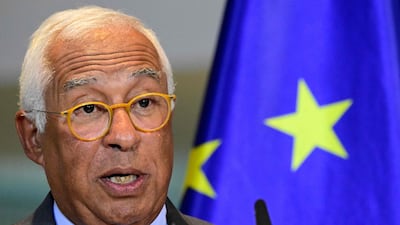

The European Union hopes to deepen security and energy relations with Gulf countries at the second leaders' summit in Riyadh next month.
Since the start of the Iran war on February 28, Europe has cast itself as a solid ally to the Gulf, despite being unable to match superior US military capabilities.
“In the current geopolitical context, there is an opportunity for deeper and more ambitious EU-GCC partnerships,” European Council President Antonio Costa said in a letter of invitation to Gulf and EU leaders dated Tuesday and seen by The National.

As the closest neighbours geographically, with long historical and cultural ties, and recognising the growing shared challenges we face, I propose that our discussions will focus on key regional issues,” Mr Costa, who will co-chair the summit with Crown Prince Mohammed Bin Salman, wrote.
He called for strengthening co-operation in priority areas such as “peace and security, connectivity, trade, economic co-operation, energy and mobility”.
European support
The Houthi-Saudi Arabia conflict escalated on Wednesday, with three people killed in attacks by the Yemeni rebels on airports in the kingdom, disrupting flights.

Following a major escalation of the Houthi offensive last month, in which the Iran-backed group seized key energy and maritime infrastructure, France and the UK – which is not an EU member – were among the first to send Riyadh military support, including fighter jet-refuelling capabilities and defence systems.
This week, Turkey and Pakistan, which signed a defence agreement with Saudi Arabia, said they would send troops. The US, historically a key Saudi ally, has been notably absent from announcements of military aid.
The physical presence of the EU's 27 leaders in Riyadh for the EU-GCC Summit on October 24 is likely to represent an important signal of support to Saudi Arabia and more widely to Gulf states affected by regional instability.
Early in the war, France and Italy sent air-defence systems to the UAE to help it fend off Iranian drone and missile attacks.
“The Riyadh summit can showcase the EU as a reliable and long-term partner to the Gulf countries and unlock shared opportunities,” Mr Costa said in the letter.

Cinzia Bianco, a research fellow on Europe and the Gulf at the European Council on Foreign Relations, told The National that Europe's backing did not mean pivoting away from the US.
“Europe can offer different things,” Ms Bianco said. “It is about a strategic partnership maturing and showing concrete defensive support is only your entrance ticket, in a way.”
The previous EU-GCC Summit took place in Brussels in 2024 and was the first since the signing of the initial EU-GCC co-operation agreement in 1989.
The EU is the second-biggest trading partner of the GCC countries: the UAE, Saudi Arabia, Bahrain, Kuwait, Oman and Qatar.
The European Commission said that over the past decade, EU-GCC trade has increased by about 30 per cent, with imports growing about 54 per cent and exports 20 per cent. The key traded good is fuel, accounting for more than 75 per cent of the EU’s imports from GCC countries.
In a joint statement issued on Wednesday, nine Southern Mediterranean EU leaders said the summit would provide an opportunity to “strengthen engagement with Gulf partners on regional peace, security and prosperity”.
“The EU should continue to work closely with Gulf partners and other partners in the region, using its diplomatic, economic, humanitarian and security instruments to support regional co-operation and peacebuilding,” they said.
Reinforcing Aspides?
Kaja Kallas, the EU's foreign affairs and security policy chief, has been pushing for months to strengthen Aspides, the bloc's defensive maritime mission.
Aspides' mandate covers a wide area including the Bab Al Mandeb strait, the Strait of Hormuz and international waters in the Red Sea. It is currently operating in the Red Sea.
“The mandate covers also Hormuz but it needs to be activated, including with more ships,” Ms Bianco said. “This is already happening, to get to the summit in Riyadh in a more credible position.”

Ms Kallas' efforts have been backed by Italy, which recently complained in a letter to her that other EU nations were not being supportive enough and suggested they contribute financially instead.
Italy and France both have one frigate deployed to the mission, which is under Greek strategic command.
Speaking last month in Brussels, Ms Kallas said the quality of vessels was as important as their number.
“For example, Aspides does not have a minehunting mandate, which means that you need frigates, you need air-defence support, you need vessels that can do the escorting of the ships,” she said.