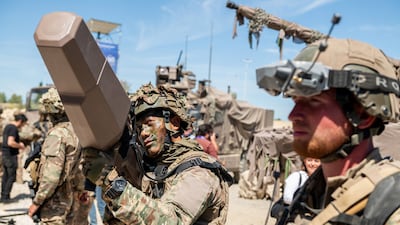

French President Emmanuel Macron's decision to send military support, including soldiers and defence systems, to Saudi Arabia in the face of Houthi attacks has triggered opposition from political parties in France, which is gearing up for presidential elections next year.
Framed as a defensive operation aimed at preserving regional stability and containing energy prices, the decision came last week after Yemen's Iran-aligned Houthis launched missile and drone attacks on Saudi Arabia's capital Riyadh and on Saudi Aramco facilities in the Red Sea city of Yanbu.
The French announcement, which came a few days after a similar decision in the UK to send air-to-air refuelling support for Saudi fighter jets, has been accompanied by little detail on its implementation.

“We maintain a close dialogue with our Saudi partner in order to refine, together, the requirements and resources needed to protect critical facilities and infrastructure,” the office of France's Chief of the Defence Staff on Wednesday told The National. “We do not comment in detail on the nature, volume, or location of the capabilities and assets that would or could be deployed.”

Far-right leader Marine Le Pen, who is favourite to become the next president, questioned Mr Macron's decision and said France does not have a mutual defence pact with Saudi Arabia similar to that with the UAE. France sent Rafale jets and air-defence systems to help the UAE after Iranian missile and drone attacks this year.
'Not the right idea'
“Saudi Arabia recently signed an agreement with Turkey and Pakistan. We're surprised that it's not Turkey and Pakistan that defending Saudi interests,” Ms Le Pen said. “Maybe the President of the Republic has other reasons that he did not wish to express publicly.”
French Foreign Minister
Echoing her arguments, her party's vice-president at the National Assembly, Sebastien Chenu, told BFM TV: “We consider that this is not the right idea, nor the right path. We should not send military personnel to this part of the world at this time.”
Turkey and Pakistan sent their military chiefs to Riyadh for diplomatic talks but have shied away from military support.
Hard-left political party France Unbowed insisted Mr Macron should allow for a debate in Parliament on the issue. They called on blocking fuel prices as prices rise amid Houthi attacks that threaten Saudi oil exports.

“Sending French troops into a war zone could very quickly make us cobelligerents – and we are not the only ones saying so – so, at the very least, there should be a discussion in Parliament,” MP Clemence Guette told France Inter. “The head of state cannot send troops into a conflict as volatile as the one currently unfolding in the Near and Middle East without a discussion taking place before the national parliament.”
The French constitution stipulates the government must inform parliament of a decision to deploy armed forces no later than three days after the start of an intervention. This may be followed by a debate. A parliamentary vote is needed if overseas operations last more than four months.
French Foreign Minister Jean-Noel Barrot insisted military support to Saudi Arabia was “strictly defensive.” “Since the start of the war in Iran, we have deployed military assets to protect our allies and partners. Were we ever considered belligerents? Never,” Mr Barrot said earlier this week.

