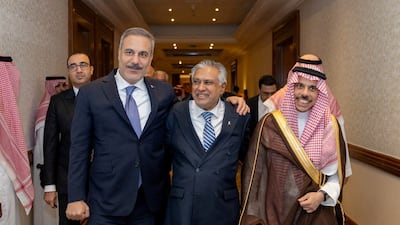

Turkey, Pakistan and Saudi Arabia have said they will ensure the “rapid deployment” of “military forces and capabilities” to help Riyadh as it confronts attacks by Iran-backed Houthi rebels.
The pledge came at an emergency meeting of ministers and military commanders from the three countries under the Makkah defence pact, a collective deterrence agreement signed in August.
“The pact has now moved much faster than expected from a declaratory collective defence framework to practical military implementation,” Deniz Karakullukcu, a foreign policy adviser at the Turkish parliament, told The National.
But agreeing to send forces is not the same as an overnight mobilisation, and Monday's pledges came alongside a commitment to uphold each country’s legislation.
Nato member Turkey is also likely to seek limits to its involvement and is reluctant to commit large numbers of troops to another country’s conflict, analysts told The National.
“I would describe this as the first real test and operationalisation of the pact but not as Turkey automatically entering the war,” Mr Karakullukcu added.
In Turkey, parliament must approve the pact before President Recep Tayyip Erdogan can ratify it. Observers expect this to happen swiftly after the reopening of parliament last week, although there is no exact timeline.
“I expect this issue to come on the parliament's agenda in the coming period,” Parliament Speaker Numan Kurtulmus told reporters in Ankara at the end of September. Parliament’s foreign affairs committee would make an announcement when the text arrived at the National Assembly in Ankara, a parliamentary media official told The National.
Approval for sending troops
On sending troops specifically, Turkey’s constitution says that in principle, parliament must approve such moves, as happened when Turkish soldiers went to Libya in 2020.
But it contains a caveat: a separate parliamentary authorisation is not needed if an international treaty to which Turkey is a party requires sending troops.
Because the text of the Makkah defence pact has not been published, Turkey’s exact obligations under the agreement remain unclear. When the pact is approved by parliament, if it provides a sufficient legal basis for sending troops, it may be that separate parliamentary approval is not required. With power over decisions on the armed forces, Mr Erdogan would then decide whether or not to send the troops.
Ankara's limits
Turkey can provide limited technical and military support before the pact is approved and ratified domestically, under various bilateral agreements with Saudi Arabia going back to the 2010s.
Nonetheless, even once the pact formally comes into force, Turkey is more likely to supply Saudi Arabia with advisory support, border defences, air and missile defence systems and intelligence sharing than it is to approve a large-scale, cross-border operation in Yemen by Turkish troops, analysts said.
“If you are asking whether Turkey is sending troops to Yemen, I say no. I am not expecting this,” Hasan Selim Ozertem, research director at Ankara-based Ussal Consultancy, told The National. “But Turkey can send troops to Saudi Arabia for its territorial defence against the threat coming from the Houthis. It's a defence pact at the end of the day. It's not an offensive pact.”
Turkish-made military systems do not necessarily require the country's armed forces for operation, Mr Karakullukcu added. “Depending on the system and the arrangement, it can be operated by Saudi personnel with training or technical support,” he said.
Sending air defence and missile systems is also strategically useful for Turkey. It is expanding a growing defence manufacturing industry that has become a pillar of its foreign policy, and new deployments allow Ankara to build a battleground reputation for domestically produced hardware.
Turkey sending high-tech equipment including drones, electronic warfare systems and military advisers “changed the dynamics on the ground", in favour of Ankara’s allies in previous conflicts in Libya, Syria and Azerbaijan, Mr Ozertem added.
Strategic considerations
Turkey is also reticent to get too involved in Yemen, analysts said. Ankara maintains trade and political relationships with Iran, which backs the Houthis against Saudi Arabia.
Alongside recent crackdowns by Turkish authorities on Iranian companies under sanctions, an overt and significant role in the Yemen conflict could increase Tehran’s suspicions about Ankara’s strategic priorities. It all places Turkey in “a delicate position”, said Murat Yesiltas, foreign policy director at the government-aligned Seta think tank.
With Saudi Arabia, “Turkey should adopt an approach of measured solidarity", Mr Yesiltas wrote in an opinion piece for the Daily Sabah newspaper. “It must provide effective defensive contributions while retaining decision-making authority over offensive operations.”
For the same reason, ministers have stressed the need for diplomacy and dialogue while acknowledging the rapid sending of military force.
Turkish Foreign Minister Hakan Fidan told state media after Monday’s emergency meeting in Riyadh that the talks covered “what kind of support could be given to Saudi Arabia's defence”, but also “what can be done to resolve the problem peacefully through dialogue".

