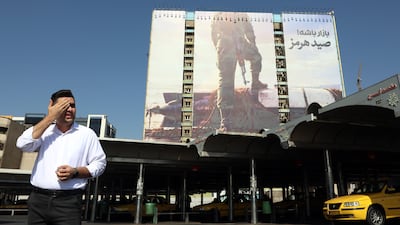

On a grey main road in central Istanbul’s Fatih district, weary-looking travellers lug large suitcases from a white coach with Iranian number plates. This is not an unusual sight in Turkey, which is connected to neighbouring Iran through trade, people and practical need.
But since the US announced wide-ranging sanctions against Iran’s aviation sector earlier this month, and the major Iranian carrier Mahan Air suspended flights to Turkey, more and more passengers have been forced to make the 2,400km trip from Tehran to Istanbul by road instead. Turkish carriers including Pegasus and Turkish Airlines have also stopped flying to Iran.
“There were some flights available but they are constantly getting cancelled, so we decided to take the bus instead,” a woman from Tehran told The National on the pavement beside the coach.
Alongside her husband, she had travelled to Istanbul to sit the Ielts, an internationally recognised English-language proficiency exam. That test had also been cancelled in Iran due to sanctions, forcing them to make the trip to Istanbul. Door to door, they had been on the road for three days.
“We are affected by all this: the economy is terrible, and our Ielts exam was cancelled in Iran so we had to come here to take it instead,” the woman’s husband said, wearing a fleece jumper and a tired expression. “The exam is on Saturday, and we will stay here maybe a week.”
The scene in Fatih is one sign of the disruption brought about since the US vowed to shut down Iran’s aviation sector earlier this month as part of Operation Economic Outcast, a renewed sanctions push against Tehran.
While flight data this week showed some flights on small Iranian airlines still operating into Istanbul, some countries, such as the UAE, Azerbaijan and Oman, have stopped services from Iran altogether. Footage circulating on Iranian social media this week showed a pilot telling passengers aboard a plane from Tehran to Dushanbe, the capital of Tajikistan, that the service was cancelled after Turkmenistan denied overflight permissions.
Economic and social isolation
Tehran will continue to find ways around US sanctions, but they will cause normal Iranians in the country of 90 million people to become increasingly cut off from the world, Iranians interviewed by The National believe.
One man speaking from Tehran used to travel frequently to the Omani capital Muscat for work. But now he does not know when he will travel again.
“Iran has become totally isolated,” he said via messaging app, speaking anonymously to avoid reprisals for speaking to foreign media. “I wanted to go [to Muscat] this coming week but now I can’t go any more. I could maybe go via Turkey [via land]. I haven’t really thought about it, but for now I’m not going.”
Coach tickets for travellers to Turkey have become more expensive as a result of both higher demand prompted by flight cancellations and higher petrol prices brought about by the war, said Arqavan, an Iranian worker at Alborz Turizm ticketing agency in Istanbul.

A seat on a coach to Tehran that previously cost 1,500 Turkish lira has increased by a third to 2,000 lira ($41). The monthly minimum wage in Iran is 16.6 million tomans, around $71.
“It’s not to exploit the travellers, but the petrol prices have also increased, so the tickets have become more expensive,” Arqavan told The National.
While flight cancellations are prompting passengers who have to travel to take the land route instead, she was overall seeing fewer Iranians coming to Turkey for leisure. The country typically attracts millions of Iranian tourists every year, who visit cities such as Istanbul to shop and buy Western products unavailable at home.
Another Iranian coach passenger said he always travelled by road regardless of the status of flights because it was cheaper, but still railed against the sanctions on his country.
“The US has no right to place us under embargo or attack us,” said the 26-year-old from Iran’s East Azerbaijan province. “They oppress Iranian people.”
Already struggling with a years-long economic crisis, Iranians' access to affordable food, medicine and other essentials has worsened as a result of the US blockade on Iran’s southern seaports, Iranian businesspeople have said.
Some Iranians believe that Washington's aim in also cutting off Iran’s air routes is to foment a popular uprising against the regime in Tehran, as it struggles to provide for a population exhausted by isolation and economic strain.
“The US is clearly sanctioning aviation to put higher pressure on ordinary people to provoke them to rise up against the establishment,” Danial Rahmat, a Tehran-based observer of Iran's political economy told The National.
“Millions of Iranians living abroad will lose their access to their families, properties and homeland. This will definitely harm people in different ways. Participation in scientific, sports and cultural activities for ordinary Iranians will become even harder.”

In January, security forces killed thousands of people in a matter of days after protests sparked by a sharp drop in the value of the rial, the Iranian currency, human rights organisations based outside the country said. Since then, the war, a polarising domestic political environment and a crackdown on dissent have kept anti-government protesters off the streets.
The US Treasury says its aim is an “economic onslaught” to sever the regime's lifelines, “until Tehran stands alone”. The Iranian regime is not unharmed by additional US sanctions. But it finds ways around them through “bypassing methods”, Mr Rahmat said, although it “takes some time to find and sustain the best ways to reduce their [sanctions'] consequences”.
Flight cancellations have been prompted by the sanctioning of not only airlines but also foreign businesses, including ground handling agents who assisted Iranian planes in landing at airports such as Istanbul. This month the US Treasury sanctioned Istanbul's S Sistem Logistics Services and MES Cargo over alleged links to Mahan Air. In a statement, S Sistem denied the US allegations that it had co-ordinated shipments, including drone components destined for Iran, on behalf of Mahan Air.
Banking blocked
Further north in Istanbul, another scene tells of the impact of US sanctions, and how countries choose to enforce them.
Earlier this month, Turkey’s BDDK banking watchdog revoked the operating licence of the partially state-owned Iranian lender Bank Mellat, which is heavily sanctioned by the US, EU and Gulf over links to Iran’s Islamic Revolutionary Guard Corps (IRGC) and nuclear proliferation.
Turkish authorities did not cite US sanctions in their decision. But the move came after Washington sanctioned another bank, Istanbul's Golden Globe Investment Bank, and two subsidiaries, over allegedly assisting in the transfer of oil revenue from China.
Washington said the move “severed the Iranian regime’s critical financial lifelines” in Turkey. Golden Globe denied the allegations in a statement on its website.

This week, Bank Mellat’s Istanbul branch, which opened in 1982 and sits alongside a Hyatt hotel and an office furniture shop in the Levent commercial district, was open only for staff to go through paperwork, according to a person familiar with the situation interviewed by The National.
“We are assessing the liabilities and the assets of the bank for the liquidation process, and we have no timeline for how long this will take,” the person said, speaking on condition of anonymity.
Mr Rahmat said the bank’s operations in Turkey were relatively insignificant in terms of Iran’s overall financial transactions. Another Tehran source, a businessman involved in raw materials imports, said that US sanctions on the financial sector had been only somewhat effective in curbing Iran’s ability to bypass sanctions, mostly via sanctions against currency traders.
“In practice, they [the US] have been able to stop a part of Iran's sanctions workarounds, which involved moving money through other countries, and they've managed to stop it to a certain extent,” the businessman said, speaking on condition of anonymity. “But in practice, I don't think they can stop it completely, because there are so many different countries, and there are a lot of different small and medium-sized currency traders.”
The UAE Central Bank this week barred Bank Melli Iran, the country’s largest lender, from conducting any financial transactions between its UAE branches and Iran after investigations found the Tehran entity had failed to comply with anti-money laundering regulations.
Turkey's ties with both Iran and the West
Despite the closures and stoppages of Iranian activity in Turkey that dovetail with a renewed US sanctions push, Ankara retains trade and diplomatic ties with Tehran.
Bilateral trade for the year to date stands at $3.8 billion, according to Turkish data, and Iranians are among the top foreign purchasers of property in Turkey, alongside Russians and Ukrainians.
Ankara is currently walking a fine line between maintaining its links with Iran and Western countries. It is part of the Nato alliance, and despite the geographical distance, Turkey’s trade with the US alone is many times greater than its business with Iran.
The US is also at pains to show that its sanctions against Iran-linked companies in Turkey are squarely aimed at squeezing Iran, not Turkey. Relations between the two countries have improved since the start of Donald Trump’s second term, in part thanks to the US leader's close relationship with President Recep Tayyip Erdogan.
As the US issued the sanctions on Golden Globe Investment Bank, the US ambassador to Turkey Tom Barrack said it would be a “serious error” to view the “narrow measure as a judgment on Turkey.” The health of the Turkish financial system “is not in question; the conduct of one institution was”, he added in the long statement.
managing partner, Herdem Law
For Turkish firms, sanctions exposure depends more on who firms are dealing with and less on their Turkish incorporation, Simge Kilic, managing partner at Herdem, an Istanbul firm focusing on international trade compliance, wrote in a recent briefing note. But “further designations touching Turkish firms with ties to Mahan Air, the IRGC, or shadow banking networks should be treated as a matter of when, not if”, she wrote.
Back at the Alborz Turizm ticketing office in Istanbul, saleswoman Arqavan expects even fewer passengers if the war continues and the economic crisis grips Iranians ever tighter.
“I think if the situation continues like this, tourism numbers will fall even more,” Arqavan continued. “Because when the petrol price becomes more expensive, so do the [bus] ticket prices, so even fewer people will come.”

