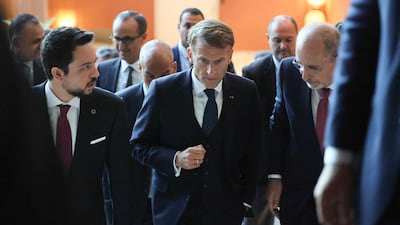

Crown Prince Hussein of Jordan joined a European leaders' meeting on Wednesday in Croatia to discuss the energy crisis caused by Iran.
Leaders of the MED9 group – Croatia, Cyprus, France, Greece, Italy, Malta, Portugal, Slovenia and Spain – were searching for a response to moves blocking the Strait of Hormuz and the prospect of Houthi forces restricting maritime passage in the Red Sea.
The working lunch was devoted to the crises in the Middle East. “Acting on energy prices and securing our supplies, working towards stability in the Middle East, preparing for the next European Council: these are all the stakes of the summit of Mediterranean countries of the European Union gathered in Croatia,” said Mr Macron.

“We are building together the future of Europe and the Mediterranean, to invest in our competitiveness and strengthen our sovereignty, while protecting our natural spaces.”
Attendees included European Commission President Ursula von der Leyen, European Council president Antonio Costa and Albert II of Monaco.
“The priority, within a Mediterranean framework, is to discuss all contacts with the US President and Iranian authorities in order to foster a resolution to the crisis and contribute to stability and security in the region, as well as to [maritime] transit,” an adviser to Mr Macron said before the meeting.

High transport costs
Faced with mounting discontent in Europe over high fuel prices caused by tensions over maritime routes in the Gulf, some European heads of state, including Mr Macron and Italy's Giorgia Meloni, are expected to lobby EU institutions for extra spending.
The G7 group of nations recently announced 100 million barrels of oil and diesel would be released to ease prices. Speaking last week, Mr Macron, who currently heads the G7, said routes were opening up slowly but that transport costs remained high.
Yemen's Houthi rebels on Monday secured control of the Bab Al Mandeb strait, the Dhubab area overlooking the sea lane and the strategic port city of Mokha. They had previously said they would block passage to Saudi vessels. This comes months into Iran's separate blockade of the Strait of Hormuz.

European leaders are expected to continue pushing for alternative routes to Hormuz, including working on developing oil pipelines via Syria, as well as to accelerate the implementation of the Great Sea Interconnector, a planned 1,300km subsea power cable to connect Greece, Cyprus and Israel, funded in part by the EU.
Southern Mediterranean states are also particularly concerned by the implementation of new measures adopted earlier this year by the EU to discourage the arrival of illegal migrants.
Last week, the European Commission moved to strengthen EU border controls in the wake of mass arrivals this summer in the Spanish enclave of Ceuta in North Africa.
The plan, which requires the approval of member states, would strengthen the mandate of Frontex, the EU border protection agency, and give it a standing corps ready for immediate deployment.
The adviser to Mr Macron said the EU needed a new framework that addressed the exploitation of migration by third countries and also increased border protection and surveillance.
“The priority is to have a comprehensive plan” that can be discussed next week by the EU's 27 leaders at a meeting in Brussels, they said.