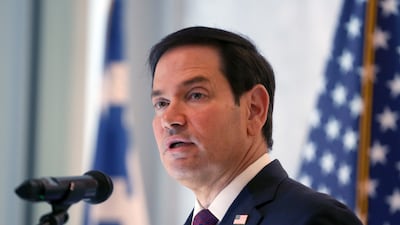
US Secretary of State Marco Rubio said on Wednesday that Iran had “lost complete control” of the Strait of Hormuz, saying oil flows through the waterway had returned to near prewar levels.
“The Strait of Hormuz is open. There’s almost as much oil flowing out now as there was before this conflict began. So they’ve lost complete control of the strait,” Mr Rubio told a press conference in Athens.
He said Iran was facing “crippling sanctions” and that its economy was in “total and complete free fall”. He predicted its economy “is about to reach a point that few countries in the world have experienced in terms of how bad it is going to get”.
The seven-day moving average for crude exports from the Gulf was 18.3 million barrels per day on September 30, compared to the average 18 million bpd that passed through the region in the 12 months before the Iran war began, according to ship-tracking firm Kpler. The figures include shipments through the Strait of Hormuz, the Red Sea and by other methods.
Mr Rubio accused Iran’s leadership of spending state revenue on Hezbollah, Hamas, Iraqi militias and the Houthis, rather than on infrastructure or improving the lives of Iranians.
“Every dollar and every penny that regime gets, they don’t spend it on roads or bridges or helping improve the lives of the Iranian people,” he said. “They spend that money on Hezbollah and Hamas, on militias that fire rockets out of Iraq and on the Houthis. That’s who they spend their money on. They should have spent their money on their people. Instead, they spend their money on terrorism and weapons.”
Brig Gen Mohammad Reza Naqdi, a senior adviser to the IRGC commander-in-chief, maintained Iran’s stance that the strait is closed and that its armed forces have “full control” over it. He said this would continue until Iran’s “legitimate demands” are met.
He added that transit routes in the strait deemed illegal by Iran would soon be closed, apparently referring to the southern route flanking Oman’s coast.
Brig Gen Naqdi said the “few routes” had been created by blasting and damaging rocky passages in the strategic waterway and were being used by “small boats smuggling oil and transferring it to tankers”, challenging the narrative that Gulf oil exports are returning to prewar levels.
US Vice President JD Vance has said Iran must make a “meaningful” reduction in its nuclear enrichment capacity to meet Washington’s demands and end the seven-month war.
Mr Vance, in an interview with Reuters, said any agreement could not rely on Iranian assurances of future nuclear drawdowns, arguing that Tehran must take concrete steps to reduce its enrichment capacity.
“If you don’t want a nuclear weapon, then why do you need 60 per cent enriched fuel?” Mr Vance said, calling it a “very basic threshold issue”.
“I think if they want to show a commitment to not building a nuclear weapon, they would do something meaningful on their enrichment capacity,” he said.
The head of the International Monetary Fund said the energy-price shock driven by the US-Iran war has been large but contained. “Even if the war in the Gulf were to end soon, the problem of high energy prices would likely persist for some time,” managing director Kristalina Georgieva said in Singapore ahead of the IMF and World Bank annual meetings.
Oil producers in the Middle East are racing to establish alternative routes to bring their exports to market. The UAE is fast-tracking construction of its West-East Pipeline, which is expected to double export capacity through Fujairah by the time its expansion is completed in 2027. Saudi Arabia has rerouted its crude through its own East-West Pipeline.
Meanwhile, Middle East refining capacity is now recovering rapidly from disruption caused by the conflict, Tom Baker, managing director for Vitol in Bahrain, said at an industry forum in Fujairah on Wednesday. About two million barrels a day of refining capacity has been knocked out in Russia, while the Middle East suffered similar issues and capacity in China has also been down, he said. “We had similar [refinery disruption] in the Middle East but it’s recovering very rapidly now,” Mr Baker said.
Iran and the US have exchanged proposals aimed at ending the war and reopening the Strait of Hormuz but US President Donald Trump rejected Tehran’s latest offer.
Mr Vance said Washington remained open to a deal but would demand concrete Iranian concessions. “We’re not going to trade words for actions,” he said.

