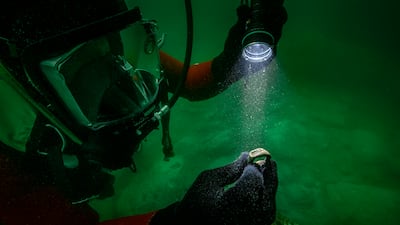

Underwater archaeologists have discovered a bronze signet ring depicting the Lighthouse of Alexandria at a submerged Egyptian palace, in what has been hailed as an important find.
The ring was found on Antirhodos, an island once part of the royal quarters in Alexandria’s Portus Magnus, or Great Harbour. The European Institute for Underwater Archaeology announced the discovery on Wednesday.
Carved into the ring is an image of the lighthouse, one of the Seven Wonders of the Ancient World.
The image is similar to those found on coins from the second century AD, although the institute did not give a firm date for the ring or details on who might have owned it.
The excavations have been led by French underwater archaeologist Franck Goddio, whose work off Egypt’s Mediterranean coast has helped bring submerged cities, temples and shipwrecks back into view.
“The discovery of the signet ring is even more important as it has been excavated in the legendary palace of the Island of Antirhodos, that once was a centre of power,” Mr Goddio said. He said it suggested the palace had housed administrative offices, including functions connected to the lighthouse.

Egypt’s Tourism and Antiquities Ministry described the find as the first known depiction of the lighthouse engraved on a signet ring.
The Lighthouse of Alexandria was completed around 280BC during the reign of Ptolemy II. Built on the island of Pharos to guide ships into the city’s harbour, it is thought to have stood more than 100 metres tall, making it one of the ancient world’s tallest structures.
A succession of earthquakes reduced it to ruins during the Middle Ages. In the late 15th century, the Mamluk sultan Qaitbay built a fortress on its site, incorporating stone from the fallen lighthouse.
The Antirhodos palace was described by the Greek geographer Strabo, who visited Egypt between 29 and 25BC.
The new find provides a clue to how the complex may have been used. Excavations on the island are revealing architectural remains across several thousand square metres which are yet to be completely examined.
Mr Goddio said excavations this year cover four sites in Alexandria’s Eastern Harbour: the temple of Isis, the palace and western mound on Antirhodos, remains of an obelisk, and the Timonium, a palace associated with Mark Antony.

Egyptian Tourism and Antiquities Minister Sherif Fathy and his assistant, Ahmed Rehema, visited the team aboard its research vessel on Monday to observe the underwater excavations and inspect the ring.
The mission is taking place in collaboration with the ministry and supported by the Hilti Foundation, which has funded Mr Goddio’s work since 1996.
After completing its current work in the Eastern Harbour, the team will begin excavations in Abu Qir Bay, the ministry said. It was there that Mr Goddio’s team located the submerged city of Thonis-Heracleion in 2000.
Excavations there have already yielded monumental statues, inscriptions and dozens of ancient vessels, offering an unusually detailed picture of a port that disappeared beneath the sea.
Among the more striking discoveries were 2,400-year-old wicker baskets that still contained doum palm fruit and grape seeds. Announced in 2021, they were found among funerary offerings, alongside imported Greek ceramics.
That year, the team also uncovered a rare Ptolemaic galley about 25 metres long. Its construction combined Greek shipbuilding techniques with features suited to navigating the Nile and its delta, including a flat bottom. Researchers said it sank when part of the nearby temple of Amun collapsed in the second century BC.
In 2023, excavations at the temple revealed silver ritual instruments, gold jewellery and fragile alabaster containers for perfumes and ointments. A Greek sanctuary dedicated to Aphrodite was also discovered nearby, containing imported bronze and ceramic objects.
In 2025, a quartz sphinx statue with the sigil of Rameses II, a granite figure and a white marble statue of a Roman nobleman were among a large haul from the area. Together, those finds have helped document the close interaction between Egyptian and Greek communities along the ancient coast. T