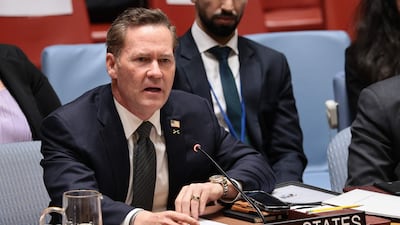

The US will push to set up an independent, multilateral body to monitor Iran sanctions, its envoy said on Thursday, after Russia and China blocked renewal of the UN panel of experts that tracked breaches.
“The United States will continue to advocate for a panel of experts while advancing an independent, multilateral panel to monitor and report on global compliance with the sanctions on Iran,” US ambassador to the UN Mike Waltz told the UN General Assembly.
“Blocking UN monitors must not block scrutiny."

Mr Waltz accused Moscow of engaging in the kind of arms transfers that independent experts would investigate.
“We know that Iran exported arms and related materiel to Russia, Venezuela under the Maduro regime, and countries in Africa,” he said. “We also have information that Russia transferred fighter aircraft and armoured vehicles to Iran in late 2025.”
There has been a fundamental dispute over whether previous UN sanctions on Iran are legally in force.
The US, Britain, France and Germany say they activated the “snapback” process under the 2015 nuclear deal last year, automatically restoring sanctions that had been lifted under the agreement.
The Security Council introduced the 1737 Sanctions Committee in 2006 to oversee sanctions imposed over Iran’s nuclear programme. The committee became inactive after the 2015 deal, known as the Joint Comprehensive Plan of Action, under which Iran accepted limits on its nuclear activities in exchange for sanctions relief.
Russia and China reject that interpretation, saying the European powers did not have the legal right to activate the process and that the previous sanctions therefore remain terminated.
The IAEA's June report said Iran remains the only non-nuclear-weapon state party to the Nuclear Non-Proliferation Treaty producing uranium enriched to 60 per cent purity.
Restrictions on IAEA inspections have made it increasingly difficult for the UN nuclear watchdog to determine the status and scope of Iran’s nuclear activities. In July, the UN watchdog said it had lost its ability to fully monitor Iran's nuclear programme.
Moscow’s UN ambassador Vasily Nebenzya said Russia will continue to oppose western efforts at the Security Council to reimpose sanctions on Iran through the snapback process.
Mr Nebenzya defended Russia’s veto of the US-drafted Security Council resolution that sought to extend the mandate of a panel of experts linked to sanctions on Iran.
He said Moscow would continue to oppose an “unlawful and reckless course", as diplomacy was the only way to address concerns over Iran’s nuclear programme and tension in the Gulf.
“Only negotiations on an equal footing, taking into account the interests of all parties as well as Iran’s legitimate rights, can both dispel any suspicions regarding Iran’s nuclear programme and resolve the current deplorable situation in the Gulf region,” Mr Nebenzya said.

