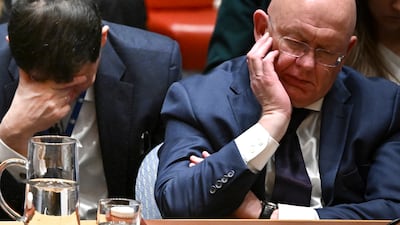

Elected members of the UN Security Council and countries set to join it next year voiced alarm on Wednesday over an eight-month deadlock over leadership of its subsidiary bodies, led by a dispute over who should lead its Iran sanctions committee.
The council has yet to agree on leaders and deputy leaders for its committees for 2026, the 10 elected members and five incoming countries said in a joint statement.
“This is the longest delay in the council's history and an unprecedented situation that undermines the effectiveness, credibility and institutional integrity of the Security Council,” they said.

The deadlock is linked to a dispute over who should lead the council's Iran sanctions committee and a wider disagreement over the reimposition of UN sanctions on Tehran through the so-called snapback mechanism, Shamala Kandiah Thompson, executive director of Security Council Report, told council members.
The snapback mechanism was included in the 2015 nuclear agreement between Iran and world powers, which was signed in 2015 and linked the dropping of sanctions against Tehran with concessions with its nuclear programme.
The group said the impasse had disrupted work, delayed decisions and weakened engagement with the wider UN membership. Successive monthly council presidents have assumed caretaker responsibilities since January to keep urgent business moving.
The statement did not identify which council member was blocking consensus but called on “those who continue to withhold agreement” to show greater flexibility and political will.
Russia’s UN envoy Vasily Nebenzya accused western council members of refusing to reconsider sanctions regimes that Moscow argued no longer reflect conditions in Iran.
Mr Nebenzya said sanctions imposed on North Korea, Sudan, South Sudan and the Central African Republic had become a “favourite instrument of foreign policy pressure” for some countries, despite what he described as the declining relevance of the reasons they were originally imposed.
Daniel Forti, head of UN affairs at the International Crisis Group, told The National: "Russia (with implicit support from China) is retaliating against the rest of the Security Council for last year's decision to reimpose sanctions on Iran.
"They have shown no interest in potential compromises crafted by the elected members.
“By convening today's press conference, the elected members used one of the few levers they have left to raise the pressure on Russia and China. No amount of quiet diplomacy seemed to work, so they are hoping that public diplomacy can start to shift the P2's calculations," he added.
The Security Council's subsidiary bodies include sanctions committees, working groups and others established to help implement and monitor decisions.
Sanctions committees can oversee measures such as asset freezes, travel bans and arms embargoes, and consider exemption requests and review reports from expert panels monitoring compliance.
The bodies are typically led by the council's 10 elected members, with assignments negotiated among all 15 Council members. While the five permanent members – Britain, China, France, Russia and the US – do not normally lead sanctions committees, their agreement is required for leaders to be assigned.
The elected non-permanent members of the Security Council said they had put forward balanced proposals and that the continuing deadlock reflected an absence of compromise rather than a lack of practical solutions.
Under the council's working methods, members should seek to agree on leaders of subsidiary bodies for the following year by October 1.

