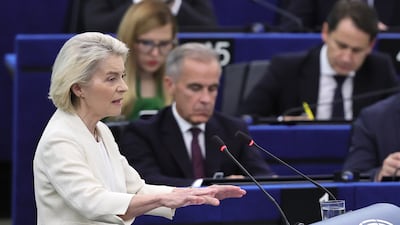

European Commission President Ursula von der Leyen on Wednesday said she deplored inaction on the deteriorating situation in Gaza and the occupied West Bank.
However, she stopped short of putting forward a proposal on banning trade with illegal Israeli settlements despite mounting pressure.
“The deep suffering in Gaza and unchecked settler violence in the West Bank have deeply affected Europeans,” Ms von der Leyen said in her annual State of the Union speech at the European Parliament in Strasbourg.

“The Israeli government’s decision to advance the illegal E1 settlement project is unacceptable. It is painful for many Europeans that member states have been unable to build the necessary majorities for a unified response.
“Some member states have moved ahead. Others are considering doing so. When Europe is divided, it cannot change the course of events,” she added.
About a dozen European Union nations support the move but opposition remains strong from Germany, Hungary and Bulgaria, among others.

Last September, Spain was the first EU country to ban trade with Israeli settlements, citing an International Court of Justice advisory issued in July 2024 which stated that Israeli occupation of land captured in the 1967 war was illegal.
This includes the West Bank, where violence by Israeli settlers against Palestinians has surged, even drawing a rare rebuke from elements of the Israeli leadership. B’Tselem, a leading Israeli rights group, said this week the country is carrying out “an elimination project” in the West Bank, aiming to dismantle Palestinian life and forcibly turn the area into a permanently Jewish-Israeli region.
European Middle East Project
Mounting pressure
Last week, in a joint move with 11 western countries led by the UK, France said it would issue a national ban on trade with Israeli settlements, citing EU inaction.
For the EU's 27 members to move together, the commission must first issue a proposal that would then have to be adopted by a qualified majority. There is no threshold for the commission to issue that proposal, which it has yet to submit for consideration.
The situation has resulted in a frustrating stalemate, says Kaja Kallas, the EU's foreign affairs and security policy chief. She recently compared Israeli illegal settlements to Russia's occupation of Crimea, an area of Ukraine with which the EU immediately stopped trading when Russian troops invaded the peninsula in 2014. Ms Kallas has repeatedly said it is up to the commission to issue a proposal for talks to move forward.
“It's like Ursula von der Leyen deeply regrets the inaction she is causing,” Martin Konecny, director of the European Middle East Project think tank in Brussels, told The National.

“It's deeply misleading for her to blame member state divisions for lack of EU action on Israel-Palestine, when she herself has been the principal block on banning trade with illegal settlements.”
In her speech, Ms von der Leyen referred to proposals she put forward last year, highlighting that EU countries have yet to adopt them. The proposals, which included imposing sanctions on extremist Israeli ministers and partially suspending trade relations with Israel, were shelved after the US brokered a ceasefire in Gaza last October.
Unlike trade measures, imposing sanctions on government ministers would require unanimity.
Canada ties
Ms von der Leyen also proposed Canada becomes the first associate member of the EU, a new category of alliance designed to build ties.
She made the invitation during her address in the French city on Wednesday, with Canadian Prime Minister Mark Carney in attendance.
“In this new world, we must urgently reimagine our partnerships and build global coalitions for our resilience and democracies,” she said. “I would like to work with you on opening the door for Canada being the first associate member of the European Union.”
Canada this month signed up on the UK-led initiative to ban trade with Israeli settlements. The collective declared its intention to “introduce national and/or support European restrictions on trade in goods with settlements”.

